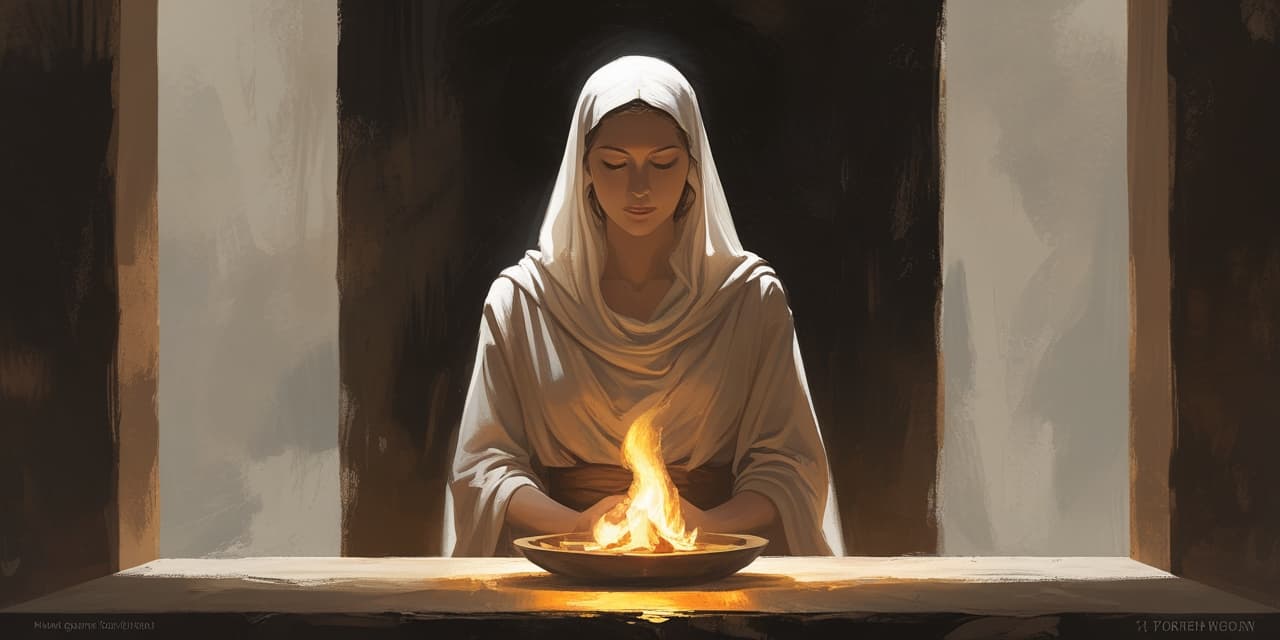
Keeper of the Sacred Flame
Hestia is the gentle goddess of the hearth, home, and family — the quiet center of both household and city. The firstborn child of the Titans Cronus and Rhea, she is the eldest sibling of Zeus, Hera, Poseidon, Hades, and Demeter.
Her name simply means "hearth" — she is at once the goddess and the thing itself, the living fire at the heart of every home. Every household fire and every city's central flame belonged to her, and a portion of every sacrifice was offered to her first. The Romans honored her as Vesta, tended by the famous Vestal Virgins.
A sworn virgin goddess, Hestia rejected the courtships of Poseidon and Apollo and asked Zeus to let her remain unwed. In some lists she yields her seat among the Olympians to Dionysus, choosing the hearth over the throne — fitting for a goddess defined by stillness rather than spectacle.
The City's Hearth
Every Greek city maintained a public hearth, the prytaneion, where Hestia's flame burned without interruption; when colonists founded a new city, they carried an ember from the mother city's hearth to kindle their own, binding the new settlement to the old. Public prayers and sacrifices traditionally opened and closed with an offering to her — a custom remembered in the old Greek saying "Hestia first, Hestia last" (source: Britannica).
Rome preserved her cult in an even more famous form. As Vesta, her sacred fire was tended in the Roman Forum for centuries by the Vestal Virgins, priestesses sworn to chastity under penalty of death, and its accidental extinguishing was treated as a grave omen for the entire state.
Symbols & Worship
- The hearth fire — never allowed to go out, in home or city
- The kettle — symbol of household provision and hospitality
- The prytaneion — each city's communal hearth, its civic heart
- First and last offerings — every sacrifice opened and closed in her honor
- The Vestal Virgins — her Roman priestesses, sworn to chastity
Common Questions
Why does Hestia have so few myths?
As goddess of the steady, unchanging hearth, Hestia rarely left Olympus or entered into conflict, so she features in few dramatic stories. Her importance lay in constant daily worship rather than mythological adventure.
Was Hestia one of the twelve Olympians?
She is traditionally counted among them, though some lists replace her with Dionysus. Ancient sources say she gave up her seat to keep the hearth-fire burning, an act that fit her self-effacing nature.
Did Hestia have any temples of her own?
Hestia had few grand temples compared to other gods, since every hearth in every home and every city's prytaneion already served as her shrine. Her worship was constant and domestic rather than centered on a single famous sanctuary.

