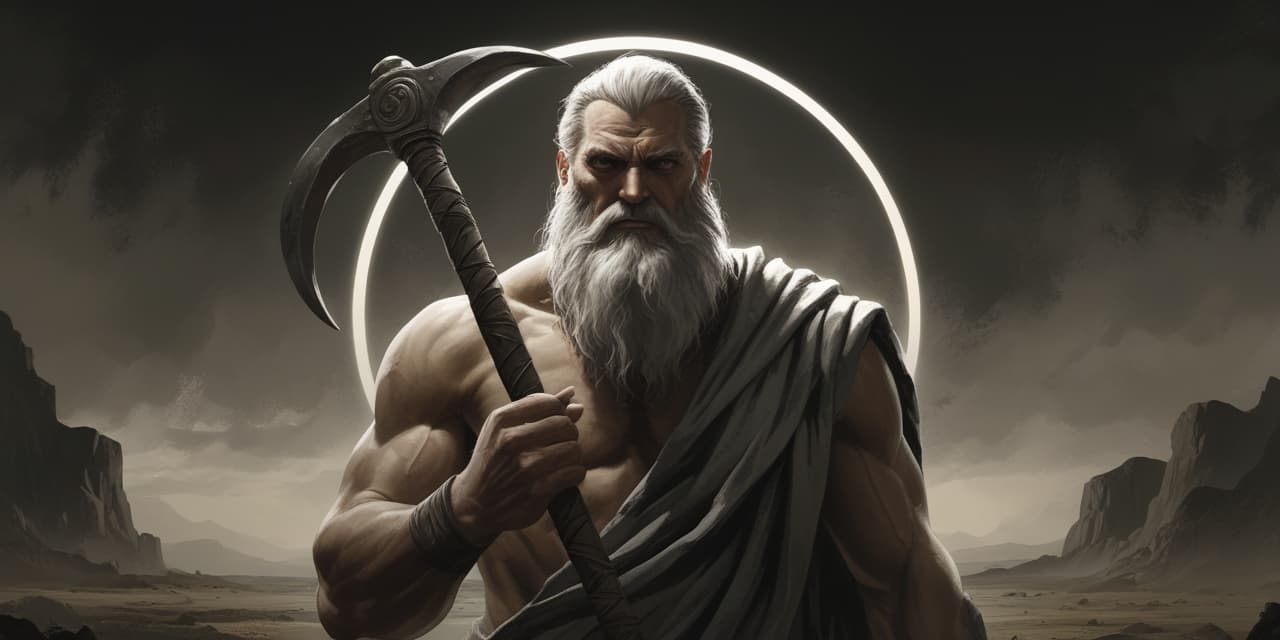
The Titan Who Devoured His Children
Cronus was the youngest of the twelve Titans and the leader who overthrew their father, Uranus. At his mother Gaia's urging, he ambushed Uranus with a great sickle, castrated him, and seized the throne of the cosmos. His reign was remembered as a golden age — a time without toil, law, or death — yet it was founded on violence and shadowed by a curse.
The name Kronos is of uncertain origin and was deliberately confused by later writers with Chronos, the personification of Time, which is why he is often shown as an old man with a scythe (the model for Father Time). His Roman counterpart, Saturn, gave his name to the planet and to Saturday.
The Prophecy and the Stone
Warned that one of his own children would overthrow him just as he had overthrown Uranus, Cronus swallowed each child that his sister-wife Rhea bore: Hestia, Demeter, Hera, Hades, and Poseidon. When the sixth child came, Rhea hid him in Crete and handed Cronus a stone wrapped in swaddling clothes, which he swallowed whole. That child was Zeus.
Grown to manhood, Zeus forced Cronus to disgorge his siblings, then led them in the ten-year Titanomachy. Defeated, Cronus and most of the Titans were cast into Tartarus — though some traditions later made him a peaceful king of the Isles of the Blessed.
The Titan Dynasty
- Uranus — his father, the primordial sky, whom he overthrew and castrated
- Gaia — his mother, the Earth, who urged the rebellion against Uranus
- Rhea — his sister and wife, who saved Zeus by tricking him with a swaddled stone
- Zeus, Hera, Poseidon, Hades, Demeter, Hestia — his six children, five of whom he swallowed at birth
- Saturn — his Roman counterpart, honored with the midwinter festival of Saturnalia
The "Golden Age" Cronus ruled over was remembered by the poet Hesiod as a time when mortals lived like gods, free from toil, old age, and sorrow — a memory later echoed in the Roman festival of Saturnalia, a topsy-turvy midwinter holiday of feasting and role reversal held in his Roman guise as Saturn. As leader of the elder generation, Cronus and the defeated Titans stand in direct opposition to his son Zeus and the ruling Olympians, a conflict recorded most fully in Hesiod's Theogony.
Common Questions
Is Cronus the same as Father Time?
Not originally. Cronus (Kronos) was the Titan king; Chronos was a separate personification of time. Their similar names led ancient and later writers to merge them, which is why Cronus is depicted with a scythe and aged appearance — the image we now know as Father Time.
Why did Cronus eat his children?
A prophecy warned that one of his children would overthrow him, just as he had overthrown his own father Uranus. To prevent it, Cronus swallowed each newborn — until Rhea saved Zeus, who grew up to fulfill the prophecy anyway.
What was the Golden Age of Cronus?
According to Hesiod, it was the first and best age of humanity, a time under Cronus's rule when people lived without toil, war, disease, or old age, and the earth provided food freely. The memory of this lost age survived into Roman religion as Saturnalia, a festival of feasting and reversed social roles held in Cronus's Roman identity as Saturn.

