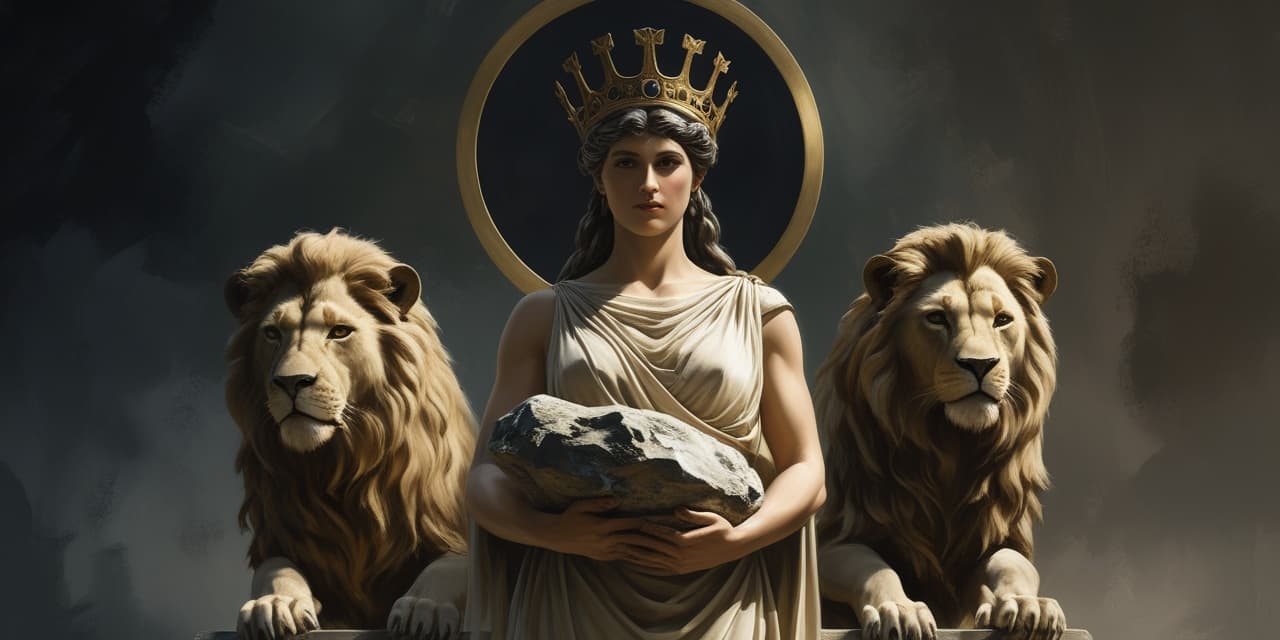
The Mother Who Saved the Gods
Rhea was a Titaness, sister and wife of Cronus, and the mother of the first generation of Olympians. Where Cronus is remembered for devouring, Rhea is remembered for rescuing — it was her cunning that preserved the child who would topple the Titans and remake the cosmos.
The meaning of her name is debated; ancient writers linked it to rheo, "to flow," casting her as a goddess of flowing things — streams, generations, the ease of birth. Later Greeks identified her with the Anatolian mother-goddess Cybele, the "Great Mother," and the Romans called her Ops, goddess of plenty.
The Trick at Crete
Cronus, fearing the prophecy that a child would overthrow him, swallowed each of Rhea's babies at birth. After losing five — Hestia, Demeter, Hera, Hades, and Poseidon — Rhea could bear it no longer. When Zeus was born, she fled to Crete, hid the infant in a cave on Mount Ida, and gave Cronus a stone wrapped in swaddling clothes to swallow in his place.
Zeus was raised in secret until he was strong enough to confront his father. When he returned, it was Rhea — in some versions — who helped administer the emetic that made Cronus disgorge his swallowed children, freeing Zeus's siblings to join the war against the Titans.
To keep Cronus from hearing his infant son's cries, Rhea enlisted the Kouretes (also called Corybantes), armored spirits who danced and clashed their spears against their shields outside the Cretan cave, drowning out the baby's wails. Some traditions place the cave on Mount Ida, others on Mount Dikte, and both mountains became major cult sites tied to Rhea and, later, to Zeus's own infancy (source: Theoi.com).
Her later identification with the Anatolian goddess Cybele brought a very different religious character to Rhea's cult — ecstatic music, drums, and lions, served by priests called Galli. This mystery-cult version of Rhea, sometimes called the Great Mother of the Gods, was formally imported to Rome in 204 BCE during the Second Punic War on the advice of an oracle.
Symbols & Associations
- The lion — sacred animal, often shown drawing her chariot
- The throne — emblem of her queenship among the Titans
- The drum (tympanon) — instrument of her ecstatic later cult as Cybele
- The swaddled stone — the trick object she gave Cronus in place of Zeus
- Mount Ida & Mount Dikte — the Cretan mountains linked to Zeus's hidden infancy
Mother of the Olympians; the cunning rescuer who outwitted Cronus to save Zeus.
The "Great Mother" of mountains and wild beasts, identified with Rhea and worshipped with ecstatic rites.
Goddess of abundance and harvest, Rhea's Roman counterpart and consort of Saturn.
Common Questions
Who were Rhea's children?
Rhea and Cronus were the parents of the six elder Olympians: Hestia, Demeter, Hera, Hades, Poseidon, and Zeus. Five were swallowed by Cronus at birth; Rhea saved Zeus, who later freed the others.
Is Rhea the same as Gaia?
No. Gaia is the primordial Earth and Rhea's mother. Rhea is a Titaness of the next generation. The two are sometimes blurred as "mother goddesses," but mythologically they are distinct: Gaia is Rhea's parent, and Rhea is the mother of the Olympians.
Why is Rhea linked to Cybele?
Greek writers identified Rhea with Cybele, the Anatolian "Great Mother" goddess, because both were powerful mother-deities associated with mountains, lions, and fertility. This composite Rhea-Cybele was later formally imported into Roman religion as the Magna Mater.

