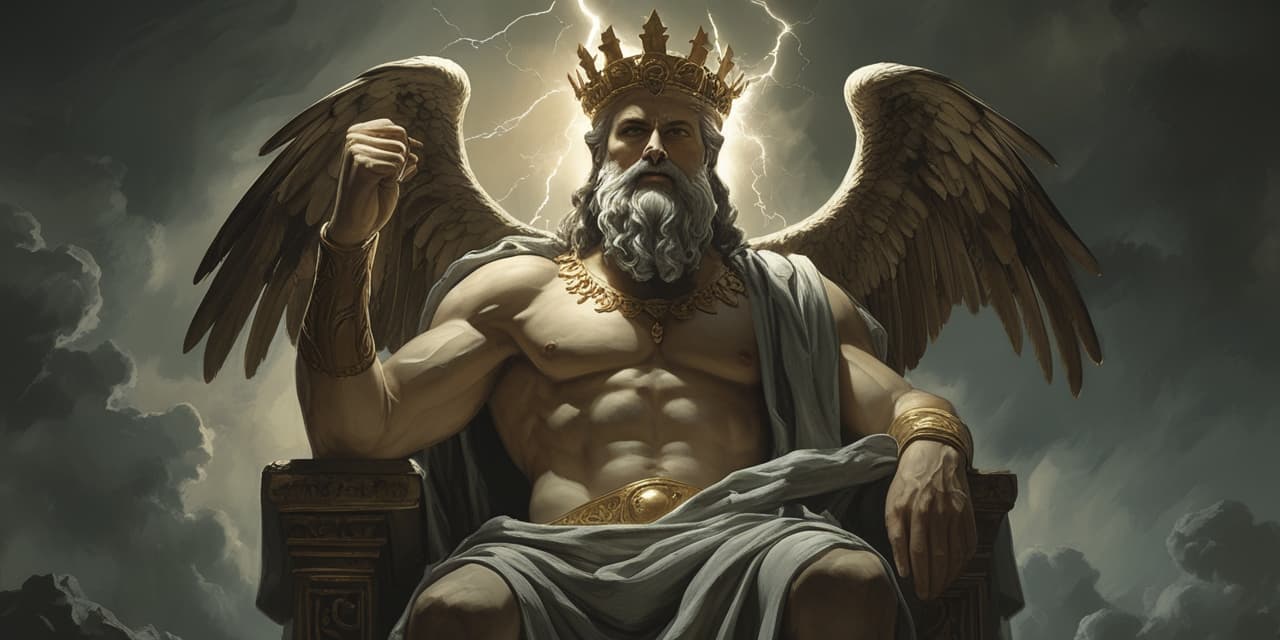
King of the Gods
Zeus is the king of the Olympian gods, ruler of the sky, and wielder of the thunderbolt. He commands gods and mortals alike, sends storms and rain, and enforces the cosmic order — punishing oath-breakers and protecting the sacred bond of hospitality (xenia). Yet even Zeus cannot override the Fates. The most powerful being in the cosmos is still bound by what is fated, one of the defining limits of Greek mythology.
His symbols are the thunderbolt, the eagle, and the oak. He is the brother of Poseidon and Hades, and husband of Hera.
The Name
Zeus comes from the Proto-Indo-European root *dyew-, meaning "sky" or "to shine" — the same root behind Latin deus (god), dies (day), and the Roman sky-god Jupiter. In the oldest layers of Greek religion, Zeus was not merely named after the sky; he was the sky, the thunder, and the clearing after a storm.
The Son Who Survived
Zeus was the youngest child of the Titans Kronos and Rhea. Warned that his own child would overthrow him, Kronos swallowed each baby at birth. When Zeus was born, Rhea hid him in Crete and handed Kronos a stone wrapped in swaddling clothes, which he swallowed instead. Raised in secret, Zeus returned as an adult, forced Kronos to disgorge his siblings, and led the Olympians to victory in the ten-year Titanomachy — armed with thunderbolts forged by the Cyclopes.
Afterward, Zeus and his brothers drew lots to divide the cosmos: Zeus took the sky, Poseidon the sea, and Hades the underworld, with the earth left as common ground. Because the sky is above all, Zeus's portion made him sovereign over the rest.
A King, Not an Autocrat
Zeus appears in nearly every major Greek myth, but he is no simple tyrant. He holds assemblies, listens to other gods, and is sometimes deceived — Hera manipulates him more than once in the Iliad. His many unions with mortal women serve a narrative purpose too: they explain the superhuman heroes of legend. Heracles, Perseus, and Helen of Troy owe their stories to divine parentage, the mechanism by which divinity entered the mortal world.
Worship and Cult
Zeus's cult was Greece's most widespread. The sanctuary at Olympia hosted both his great temple — home to the sculptor Phidias's colossal gold-and-ivory cult statue, counted among the Seven Wonders of the Ancient World — and the Olympic Games held every four years in his honor. His oracle at Dodona, older than Delphi in some traditions, delivered prophecy through the rustling leaves of a sacred oak tree, one of his defining symbols (source: Britannica).
As Zeus Xenios, he personally guaranteed the sacred law of hospitality, punishing hosts and guests who broke it — a theme that runs throughout the Odyssey. As Zeus Horkios, he witnessed and enforced oaths, and as Zeus Olympios, he was worshipped as ruler of the entire pantheon of Olympians who succeeded the Titans he helped overthrow.
Titles & Epithets
- Zeus Olympios — ruler of Olympus, honored at the Olympic Games
- Zeus Xenios — guardian of hospitality and guest-friendship
- Zeus Horkios — witness and enforcer of oaths
- Zeus Ombrios — bringer of rain and storms
- Zeus Ktesios — protector of household property and stores
Common Questions
What is Zeus the god of, exactly?
Zeus is primarily the god of the sky, thunder, and lightning, but his authority extends to justice, law, hospitality (xenia), and kingship. As king of the Olympians, he governs the divine order as a whole, making him a god of cosmic rule as much as a weather deity.
What is the difference between Zeus and Jupiter?
Jupiter is Zeus's Roman equivalent — they share the same Proto-Indo-European origin and core functions of sky, thunder, and kingship. Jupiter is more formal and civic-minded, tied to Roman law, while Zeus is more adventurous and politically tangled in the dramas of gods and mortals. They are the same deity filtered through two cultures.
Where was Zeus worshipped?
His two most famous cult sites were Olympia, where the Olympic Games honored him and Phidias's giant gold-and-ivory statue stood in his temple, and Dodona, home to an oracle that interpreted the rustling of a sacred oak's leaves — among the oldest oracular sites in the Greek world.

