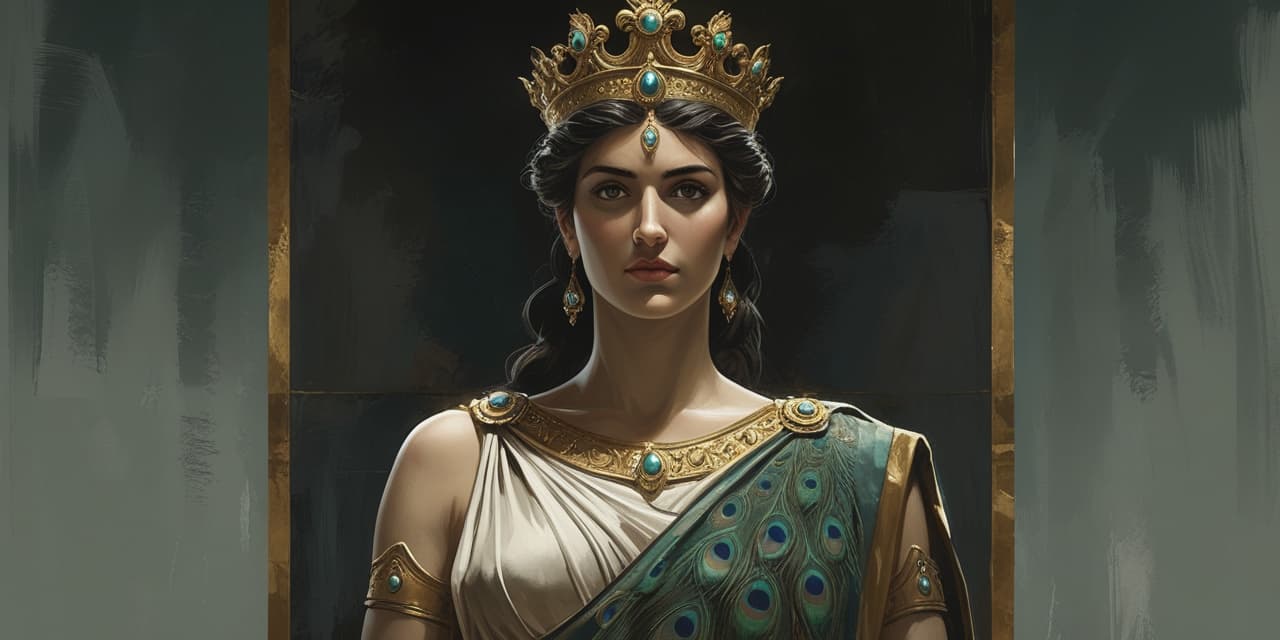
Hera

Queen of the gods; goddess of marriage and family

Pronunciation
HAIR-uh
Domain
marriage, family, women, sovereignty
Symbols
peacock, pomegranate, diadem, cuckoo
Also known as
Here, Juno
Hera, Queen of the Olympian gods, ancient Greek goddess
Hera, Queen of the Gods — Source: Crunch Learning

The Most Misread Goddess in the Pantheon

Hera has a reputation problem. Modern readers encounter her mostly through her conflicts with Zeus's mortal lovers and demigod offspring — the torment of Heracles, the persecution of Io, the enmity toward Dionysus. She comes across as vindictive, obsessive, and petty. This is an incomplete picture. Hera is the goddess of marriage, childbirth, and women's lives, worshipped across the Greek world as a protector figure of enormous power and dignity. The myths emphasize her conflicts partly because conflict makes good stories, and partly because divine jealousy was a relatable human experience.

Her name's etymology is uncertain. Proposed derivations include "mistress" or "lady" (a feminine form of heros), "protector," or a pre-Greek word of unknown origin. Like Athena, she may be older than the Greek language itself — her cult at Samos and Argos is among the oldest documented in the Greek world, predating the Olympian mythology as we know it.

Swallowed and Released

Hera was the third child of Kronos and Rhea, swallowed at birth along with Hestia, Demeter, Hades, and Poseidon. When Zeus forced Kronos to regurgitate his siblings, Hera was freed — older than Zeus in birth order, younger in the sense that she emerged second in the forced regurgitation. The myth establishes her from the start as someone who survived being consumed by her own father.

After the Titanomachy, Zeus pursued Hera for marriage. The courtship myths vary — some say she refused him repeatedly. He transformed into a shivering cuckoo to gain her sympathy; she sheltered the bird, he revealed himself, and she agreed to marry him in exchange for his promise of fidelity. She knew, going in, that the promise would be difficult to keep.

4 Children with Zeus (Ares, Hephaestus, Hebe, Eileithyia)
1 Child she bore alone (Hephaestus, in most versions)
200+ Years the Heraion sanctuary at Samos was active before the Parthenon was built

Queen, Not Just Wife

Hera's title is Queen of Olympus, and this is not a courtesy title. She is a full divine sovereign, not merely an appendage of Zeus's authority. She presides over her own council, she commands her own sphere of divine governance, and she acts independently throughout Greek mythology — sometimes with Zeus's approval, sometimes in direct defiance of him.

In the Iliad, Hera manipulates Zeus repeatedly. She borrows Aphrodite's love-charm to seduce him and put him to sleep, then uses his sleep to direct the battle in favor of the Greeks without his interference. She argues with him, outmaneuvers him, and openly defies his commands. Zeus eventually reasserts his authority through threats, but the relationship in the epic looks more like a complicated royal partnership than simple patriarchal dominance.

Her Actual Domains

Understanding Hera requires looking at what she governed in actual religious practice, not just what the myths say about her character:

  • Marriage and the sanctity of the marital bond — she was the divine guarantor of marriage vows, which is why Zeus's infidelities were so theologically significant
  • Women's lives and transitions — she presided over women's major life stages, not just marriage but childbirth, fertility, and the orderly domestic sphere
  • Childbirth (jointly with Eileithyia) — her daughter Eileithyia was goddess of childbirth, but Hera controlled whether Eileithyia attended or not; withholding Eileithyia was one of her most effective punishments
  • Queenship and sovereign power — as queen of the gods, she was the divine model for mortal queens
  • Cow symbolism and cattle — her ancient epithet boopis (ox-eyed) referred to large, beautiful eyes and was a term of high praise; cattle were sacred to her

Hera as Punisher of Zeus's Affairs

The myths of Hera's vengeance are numerous and occasionally brutal. They require some context to understand.

Heracles was Zeus's son by Alcmene. Hera tormented him from birth — sending two serpents to kill him in his cradle, driving him to the madness that caused him to kill his own family (and thus gave him his twelve labors as penance). She was his divine enemy throughout his life. And yet, at his apotheosis — when Heracles died and became a god — Hera accepted him, and he married her daughter Hebe. The enmity ended with divine reconciliation.

Io was a priestess of Hera's own temple whom Zeus transformed into a white cow to hide his affair. Hera saw through the disguise, claimed the cow, and set the hundred-eyed giant Argus to guard her. When Hermes killed Argus to free Io, Hera placed Argus's eyes in the tail of the peacock — her sacred bird. Then she sent a gadfly to torment Io across the entire world.

Hera (Greek)

Complex, sovereign, legitimately aggrieved. Her punishments often target Zeus's actions indirectly. Goddess of marriage who is in a troubled marriage.

Juno (Roman)

Hera's Roman equivalent. More civic-minded, patron of Rome itself alongside Jupiter. Her wrath drives the Aeneid's conflict.

Her Sacred Sites and Symbols

Hera's two most important sanctuaries were at Samos and Argos — both of which had active temples before Athens's Acropolis was developed. The Heraion at Samos was one of the largest temples in the ancient Greek world. Argos considered itself Hera's own city in the way Athens belonged to Athena, and the Argive Heraion hosted the Heraia, an all-women's footrace that was one of the oldest athletic festivals in Greece.

Her symbols reflect her domains:

  • The peacock — associated with the eyes of Argus and with royal display; the peacock's fan of eyes represented her all-seeing surveillance
  • The cow — ancient cattle symbolism; her epithet boopis (ox-eyed) was a compliment in ancient Greek aesthetic terms
  • The pomegranate — symbol of fertility, marriage, and the underworld (Persephone shares this symbol)
  • The diadem and scepter — her royal insignia; depictions consistently show her crowned and holding a scepter, emphasizing her queenship
  • The cuckoo — from the Zeus courtship myth; the cuckoo was her sacred bird alongside the peacock

Hera in Modern Interpretation

Modern retellings of Greek mythology have worked to rehabilitate Hera — to read her not as a petulant jealous wife but as a sovereign whose legitimate anger at her husband's constant infidelities (and at children he fathered who were then elevated above her own) was a reasonable response to a genuinely difficult situation. Her power was real. Her grievances were real. And the way she asserted herself — through persistence, through strategy, through leveraging her own divine authority — was not petty. It was the only form of agency available to her.

This is part of why Hera resonates for contemporary readers in a way she perhaps didn't for ancient ones. Her mythology is, among other things, a sustained study in what happens when a powerful woman's legitimate authority is systematically undermined by the more powerful man she's bound to.

Common Questions

What is Hera the goddess of?

Hera is the goddess of marriage, women's lives, and childbirth — as well as queen of Olympus. She presides over the institution of marriage and its sanctity, over women's major life transitions, and over the orderly domestic sphere. Her anger at Zeus's affairs is theological as much as personal: she is the divine guardian of marital fidelity, and Zeus's behavior is a constant challenge to her core domain. In actual religious practice, she was one of the most widely worshipped deities in ancient Greece, with major sanctuaries at Samos and Argos.

Why did Hera hate Heracles so much?

Heracles was the son of Zeus and a mortal woman named Alcmene — living proof of Zeus's infidelity, and a constant reminder of it. Hera's enmity toward Heracles began before his birth (she tried to prevent it by keeping Eileithyia, the goddess of childbirth, from attending) and continued throughout his life. She drove him to madness, set monsters against him, and worked against him at every turn. Paradoxically, his name may mean "glory of Hera" — some scholars think his labors were framed as service to Hera's honor. At his apotheosis, she accepted him into Olympus.

Why is the peacock sacred to Hera?

The connection comes from the myth of Io. When Hermes killed the hundred-eyed giant Argus (who was guarding Io for Hera), Hera took Argus's hundred eyes and placed them in the tail of the peacock — her sacred bird. The peacock's tail fan, covered in eye-shaped patterns, represents Argus's eyes living on in the goddess's service. The peacock also suited Hera's associations with royal display and sovereignty — no other bird is quite as regal.

Family Tree

Hera's familyHeraQueen of the gods; godde…AresEileithyiaHebeHephaestus

Siblings

ZeusPoseidondemeterhestiahades