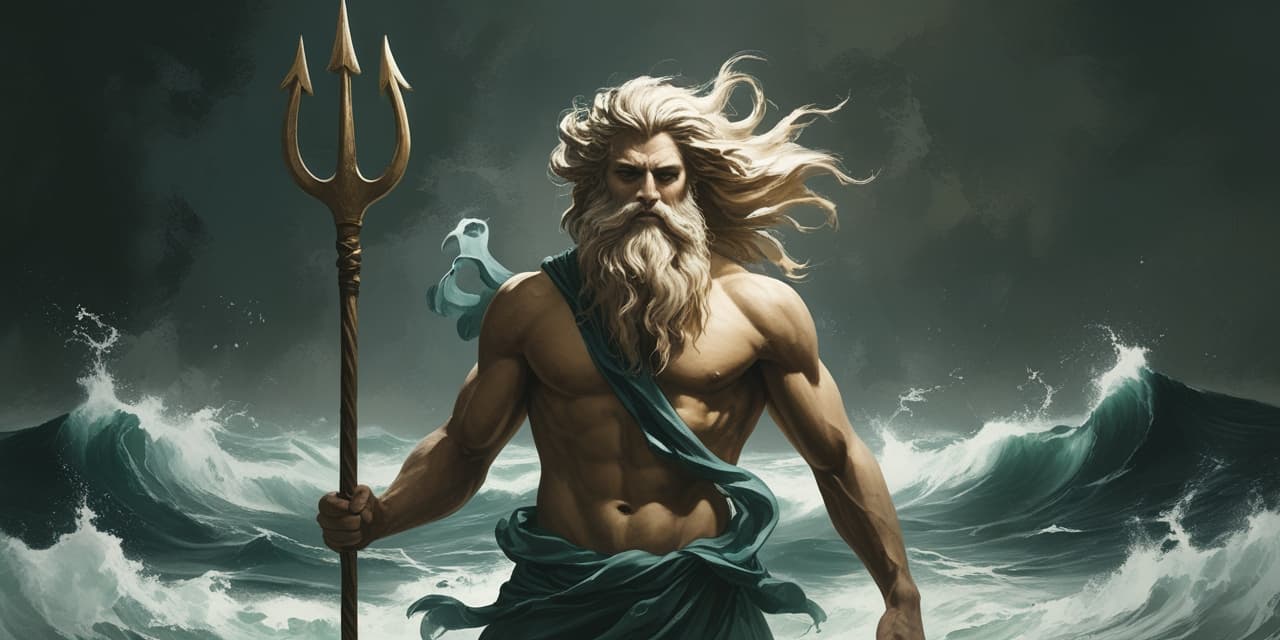
Who Poseidon Is
Poseidon is the Greek god of the sea, earthquakes, and horses — one of the twelve Olympians and one of the three sons of Cronus who divided the cosmos after the Titanomachy. When the brothers drew lots, Zeus took the sky, Hades the underworld, and Poseidon the sea, while all three shared the earth. For a seafaring civilization, his domain was vital: he granted safe voyages or wrecked ships at will, and the ancient Greeks knew him as powerful but volatile. Before Poseidon's rise, the primordial Titan Oceanus had personified the waters of the world.
His name appears in Mycenaean Linear B tablets as Po-se-da-o, making it one of the earliest attested Greek deity names. The etymology is disputed but may mean "husband of the earth" (posis + da) — a hint that he was an old earth god before the sea association, which would also explain his power over earthquakes. The Greeks called him Enosichthon, the earth-shaker, and believed a strike of his trident could split the ground.
The Contest for Athens
Poseidon and Athena competed for patronage of Attica. Each offered a gift: Poseidon struck the Acropolis and produced a saltwater spring, while Athena planted an olive tree. The Athenians chose the olive, and Athens belonged to Athena. Poseidon flooded the plain in anger — yet the city still honored him, housing the mark of his trident in the Erechtheion alongside Athena's sacred tree.
The Grudge Against Odysseus
Poseidon's myths often turn on his temper. When Odysseus blinded the Cyclops Polyphemus — Poseidon's son — and then boasted his own name, the god answered the curse with a decade of storms and blocked passage. The Odyssey is largely the story of one man outlasting a sea god's vendetta. His children reflect his raw nature: the herald Triton, the monstrous Polyphemus, and the winged horse Pegasus, born when Perseus beheaded Medusa.
Marriage and Worship
Poseidon's consort was the Nereid Amphitrite, whom he won after sending a dolphin to persuade her to marry him — the dolphin became one of his sacred symbols in gratitude. Their son Triton, part man and part fish, served as his father's herald, blowing a conch-shell trumpet to calm or rouse the waves. Poseidon was honored at major sanctuaries across the Greek world, including the dramatic clifftop temple at Cape Sounion and the Isthmian Games held near Corinth every two years in his name.
He also claimed a share of horses among his creations: in one myth he struck the earth and produced the first horse, and he was worshipped as Hippios, "of horses," patron of horsemen and chariot racing. His Roman counterpart, Neptune, absorbed most of his maritime associations but comparatively little of his link to horses and earthquakes (source: Britannica).
Titles & Epithets
- Enosichthon — "earth-shaker," his role as god of earthquakes
- Hippios — "of horses," patron of horsemen and chariots
- Pelagaios — "of the sea," his primary maritime domain
- Soter — "savior," invoked by sailors for safe voyages
- Gaieochos — "earth-holder" or "earth-embracer"
Common Questions
Why is Poseidon also the god of earthquakes?
Poseidon may originally have been an earth deity before he became a sea god — his name possibly means "husband of the earth." Even in classical religion he was called Enosichthon, the earth-shaker, as often as ruler of the sea. For a people living in an earthquake-prone land beside the sea, one god governing both moving forces made intuitive sense.
Why was Poseidon angry at Odysseus in the Odyssey?
Odysseus blinded the Cyclops Polyphemus, Poseidon's son, then shouted his real name as he escaped — letting the Cyclops curse him by name. Poseidon spent ten years making Odysseus's journey home as difficult as possible, sending storms and blocking safe passage to Ithaca.
Who was Poseidon's wife?
Poseidon's consort was Amphitrite, a Nereid (sea-nymph) whom he won over with the help of a dolphin messenger. Together they had the merman Triton, who serves as his father's herald beneath the waves.

