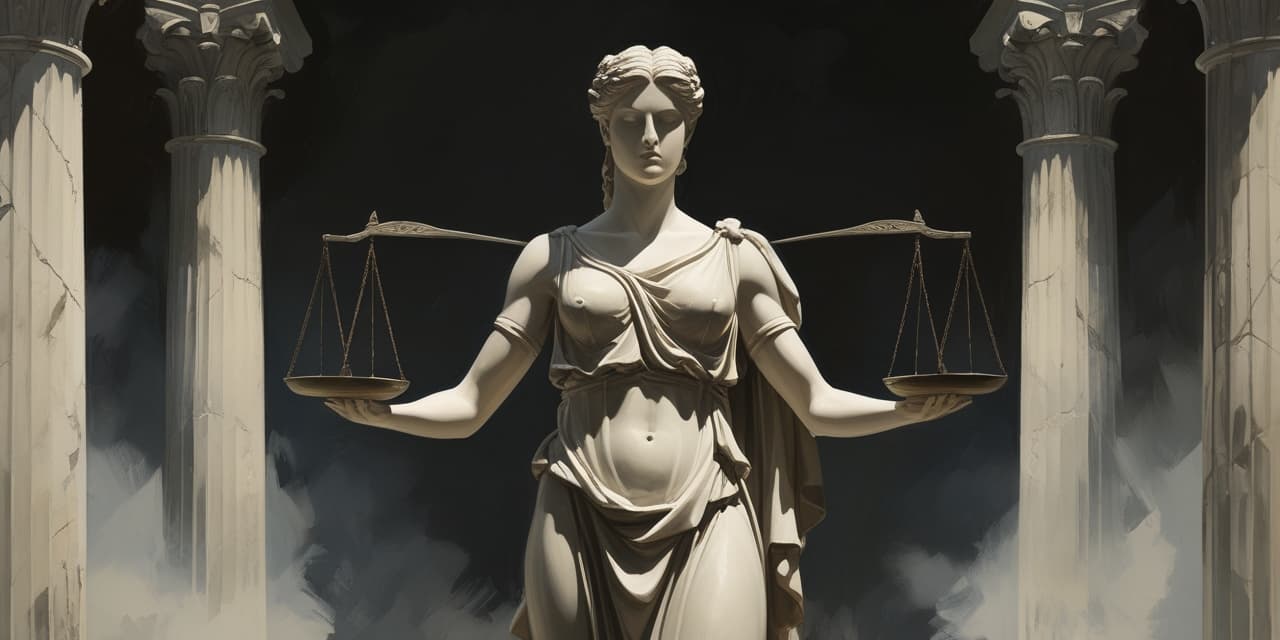
The Voice of Divine Order
Themis was a Titaness, daughter of Uranus and Gaia, who personified divine law, custom, and the right ordering of things. Where mortal courts apply written statutes, Themis stood for the deeper, unchanging order of the cosmos — the natural justice that governs gods and mortals alike. She lies behind the modern image of Justice holding scales, though the blindfold was only added in the 16th century.
Her name comes from the Greek themis, meaning "that which is laid down" — established custom, divine law, the right thing to do. The Romans knew her counterpart as Justitia, from whom we get the very word "justice."
Unlike most of her Titan brothers, Themis was welcomed into the new Olympian order. She became an early consort of Zeus and his trusted counselor, bearing him the Horae (the Seasons) and the Moirai (the Fates). She also held the oracle at Delphi before Apollo, speaking prophecy from the navel of the world.
In Aeschylus's Prometheus Bound, Themis (sometimes merged with Gaia) is portrayed as the mother of Prometheus and the source of the prophetic wisdom he later shares with Zeus — including the secret that a son born to the sea-nymph Thetis was destined to overthrow his father, a warning that led Zeus to marry Thetis to a mortal instead. According to Aeschylus's Eumenides, the Delphic oracle itself passed from Gaia to Themis, then to the Titaness Phoebe, and finally to Apollo, tracing a line of prophetic authority across three generations of deities.
As a Titaness who joined rather than opposed the new order, Themis also personified the proper convening of the gods themselves — it was she, in several accounts, who summoned the Olympians to council, since even divine assemblies required order to function.
Children of Themis
- The Horae — the Seasons, goddesses of natural order and the turning year
- The Moirai — the three Fates who spin, measure, and cut the thread of life
- Astraea — in some accounts, goddess of innocence and purity, later the constellation Virgo
- Dike — one of the Horae, personifying human justice specifically
Divine, eternal law — the cosmic order that binds even the gods.
Her daughter, the spirit of human justice and fair judgment.
Her Roman counterpart, shown on coins with scales and sword but eyes uncovered - the blindfold came much later.
Common Questions
What was Themis the goddess of?
Themis was the Titaness of divine law, order, custom, and prophecy. She represented the unchanging cosmic justice that governs both gods and mortals, distinct from the human-made laws of the courts.
Is Themis the same as Lady Justice?
The familiar figure of Lady Justice descends from Themis and her Roman counterpart Justitia. Her scales go back to antiquity, while the blindfold is a 16th-century addition that later came to stand for impartiality.
Did Themis rule the oracle at Delphi before Apollo?
According to Aeschylus's tragedy the Eumenides, the Delphic oracle passed from Gaia to Themis, then to Phoebe, before Apollo finally took it over, making Themis one of a succession of prophetic goddesses who held the site sacred to divine speech.

