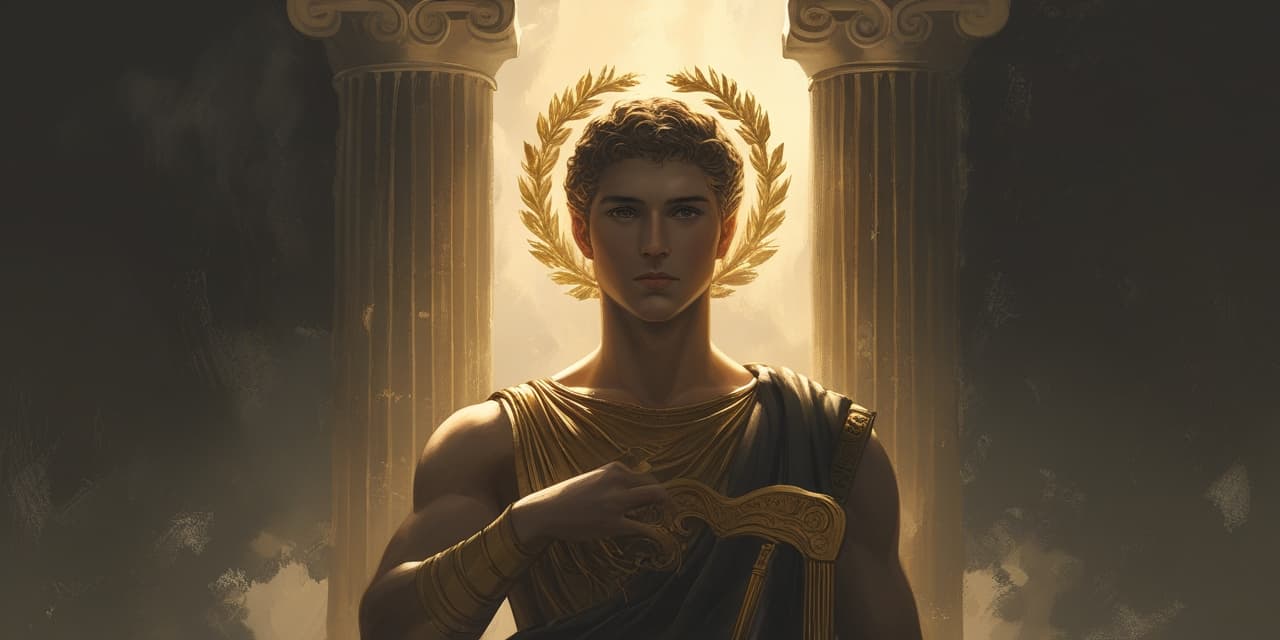
Apollo

God of light, prophecy, music, and healing

Pronunciation
uh-POL-oh
Domain
sun, prophecy, music, poetry, healing, archery
Symbols
lyre, laurel wreath, silver bow, raven, swan
Also known as
Phoebus, Apollo
Apollo, ancient Greek sculpture with the Temple of Delphi
Apollo with the Temple at Delphi — Source: The Collector

The Most Greek of All the Gods

If you had to pick one deity who embodies the Greek ideal — beauty, reason, order, artistic excellence — it would be Apollo. He is the god of the sun (in later traditions), of prophecy, of music, of poetry, of archery, of healing, and of plague. He's also the patron of rational thought. No other Olympian covers as much ground.

His name's etymology is genuinely disputed, which is unusual for a major deity. The most cited connection is to apollymi (to destroy), but this doesn't fully satisfy classicists. Other theories link it to Doric apellon (assembly), or trace the name to pre-Greek Anatolian origins. Apollo may be one of the few Olympians who arrived in Greece from outside — possibly from Lycia or from the same cultural stream that gave us the Hittite deity Appaliunas.

Born on Delos

Apollo and his twin sister Artemis were children of Zeus and the Titaness Leto. Hera, furious at Zeus's affair, prevented Leto from giving birth anywhere on solid earth. Every land refused her, afraid of Hera's wrath. Finally, the floating island of Delos accepted her — it had nothing to lose, being already adrift and barren.

Apollo was born on Delos, and the island immediately became sacred. His first act after birth was to demand a bow and arrows, which he used almost immediately to slay Python — the monstrous serpent at Delphi who had tormented his mother. He claimed the oracle at Delphi as his own. That's the myth of a god establishing his identity immediately: he arrives, he acts, he claims his domain.

9 Muses under his patronage
300+ Years the Oracle at Delphi was active
2 Twins (Apollo and Artemis)

The Oracle at Delphi

Apollo's most important institution was the Oracle at Delphi — arguably the most influential religious institution in the ancient Greek world. Cities consulted it before wars, colonies, marriages, and major decisions. Kings sent embassies with expensive gifts. The Pythia (the priestess who served as the oracle's mouthpiece) delivered cryptic prophecies that Apollo supposedly communicated through her.

The oracle's reputation rested on a feedback loop: its prophecies were ambiguous enough to be interpreted multiple ways, but when things went wrong, the failure was blamed on misinterpretation rather than the oracle itself. Croesus famously asked if he should attack Persia, and was told a great empire would fall. He attacked. A great empire fell — his own. The oracle was technically correct.

What's less often discussed is how politically sophisticated the oracle was. It consistently supported the interests of Greek city-states, promoted colonization, advised on constitutional reforms, and maintained a neutrality that made it trusted across rival polities. Whether that was divine guidance or extremely skilled human politics is left as an exercise for the reader.

Apollo's Many Domains

The breadth of Apollo's domain is what makes him so interesting as a deity — and occasionally confusing. Here's how the domains connect:

  • Light and the Sun — Apollo absorbed the solar functions of Helios in later Greek and Roman religion. As a light deity, he represents clarity, truth, and illumination in both physical and intellectual senses.
  • Prophecy — Light reveals what is hidden; prophecy reveals what is future. The connection is conceptual: Apollo is the god of truth-telling in all its forms.
  • Music and Poetry — He plays the lyre and leads the nine Muses. The arts are expressions of divine order, harmony, and beauty — all Apollonian values.
  • Healing and Plague — Apollo both sends and cures pestilence. His arrows can carry disease; his blessing can restore health. His son Asclepius became the god of medicine.
  • Archery — Silver bow, precision, distance. Apollo kills from afar, which fits his nature: he's a god of light and truth, both of which work best with clear distance and aim.

Apollonian

Order, reason, harmony, light, measured beauty. Nietzsche's term for the rational, structured impulse in art and culture.

Dionysian

Chaos, ecstasy, intoxication, darkness, raw energy. Nietzsche's counterpart — the irrational, passionate impulse.

Nietzsche famously used Apollo and Dionysus as symbols for two opposing drives in human culture and art. The framing stuck because it captures something real: Apollo and Dionysus are the two poles of Greek religious experience, and Greek culture held both in tension.

The Tragedies of Apollo

Apollo is also a god of failed love stories. Several myths involve him pursuing someone who does not want to be caught:

Daphne — Apollo fell for the nymph Daphne after being struck by Eros's arrow. She fled; her father the river god Peneus transformed her into a laurel tree just before Apollo reached her. He adopted the laurel as his sacred plant, wearing a crown of it forever. The laurel wreath that crowns Olympic champions and Roman emperors traces back to this myth of unrequited love.

Hyacinthus — Apollo loved the Spartan youth Hyacinthus deeply. Zephyrus, the west wind, was jealous. When Apollo and Hyacinthus were throwing a discus, Zephyrus blew it off course. It struck Hyacinthus and killed him. From his blood, Apollo caused the hyacinth flower to grow, inscribing it with his cries of grief (AI, AI in Greek — the sounds of lamentation).

Cassandra — Apollo gave the Trojan princess Cassandra the gift of prophecy. She refused his advances. He couldn't take back his gift, so he cursed her: she would prophecy truly, but no one would ever believe her. She predicted the fall of Troy. Nobody listened. This is one of Greek mythology's cruelest and most enduring stories.

Apollo and the Arts

Apollo's patronage of music, poetry, and the arts is as old as any of his other domains. He plays the lyre — a gift originally made by Hermes from a tortoise shell — and leads the nine Muses on Helicon and Parnassus. The Muses governed every intellectual and creative discipline the Greeks cared about.

As patron of the Muses, Apollo became the patron of culture itself. Poets invoked him at the beginning of epic poems. Musicians honored him before performances. The phrase "invoke the Muse" that opens the Iliad and Odyssey is ultimately an invocation of Apollo's domain.

This is why "Apollonian" became shorthand for everything ordered, beautiful, and rationally structured in art — because Apollo literally presided over the organized creation of beauty.

Common Questions

Is Apollo the god of the sun?

In early Greek religion, Helios was the sun god — a Titan who drove the solar chariot across the sky. Apollo was primarily a god of light, truth, and prophecy. Over time, especially in Roman religion (where he was also called Apollo), the two figures merged, and Apollo absorbed Helios's solar functions. By the Hellenistic period, Apollo and the sun were effectively synonymous in popular understanding, though scholars distinguished them.

Why is Apollo important to ancient Greek culture?

Apollo was central to Greek identity in a way few other gods were. His oracle at Delphi shaped Greek history — advising colonization efforts, constitutional reforms, and military campaigns. His patronage of the arts meant that Greek intellectual and creative life was conducted under his auspices. And his embodiment of beauty, reason, and order made him a symbol of the ideals Greeks most prized in themselves.

What is the myth of Apollo and Python?

Python was a monstrous serpent (or dragon) who guarded the oracle at Delphi — in some versions, Python had been set to guard Leto and tormented her during her pregnancy. Shortly after his birth, Apollo hunted Python down and killed it with his arrows. He then took Delphi as his own sacred site and established his oracle there. The Pythian Games (held at Delphi every four years, like a local version of the Olympics) commemorated this victory.

Family Tree

Apollo's familyApolloGod of light, prophecy, …AsclepiusOrpheus

Siblings

artemis