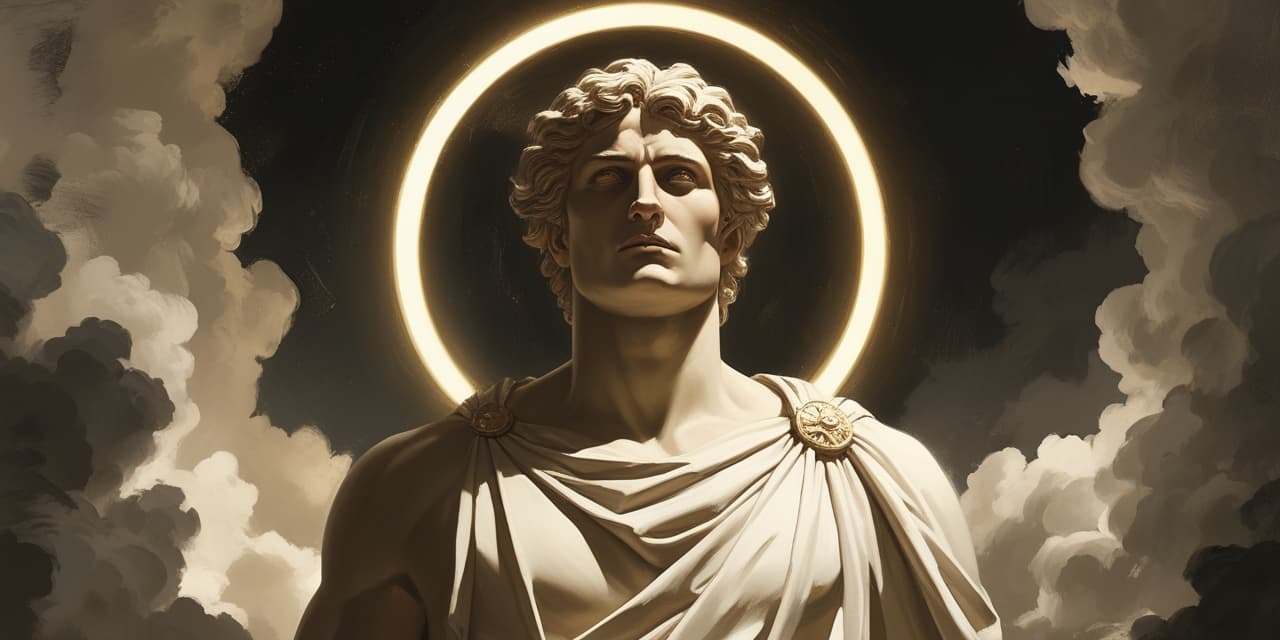
The Father of the Lights of Heaven
Hyperion was one of the twelve Titans, children of Uranus and Gaia, and the lord of heavenly light. The Greeks credited him with first observing and ordering the movement of the sun, the moon, and the dawn — the celestial rhythms that measure out the day, the month, and the year.
His name means "the high one" or "he who watches from above," from hyper ("over") and a root meaning "to go" or "to watch." With his sister-wife Theia, the Titaness of sight and shining light, he fathered the three great luminaries: Helios the sun, Selene the moon, and Eos the dawn.
Like his brothers Cronus and the other male Titans, Hyperion belonged to the generation overthrown by the Olympians. Homer sometimes uses "Hyperion" as another name for the sun itself, blurring the father into his luminous son Helios.
Hyperion fought on the Titans' side in the ten-year Titanomachy against Zeus and the Olympians. Along with most of his brothers, he was defeated and cast into Tartarus, the primordial pit described in Hesiod's Theogony as lying "as far beneath the earth as the earth is beneath the sky."
His descendants proved as significant as his own myths: his grandson Phaethon, son of Helios, begged to drive the sun-chariot for a single day and lost control of its horses, scorching the earth until Zeus struck him down with a thunderbolt — a cautionary tale about inherited power wielded beyond one's skill.
Descendants of Hyperion
- Helios — the sun, who drives a golden chariot across the sky each day
- Selene — the moon, who rises as her brother sets
- Eos — the rosy-fingered dawn, opening the gates of morning
- Phaethon — his grandson through Helios, whose reckless chariot ride scorched the earth
- Theia — his sister-consort, Titaness of sight and shining light
Titan of light who first watched and ordered the heavens.
His son, the sun-god who drives the fiery chariot across the sky each day.
His daughter, the rosy-fingered dawn who opens the gates of morning.
Common Questions
What does the name Hyperion mean?
Hyperion means "the one who watches from above" or "the high one," from the Greek hyper. It fits his role as the Titan who observed and governed the lights of heaven.
Is Hyperion the sun god?
Not exactly. Hyperion is the Titan of light and father of the sun-god Helios. Homer occasionally calls the sun "Hyperion," which is why the two are sometimes confused, but mythologically Helios is his son.
What happened to Hyperion after the Titanomachy?
Like most of the Titans who fought alongside Cronus, Hyperion was defeated by Zeus and the Olympians and cast into Tartarus. Unlike his son Helios, who continued to drive the sun across the sky in later myth, Hyperion himself largely disappears from Greek storytelling after the war.

