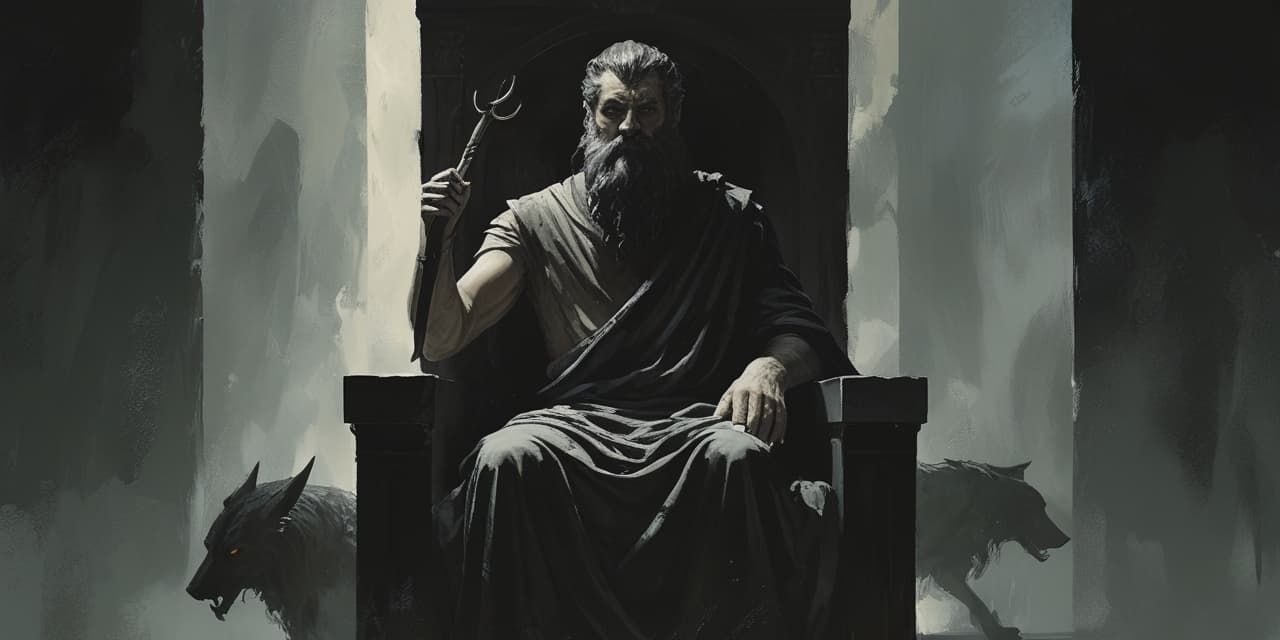
The Reluctant Lord of the Dead
Hades was the eldest son of Cronus and Rhea and brother of Zeus. When the three brothers divided the cosmos after defeating the Titans, Hades drew the underworld — the realm of the dead. He is not a god of death itself (that role belongs to Thanatos) but its ruler and warden, a stern, just, and rarely cruel king of the shades.
His name likely means "the unseen one," from a- ("not") plus a root for "to see." So feared was his name that Greeks avoided speaking it, calling him instead Plouton, "the wealthy one" — the source of the Roman name Pluto — because all the riches of the earth, its metals and crops, come from below.
The Abduction of Persephone
Hades's central myth is his marriage. Struck by desire for Persephone, daughter of Demeter, he carried her down into his realm. Demeter's grief blighted the earth until Zeus intervened. By then Persephone had eaten pomegranate seeds in the underworld, binding her to it; the compromise saw her divide the year between Hades below and her mother above — the origin of the seasons.
Beyond this, Hades appears seldom in myth. He owned the Helm of Darkness, which made its wearer invisible (loaned to heroes like Perseus), and guarded his realm with the three-headed hound Cerberus. He rarely left the underworld and rarely meddled in the affairs of the living.
Realms of the Underworld
- Asphodel Meadows — where ordinary souls wander in the afterlife
- Elysium — a paradise reserved for heroes and the especially virtuous
- Tartarus — a deep abyss of punishment, where the defeated Titans and great sinners were confined
- The River Styx — the underworld's most sacred river, by which even gods swore binding oaths
- Charon — the ferryman who carried souls across the river for a coin
Few mortals ever entered the underworld and left. The musician Orpheus descended to plead for the return of his wife Eurydice, and his song moved Hades and Persephone enough that they agreed to release her — on the condition he not look back until they reached the surface; he failed, and lost her forever. The god also punished notorious sinners directly: Sisyphus was condemned to push a boulder uphill for eternity, and Tantalus to stand hungry and thirsty just out of reach of food and water, the origin of the word "tantalize." As the brother of Zeus and one of the three sons of Cronus who divided the cosmos, Hades ranks with the Olympians in power even though, per Britannica, he does not dwell among the Twelve on the mountain itself.
Common Questions
Is Hades the Greek devil?
No. Hades is the ruler of the dead, not an evil tempter. The Greek underworld was a destination for all souls, not a place of punishment for sinners, and Hades governed it with grim impartiality. The "devil" comparison comes from later Christian framing, not Greek belief.
Why is Hades also called Pluto?
Greeks avoided his dreaded name and instead called him Plouton, "the wealth-giver," because precious metals and the crops that grow from seed both come from beneath the earth. The Romans took this title as Pluto, his most common Latin name.
What happened to Orpheus and Eurydice in the underworld?
The musician Orpheus traveled to the underworld to beg for his dead wife Eurydice's return. His music so moved Hades and Persephone that they agreed, on one condition: he could not look back at her until both had reached the surface. He looked back too soon, and Eurydice was pulled back into the underworld forever.

