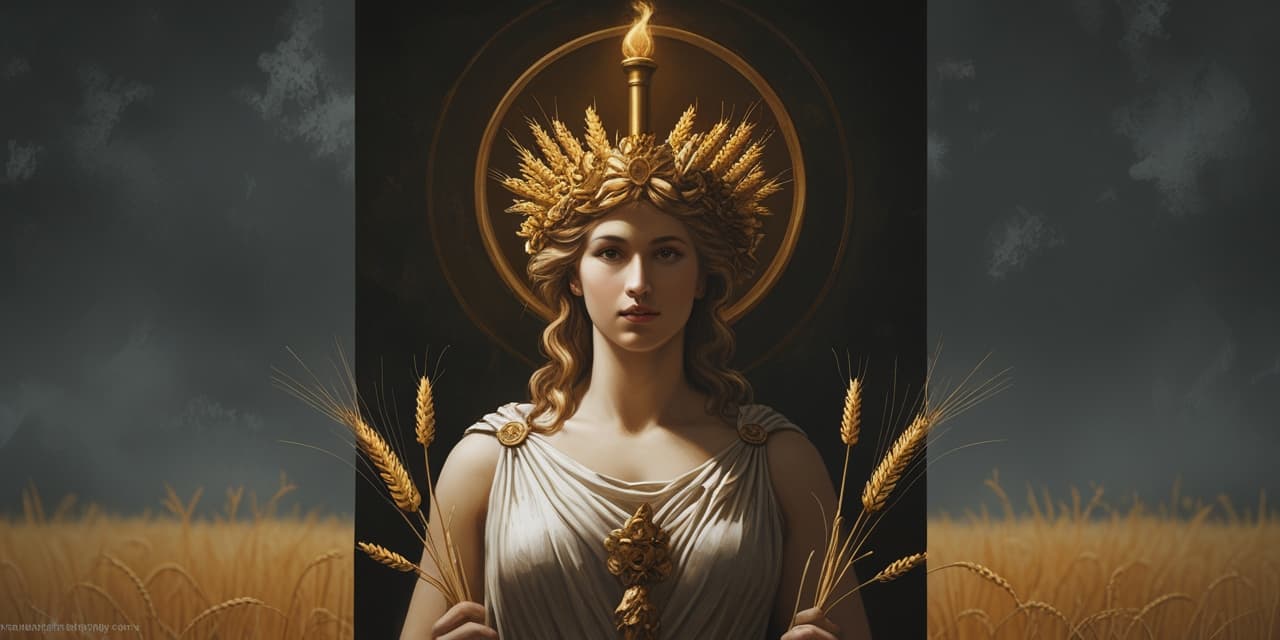
The Lady of the Grain
Demeter is the goddess of the harvest, grain, and the fertile earth — the power that makes crops grow and sustains human civilization. A daughter of the Titans Cronus and Rhea, she is sister to Zeus, Poseidon, and Hades, and one of the eldest Olympians.
Her name is often read as "Earth Mother," from de (a form of ge, earth) and meter (mother), capturing her role as the nurturing force of the soil. The Romans worshipped her as Ceres, from whose name we draw the word "cereal."
Her central myth is the loss of her daughter Persephone, seized by Hades to be queen of the underworld. In grief, Demeter let the earth go barren until a compromise was struck: Persephone would spend part of each year below and part above. Her descent and return became the Greeks' explanation for the turning seasons.
Titles & Worship
- Thesmophoros — "law-bringer," honored in the women-only Thesmophoria festival
- Chloe — "the green shoot," her aspect as goddess of new growth
- Sheaf of wheat — her most common attribute, symbolizing the grain harvest
- Torch — carried during her search for Persephone across the earth
- Eleusis — the town near Athens that hosted her most sacred rites
Demeter's grief-driven search for her daughter took her in disguise across the known world, and it was at Eleusis that she was received kindly by the local royal family and, in gratitude, taught the secret rites that became the Eleusinian Mysteries — an initiation cult that promised participants a better fate after death and endured for close to two thousand years, one of the longest-running religious institutions of the ancient world. As one of the twelve Olympians and sister to Hades, the god who took her daughter, Demeter's myth binds the underworld directly to the cycle of the harvest.
Common Questions
How does Demeter explain the seasons?
When Persephone is with Hades in the underworld, Demeter mourns and the earth turns cold and barren — winter. When her daughter returns each spring, Demeter rejoices and the land blooms again, giving the Greeks a story for the agricultural year.
What were the Eleusinian Mysteries?
They were secret initiation rites held at Eleusis in honor of Demeter and Persephone. Initiates were promised a blessed afterlife, and the rituals — never written down — ranked among the most revered in the ancient Greek world.
What was the Thesmophoria?
The Thesmophoria was an annual women-only festival honoring Demeter in her role as lawgiver and protector of marriage and fertility. Held across many Greek city-states, it involved fasting, sacrifice, and rites of renewal timed to the autumn sowing season, and was among the most widespread Demeter festivals outside of Eleusis.

