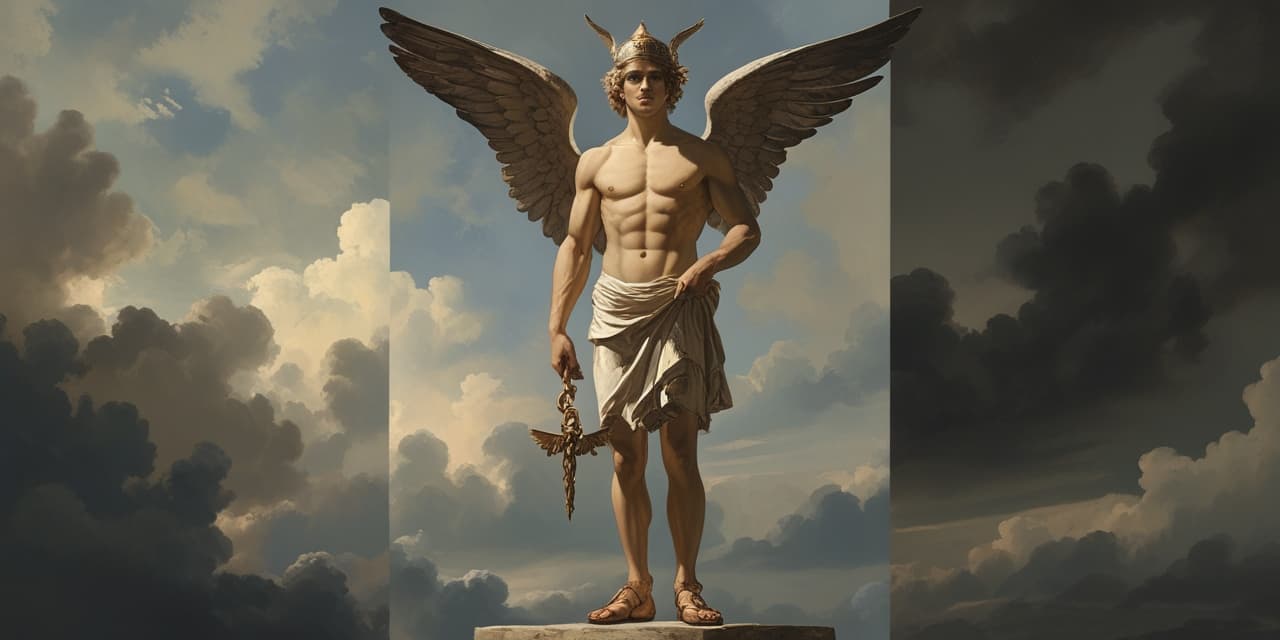
The God of the Crossroads
Hermes is the swift messenger of the Olympians and the most restless of the gods — patron of travelers, merchants, heralds, athletes, and thieves alike. Born in a cave on Mount Cyllene to Zeus and the nymph Maia, he is the great crosser of boundaries, moving freely between Olympus, the mortal world, and the realm of Hades, where he guides the dead as the psychopomp.
His name likely derives from herma, the stone heaps and boundary markers set at crossroads and doorways in his honor. Those cairns capture his essence perfectly: a god of thresholds, exchange, and the open road.
On the day of his birth Hermes invented the lyre from a tortoise shell, then stole the cattle of Apollo. When Apollo confronted him, the infant charmed him with music, and the two reconciled — Hermes traded the lyre for the cattle and gained the golden caduceus.
Guide of Souls
Beyond his role as messenger, Hermes served as psychopomp, escorting the souls of the dead down to the underworld ruled by Hades. He alone among the Olympians moved freely between the world of the living, the halls of Olympus, and the realm below, which made him the natural go-between in myths that cross those boundaries — from briefly returning Persephone to Demeter each spring to guiding King Priam safely into the Greek camp to ransom Hector's body in the Iliad.
His cunning made him patron of merchants, orators, athletes, and thieves alike — a paradox the Greeks embraced rather than resolved. Herm-stones bearing his head marked property lines and crossroads across Greece, and he later fathered the rustic god Pan with a nymph on Mount Cyllene, according to the Homeric Hymn to Hermes.
Titles & Domains
- Psychopomp — guide of souls to the underworld
- Diaktoros — "the guide" or "messenger"
- Patron of merchants — protector of trade, weights, and profit
- Patron of thieves — honored for his own cunning as an infant
- Patron of travelers — herm-stones marked safe roads and boundaries
- Patron of athletes — invoked at gymnasiums and the palaestra
Common Questions
What is the difference between Hermes and Mercury?
They are the same deity under different names. Hermes is the Greek god; the Romans identified him with their own god of commerce, Mercury, and the two traditions largely merged.
Is the caduceus a medical symbol?
The caduceus of Hermes is a herald's staff tied to commerce and negotiation, not medicine. The true medical emblem is the single-snake Rod of Asclepius, though the two are often confused in modern usage.
Is Hermes one of the twelve Olympians?
Yes. Hermes is counted among the twelve Olympian gods, alongside his father Zeus and siblings such as Apollo and Athena. Despite his high status, he is unusually approachable in myth — as comfortable guiding souls to the underworld as delivering messages on Olympus.

