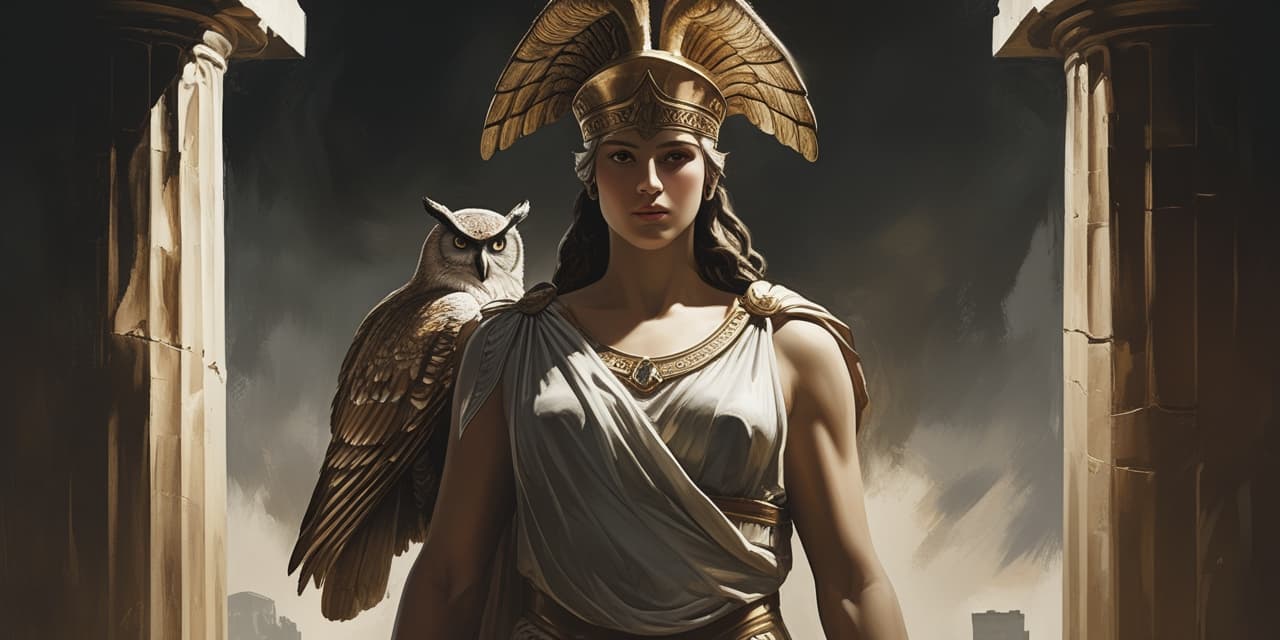
Who Athena Is
Athena is the Greek goddess of wisdom, craft, and strategic warfare — patron of Athens and one of the most revered figures in the pantheon. Her birth is unlike any other deity's. Zeus swallowed her mother Metis after a prophecy warned that her offspring would surpass him, and Metis kept making armor for her unborn child inside him. When Zeus suffered a splitting headache, Hephaestus (or, in some versions, Prometheus) split his skull with an axe and Athena emerged fully grown, in full battle armor, shouting a war cry. Born from pure intellect, she arrives complete, skilled, and ready — wisdom expressed as action.
Her Name and Origins
Athena's name is pre-Greek, with no clean Indo-European etymology, suggesting she was adopted from an earlier Aegean culture, possibly Minoan. Whether Athens is named after her or she after Athens has been argued for centuries without resolution. She was also called Pallas Athena, after either an epithet meaning "young woman" or a childhood friend she accidentally killed sparring. She bore the aegis, a terror-inducing shield, often shown with the head of Medusa.
Two Kinds of War
Athena and Ares are both war deities, but the Greeks drew a sharp line between them. Ares is war as brutal violence; Athena is war as strategy — military intelligence, discipline, and the crafting of weapons and armor. In the Iliad, Athena guides the Greek heroes and even deflects an arrow aimed at Menelaus, and when she and Ares clash directly, she wins decisively. The Greeks left no doubt which kind of war they admired.
Calculated warfare. Wisdom applied to conflict. The god of winning wars, not just fighting them.
Raw aggression. The chaos of battle itself. Often depicted as uncontrolled, even cowardly when injured.
The Myth of Arachne
Athena was also goddess of techne — skilled making — patron of weaving, pottery, and metalwork. Her most famous myth turns on that craft. Arachne, a mortal weaver of extraordinary skill, claimed to be the better artist. Disguised as an old woman, Athena warned her to be humble; Arachne refused. In the contest, Arachne wove flawless scenes of gods behaving badly. Unable to fault the work, Athena destroyed it, and in despair Arachne hanged herself. Athena transformed her into a spider so she could weave forever, which is why her name, the Greek word for spider, lives on in "arachnid."
Patron of Athens
Athena's most famous contest was against Poseidon for patronage of the city that would bear her name. Poseidon struck the Acropolis with his trident and produced a spring of seawater; Athena planted an olive tree, offering food, oil, and wood. The gift of the olive won, and the story was later carved into the west pediment of the Parthenon, her great temple on the Acropolis. As one of the twelve Olympians, she was honored above all in the city that took her name, with the Panathenaic festival held in her honor every year and a grand version every four.
Titles & Symbols
- Pallas Athena — a name of disputed origin, possibly honoring a childhood companion
- Athena Parthenos — "Athena the Virgin," namesake of the Parthenon and its lost gold-and-ivory cult statue
- Athena Promachos — "who fights in front," her aspect as a warrior-defender of the city
- Athena Nike — "Athena of Victory," honored in her own small temple on the Acropolis
- Owl — her sacred bird, a symbol of wisdom still tied to Athens today
- Olive tree — her gift to the city, source of Athens's oil trade
Common Questions
Why was Athena born from Zeus's head?
Zeus swallowed her pregnant mother Metis after a prophecy warned her children would surpass him. When he later suffered a terrible headache, Hephaestus (or, in some versions, Prometheus) split his skull and Athena emerged fully grown and armed. The myth encodes the Greek idea that true wisdom is born from rational intelligence rather than physical or emotional sources.
What's the difference between Athena and Ares as war gods?
Ares represents the brutal, chaotic violence of battle, while Athena represents strategic warfare — planning, discipline, and the intelligent application of force. The Greeks valued Athena's version far more, and in myths where they interact, she consistently bests him.
Why is the owl associated with Athena?
The little owl (Athene noctua, named for her) was common around the Acropolis and became her sacred bird, a symbol of wisdom and keen sight even in darkness. Athenian coins were stamped with her owl alongside her profile, and the image remains one of the most recognizable emblems of the city and the goddess alike.

