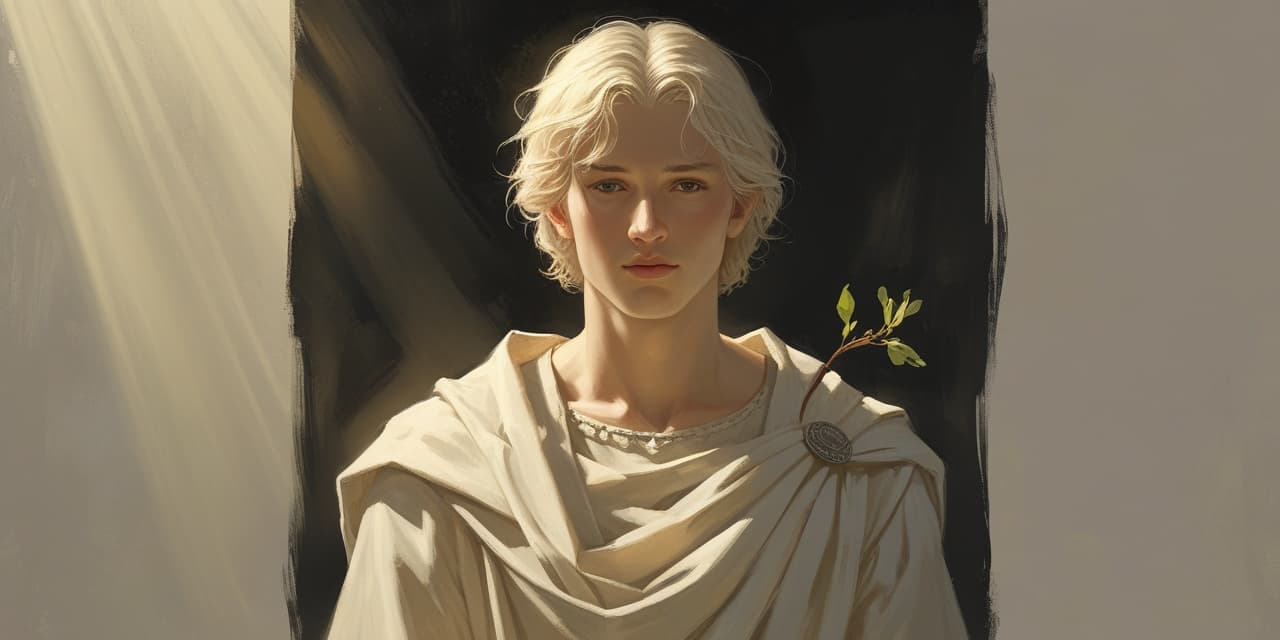
The Shining God
Baldr is the radiant, gentle son of Odin and Frigg, a god of light, beauty, and goodness so luminous that light shines from him. Beloved by all of the Aesir, he dwells in the bright hall Breidablik, where nothing impure may stand. His death is the great turning point of Norse mythology — the first sign that Ragnarok is near.
His name may derive from a Proto-Germanic word meaning "lord" or "prince," and is related to Old English bealdor, "hero." Some scholars instead link it to a root meaning "bold" or "bright," fitting his shining nature.
When Baldr begins to dream of his own death, Frigg makes every thing in the world swear never to harm him — overlooking only the mistletoe. The gods amuse themselves by hurling weapons that bounce off him harmlessly, until Loki fashions a mistletoe dart and guides the hand of the blind god Höðr. Baldr falls dead, and the gods' grief is boundless.
Frigg sends a messenger to Hel to beg for his return; the underworld will release him only if every being weeps for him. All do, save one giantess — Loki in disguise — and so Baldr remains among the dead. Yet prophecy holds that he will return after Ragnarok to rule the reborn, peaceful world.
Baldr's funeral is one of the most vivid scenes in the Prose Edda: his body is carried to his ship Hringhorni, the greatest of all ships, alongside that of his wife Nanna, who collapses and dies of grief and is burned beside him. The giantess Hyrrokkin is summoned to launch the massive vessel, and Thor, his grieving half-brother, kicks a dwarf named Litr into the flames in his rage. Odin leans down and whispers something into his dead son's ear — a secret the sources never reveal, referenced only as an unanswerable riddle in the poem Vafþrúðnismál.
A very different account survives in the Danish historian Saxo Grammaticus's twelfth-century Gesta Danorum, which strips away the gods' divinity and recasts Baldr and Höðr as rival human warriors competing for the hand of Nanna; there, Baldr dies not from mistletoe but from a wound dealt in battle. Most scholars treat Snorri Sturluson's version, drawn from the Poetic Edda, as closer to genuine pre-Christian belief.
Key Myths & Attributes
- The Dreams of Baldr — his premonitions of death set the entire tragedy in motion.
- The Invulnerability Game — the gods amuse themselves by hurling weapons that bounce off him harmlessly.
- Death by Mistletoe — a Loki-guided dart thrown by the blind god Höðr kills him.
- The Ship Funeral — his body is burned aboard Hringhorni alongside Nanna, launched by the giantess Hyrrokkin.
- Hel's Bargain — Frigg's messenger rides to the underworld to plead for his release.
- Prophesied Return — after Ragnarok, Baldr comes back to help rule the renewed world.
The brightest and best-loved of the gods, dwelling in a hall no impurity may enter.
His killing marks the beginning of the end — yet he is fated to return and rule the world reborn.
Common Questions
How did Baldr die?
He was killed by a dart of mistletoe — the one thing his mother Frigg had not made swear to spare him — thrown by the blind god Höðr under Loki's guidance.
Does Baldr come back to life?
Prophecy says yes. After Ragnarok destroys the old world, Baldr returns from the dead to help rule the renewed and peaceful earth.
What happens at Baldr's funeral?
His body is burned aboard his ship Hringhorni together with his grief-stricken wife Nanna, launched by the giantess Hyrrokkin, while Odin whispers an unrevealed secret into his son's ear before the pyre is lit.

