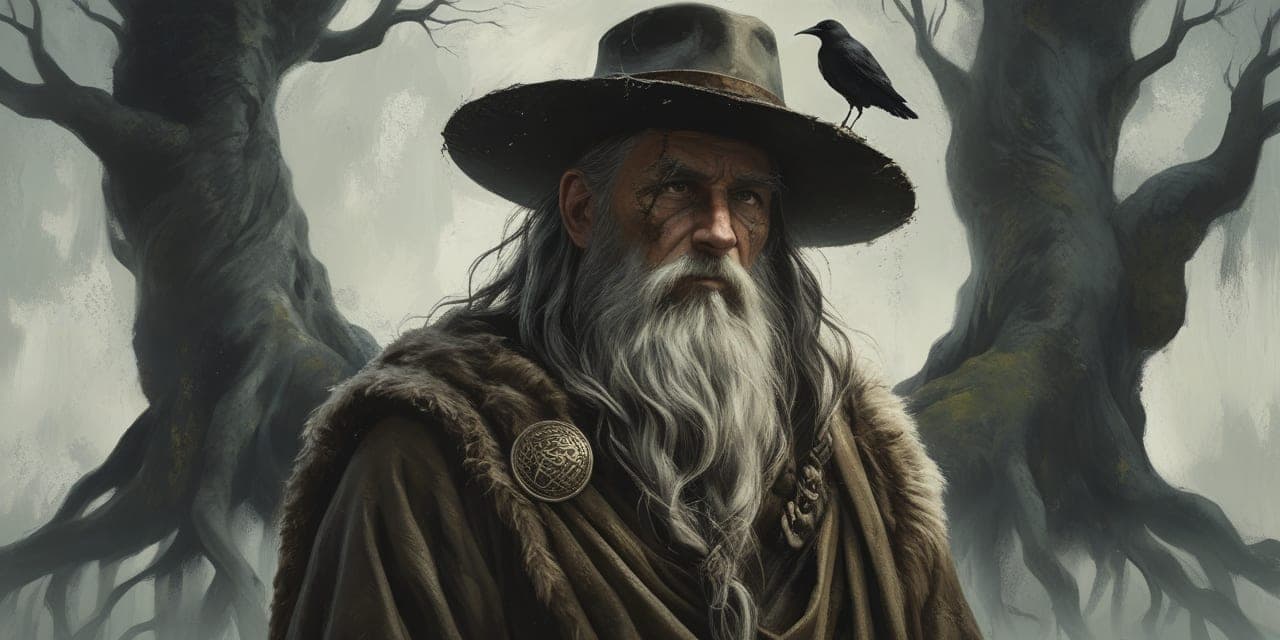
The Allfather
Odin is the chief of the Aesir and ruler of Asgard, a god of wisdom, war, poetry, death, and magic. Son of Bor and the giantess Bestla, he and his brothers slew the primeval giant Ymir and shaped the world from his body. Restless and relentlessly curious, Odin wanders the nine worlds disguised as an old traveler, seeking knowledge wherever it can be found.
His name derives from Proto-Germanic Wodanaz, rooted in woð, meaning "fury," "inspiration," or "ecstasy" — the frenzy of the warrior and the poet alike. The same root gives the English weekday Wednesday, "Woden's day."
Odin's hunger for wisdom costs him dearly. He gives up an eye to drink from Mimir's well, and hangs himself for nine nights on the world-tree Yggdrasil, pierced by his own spear, to win the runes. Two ravens, Huginn (thought) and Muninn (memory), fly across the world each day and whisper to him all they see.
With his wife Frigg he fathers the radiant Baldr, whose death he is powerless to prevent. At Ragnarok, Odin rides out to battle the wolf Fenrir and is swallowed whole, his long quest for knowledge unable to save him from his foretold end.
Odin's hunger for poetry is as fierce as his hunger for runes. Disguised under the name Bölverk, he seduces the giant's daughter Gunnlod to drink the mead of poetry from vats hidden inside a mountain, then escapes in the form of an eagle, spitting the mead out for the gods and for gifted human poets — the mythic origin of poetic inspiration itself. The Poetic Edda credits him with dozens of other names, among them Grímnir ("the masked one") and Alfödr ("Allfather"), reflecting the sheer range of guises he takes across the myths.
Half of all warriors who die honorably in battle are claimed by Odin's Valkyries and carried to Valhalla, his hall of the slain, where they feast and train in preparation for Ragnarok. The other half go to Freya's hall Fólkvangr — a division that underscores how closely war, death, and the coming apocalypse are bound together in Odin's domain.
Titles & Names
- Alfödr — "Allfather," his most common title as ruler of the gods.
- Grímnir — "the masked one," the disguise he wears to test the hospitality of King Geirröd.
- Bölverk — "evil-doer," the name he uses when he tricks the giant Suttung out of the mead of poetry.
- Sigfödr — "father of victory," reflecting his role as a war-god who decides battles.
- Herjan — "lord of hosts," one of many war-related bynames listed in the Poetic Edda.
- Valfödr — "father of the slain," for his claim on half of all warriors who die in combat.
Common Questions
Why does Odin have only one eye?
He sacrificed an eye to drink from Mimir's well of wisdom, trading sight for deeper knowledge of the cosmos and its fate.
Is Odin the same as Woden or Wotan?
Yes. Woden (Old English) and Wotan (Old High German) are the same deity under the broader Germanic tradition; all descend from Proto-Germanic Wodanaz.
What is Valhalla?
Valhalla is Odin's great hall in Asgard, where Valkyries bring half of the warriors slain in battle to feast and train until they are needed to fight alongside the gods at Ragnarok.

