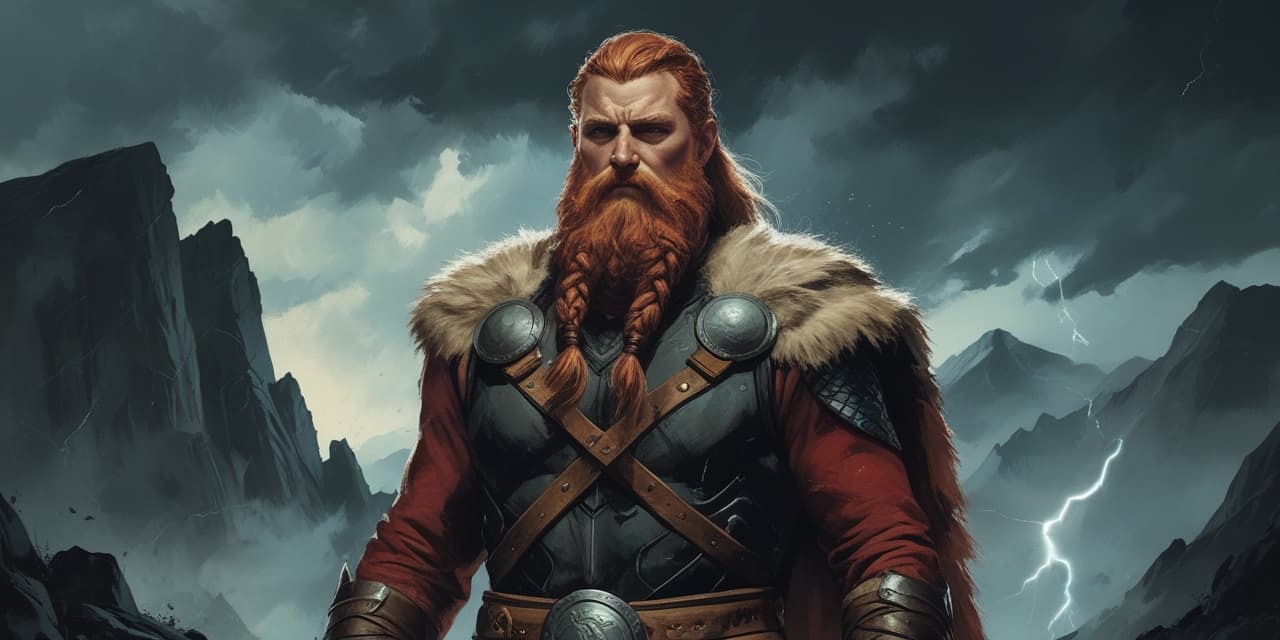
The Thunderer
Thor is the red-bearded god of thunder, the strongest of the Aesir and the tireless defender of both gods and mortals against the giants. Son of Odin, he rides a chariot pulled by two goats whose rumbling wheels make the thunder, and wields the hammer Mjolnir, which always returns to his hand.
His name is simply the Old Norse word for "thunder," from Proto-Germanic Þunraz. The same deity appears as Thunor in Old English and Donar among the continental Germans, and his day survives as Thursday, "Thor's day."
Of all the gods, Thor was the most beloved by ordinary Norse people, who wore tiny hammer amulets for protection. His myths are full of vigor and humor: he fishes for the world-serpent Jörmungandr, dresses as a bride to recover his stolen hammer, and matches strength against giants in their own halls.
At Ragnarok, Thor faces Jörmungandr a final time. He slays the great serpent but staggers only nine paces before falling dead from its venom — the protector of the world dying with the world he defended.
One of Thor's richest adventures takes him and Loki to the hall of the giant-king Utgard-Loki, where he is tricked into a series of impossible contests: wrestling an old woman who is secretly Old Age itself, draining a horn secretly connected to the ocean, and lifting a "cat" that is really the world-serpent Jörmungandr in disguise. Only after the visit does the giant-king reveal the illusions, marveling that Thor came closer to besting them than any mortal or god could.
Thor's hammer needs help to wield: he must strap on the belt Megingjörð, which doubles his strength, and don the iron gauntlets Járngreipr just to grip Mjolnir's handle, forged deliberately short after Loki sabotaged the dwarf-smiths mid-work. Archaeologists have found thousands of small Mjölnir pendants across Scandinavia, many dating to the Christianization period, suggesting Thor's hammer became a defiant symbol of the old faith.
Titles & Weapons
- Mjolnir — his hammer, forged by the dwarves Brokkr and Sindri, capable of leveling mountains.
- Megingjörð — a belt that doubles his already formidable strength when worn.
- Járngreipr — iron gauntlets he needs to grip Mjolnir's short handle.
- Vingþórr — "battle-Thor" or "hallowing-Thor," one of his poetic bynames.
- Öku-Þórr — "Thor the charioteer," referencing his goat-drawn chariot.
- Véurr — "hallower" or "defender of the sanctuary," a name used of him in the Prose Edda.
Common Questions
What is Thor's hammer called?
Mjolnir — a weapon forged by dwarves that never misses its target and always returns to Thor's hand. Worshippers wore miniature versions as protective amulets.
Who are Thor's parents?
Thor is the son of Odin, the Allfather. In the Prose Edda his mother is named as Jörð, the personified earth.
Why does Thor need a special belt and gloves?
The belt Megingjörð doubles his already immense strength, and the iron gauntlets Járngreipr let him grip Mjolnir's handle, which the dwarves forged too short after Loki sabotaged their work.

