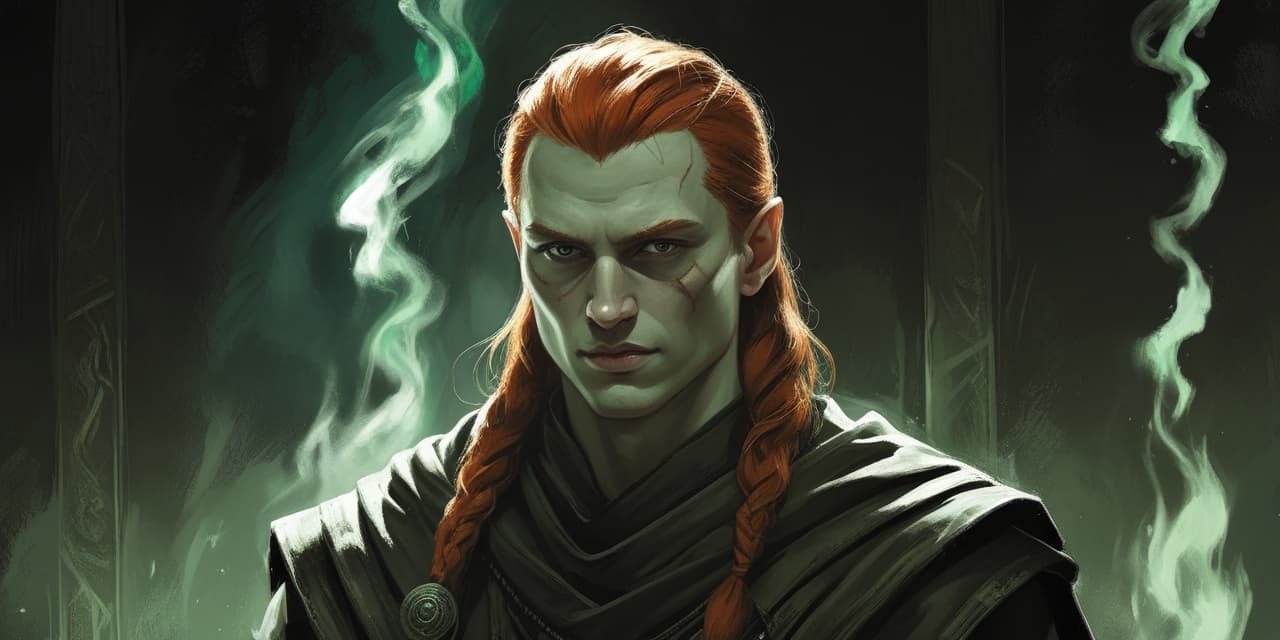
The Trickster
Loki is the cunning, ambiguous trickster of Norse myth — a shape-shifter of giant ancestry who lives among the Aesir as Odin's blood-brother. He is neither wholly god nor wholly enemy, by turns helping the gods out of disasters he himself has caused and dragging them toward ruin.
The origin of his name is uncertain. Scholars have linked it to a root meaning "knot" or "tangle," or to logi, "flame," a fitting image for a figure who is slippery, unpredictable, and dangerous. He is also called Loptr, "air," reflecting his airy elusiveness.
Loki's schemes drive many of the great myths. He cuts off the goddess Sif's hair and must replace it, triggering the dwarves' forging of the gods' greatest treasures, including Thor's hammer Mjolnir. But his cruelest act is engineering the death of Baldr, guiding the blind god Höðr to throw the fatal mistletoe.
For that crime the gods bind Loki beneath the earth with a serpent dripping venom onto his face, his writhing said to cause earthquakes. At Ragnarok he breaks free to lead the giants against the gods, and falls in mutual slaughter with the watchman Heimdall.
Loki fathers three monstrous children with the giantess Angrboða: the wolf Fenrir, the world-serpent Jörmungandr, and Hel, who becomes ruler of the underworld realm that bears her name. Fearing prophecies about them, the gods bind Fenrir, cast Jörmungandr into the sea, and send Hel to rule the dead — precautions that ultimately fail to stop Ragnarok. Loki's shape-shifting produces an even stranger offspring: disguised as a mare to distract a giant's stallion, he later gives birth to an eight-legged foal, which he gives to Odin as the horse Sleipnir.
In the poem Lokasenna, Loki crashes a feast of the gods and insults every one of them in turn, airing old grievances before Thor arrives and threatens him into fleeing — a prelude to his final capture and binding.
Key Relationships
- Odin — Loki's blood-brother, whom he both aids and ultimately betrays.
- Angrboða — the giantess mother of his monstrous children Fenrir, Jörmungandr, and Hel.
- Sigyn — his loyal wife, who holds a bowl to catch the serpent's venom while he is bound.
- Baldr — the god whose death Loki secretly engineers, setting Ragnarok in motion.
- Heimdall — the watchman fated to kill and be killed by Loki at Ragnarok.
- Thor — a frequent traveling companion in myths, despite Loki's treachery elsewhere.
Recovers stolen treasures, aids Thor's adventures, and wins the gods their finest gifts.
Plots Baldr's death and ultimately leads the forces of chaos against Asgard at Ragnarok.
Common Questions
Is Loki a god or a giant?
Both, in a sense. Loki is of giant (jötunn) descent but is counted among the Aesir and treated as a god, embodying his in-between, boundary-crossing nature.
Who are Loki's children?
With the giantess Angrboða he fathers the wolf Fenrir, the world-serpent Jörmungandr, and Hel, ruler of the underworld — and by shape-shifting into a mare, he also gives birth to Odin's eight-legged horse Sleipnir.
Why is Loki bound with a serpent?
As punishment for engineering Baldr's death, the gods chain Loki to three rocks beneath the earth and fix a serpent above him to drip venom on his face; his wife Sigyn catches most of it in a bowl, and his writhing when it overflows is said to cause earthquakes.

