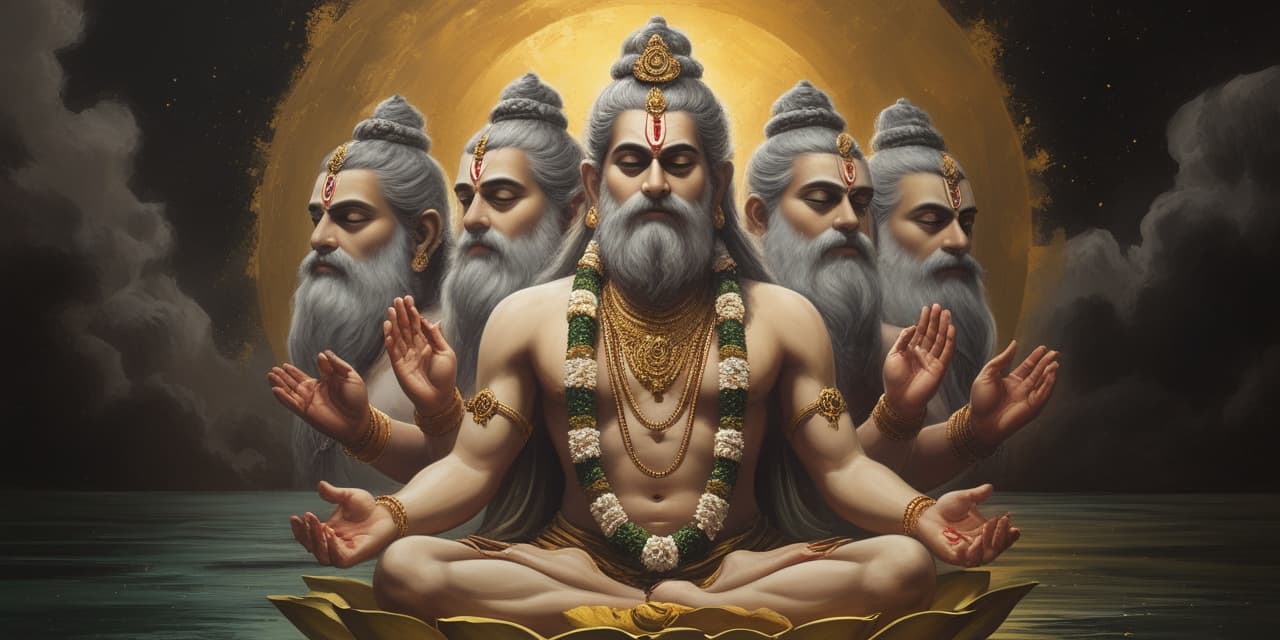
The First of the Trimurti
Brahma is the creator god of Hindu mythology, the first member of the Trimurti. From his mind and body emerged the cosmos, the first beings, and the four Vedas, the sacred texts of knowledge. He is typically shown with four heads facing the cardinal directions, four arms, and a serene white beard, seated upon a lotus or riding a swan.
The name "Brahma" derives from the Sanskrit root brh, meaning "to grow" or "to expand," tied to brahman, the absolute reality underlying the universe. He should not be confused with that impersonal Brahman nor with the priestly class, the brahmins, though all share the same expansive root.
In one famous myth, Brahma and Vishnu argued over who was supreme. A boundless pillar of fire appeared, and each set out to find its end. Vishnu honestly admitted he could not; Brahma falsely claimed he had reached the top. For this lie, Shiva cursed him to receive little worship, which explains why temples to Brahma are rare today.
Brahma's role as creator also entangles him with his own daughter, Saraswati, whom he is said to have formed from his body; when she tried to evade his gaze by moving around him, he grew a fifth head to watch her from every direction, and Shiva later severed that fifth head for its impropriety, leaving him the four he bears today (see the Wikipedia entry on Brahma for the textual variants of this myth). Despite his diminished cult, Brahma retains a handful of major shrines, most famously the Brahma Temple at Pushkar in Rajasthan — widely cited as one of very few temples in India dedicated to him — where an annual fair draws thousands of pilgrims. He is also honored in the Hindu day's structure: each of his "days," a kalpa, is said to last 4.32 billion human years, after which the universe dissolves into Shiva and the cycle begins again under a new Brahma.
Titles & Epithets
- Svayambhu — "the self-born," referring to his emergence without parents
- Prajapati — "lord of creatures," an older Vedic title later absorbed into Brahma
- Vedanatha — "lord of the Vedas," honoring his authorship of sacred knowledge
- Chaturmukha — "the four-faced one," describing his four heads
- Hiranyagarbha — "the golden womb," the cosmic egg from which he is said to have arisen
Common Questions
Why are there so few temples to Brahma?
According to myth, Shiva cursed Brahma after he lied about finding the top of a cosmic pillar, condemning him to little worship.
Who is Brahma's consort?
Saraswati, the goddess of knowledge, music, and the arts, is his wife and partner in creation.
Where can Brahma still be worshipped?
The Brahma Temple at Pushkar in Rajasthan is the most famous surviving shrine dedicated to him, alongside a small number of other temples across India, and it hosts a major pilgrimage fair each year.

