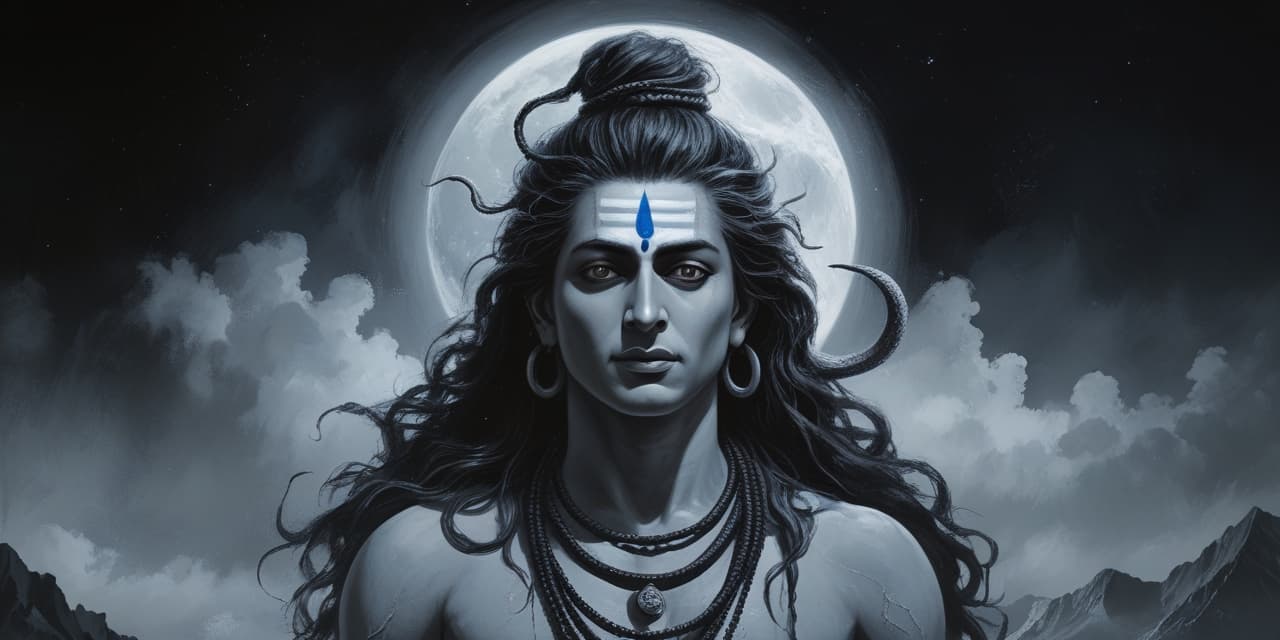
The Destroyer and Transformer
Shiva is the third member of the Trimurti, the god of destruction and transformation. His role is not merely to end things but to dissolve the old so that new creation may begin. He is depicted with matted hair holding the Ganges, a crescent moon, a third eye that can incinerate with a glance, a coiled serpent, and a trident.
The name "Shiva" means "the auspicious one" in Sanskrit, a propitiating title for a deity who is also the fierce Rudra of the Vedas. This duality defines him: at once the serene yogi meditating on Mount Kailash and the wild dancer whose cosmic dance, the Tandava, destroys and renews the universe.
With his consort Parvati, Shiva fathered Ganesha, the elephant-headed remover of obstacles. He is widely worshipped in the aniconic form of the lingam, and his devotees, the Shaivites, regard him as the supreme reality from which all else flows.
Shiva's mythology is full of extremes. He drank the poison Halahala that emerged during the churning of the cosmic ocean to save the universe from its effects, holding it in his throat rather than swallowing it — the poison stained his neck blue, earning him the epithet Nilakantha, "the blue-throated one." He is also the ascetic archetype, seated in eternal meditation on Mount Kailash, yet as Nataraja, "lord of the dance," he performs the Tandava within a ring of fire, a form immortalized in Chola-era bronze sculpture and cited by physicist Fritjof Capra as a metaphor for the cosmic dance of subatomic particles (see the Wikipedia entry on Shiva for the range of his forms). Twelve especially sacred lingam shrines across India, the Jyotirlingas, are believed to mark sites where Shiva manifested as a column of light, and remain major pilgrimage destinations today.
Titles & Epithets
- Mahadeva — "the great god," his most common honorific
- Nataraja — "lord of the dance," his cosmic-dance form
- Nilakantha — "the blue-throated one," from swallowing the poison Halahala
- Rudra — his fierce, storm-associated Vedic predecessor
- Pashupati — "lord of animals," an ancient title tying him to fertility and wild creatures
- Bholenath — "the innocent lord," reflecting his simplicity and ease of devotion
Common Questions
Is Shiva only a destroyer?
No. His destruction clears the way for renewal, and he is equally honored as a meditative yogi and the auspicious source of creation.
What is the lingam?
The lingam is an aniconic symbol of Shiva, representing his formless, generative cosmic energy.
Why is Shiva's throat blue?
He drank the poison Halahala, produced during the churning of the cosmic ocean, to protect the universe, holding it in his throat where it left a permanent blue stain — hence the epithet Nilakantha.

