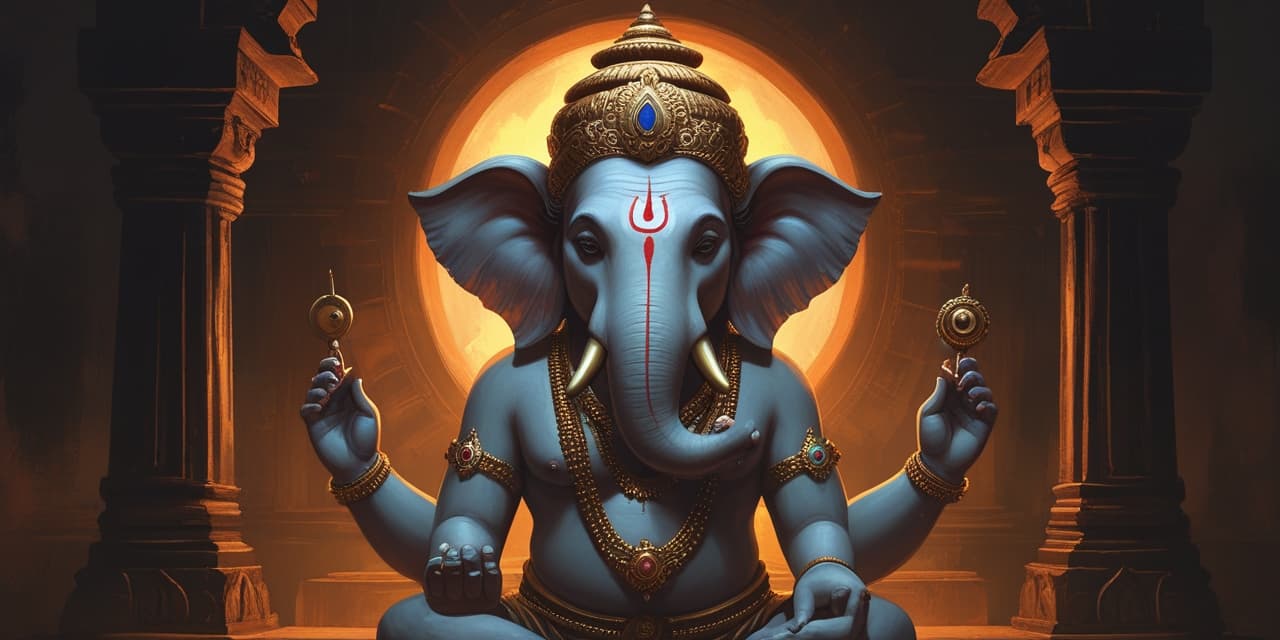
The Remover of Obstacles
Ganesha is the elephant-headed god of beginnings, wisdom, and the remover of obstacles, invoked before any new venture, journey, or ceremony. He is the son of Shiva and Parvati, instantly recognizable by his elephant head, ample belly, single broken tusk, and small mouse mount.
His name combines the Sanskrit gana ("group" or "host" — Shiva's attendant troops) and isha ("lord"), making him "lord of the hosts." He is also called Ganapati, with the same meaning, and Vinayaka, "the remover."
The myth of his elephant head explains his form: Parvati created him to guard her door, and when he barred Shiva from entering, the enraged god struck off his head. To console the grieving Parvati, Shiva replaced it with the head of the first creature found, an elephant, and restored him to life. His broken tusk is said to have served as a stylus when he transcribed the epic Mahabharata, a sign of his patronage of learning and letters (a story recorded in the Puranic tradition and summarized on the Wikipedia entry on Ganesha).
Another well-known tale explains his single tusk directly: when the moon god Chandra mocked his round belly, Ganesha broke off one of his own tusks and hurled it at the moon, cursing Chandra to wax and wane forever after — the origin, in myth, of the lunar cycle. As the son of Shiva and Parvati and a member of the Trimurti's extended family, he is also brother to the war god Kartikeya (Skanda), against whom he is frequently paired in myths that test the two brothers' wit and speed. Ganesha's popularity is on full display each year during Ganesh Chaturthi, a ten-day festival culminating in the immersion of enormous clay idols in rivers and the sea, celebrated with particular scale in Maharashtra.
Titles & Epithets
- Ganapati — "lord of the hosts," the same meaning as Ganesha in different Sanskrit roots
- Vinayaka — "the remover," used widely in western India
- Lambodara — "the pot-bellied one," referencing his round form
- Ekadanta — "the one-tusked," recalling the moon myth
- Vighnaharta — "destroyer of obstacles," his most invoked function
Common Questions
Why does Ganesha have an elephant head?
Shiva beheaded him while he guarded Parvati's door, then revived him with an elephant's head to ease Parvati's grief.
Why is Ganesha worshipped first?
As the remover of obstacles and lord of beginnings, he is invoked at the start of rituals, journeys, and new undertakings.
Why does Ganesha have only one tusk?
Myth says he broke off his own tusk to hurl at the moon after Chandra mocked his appearance, cursing the moon to wax and wane — and leaving Ganesha with the single tusk seen in most images.

