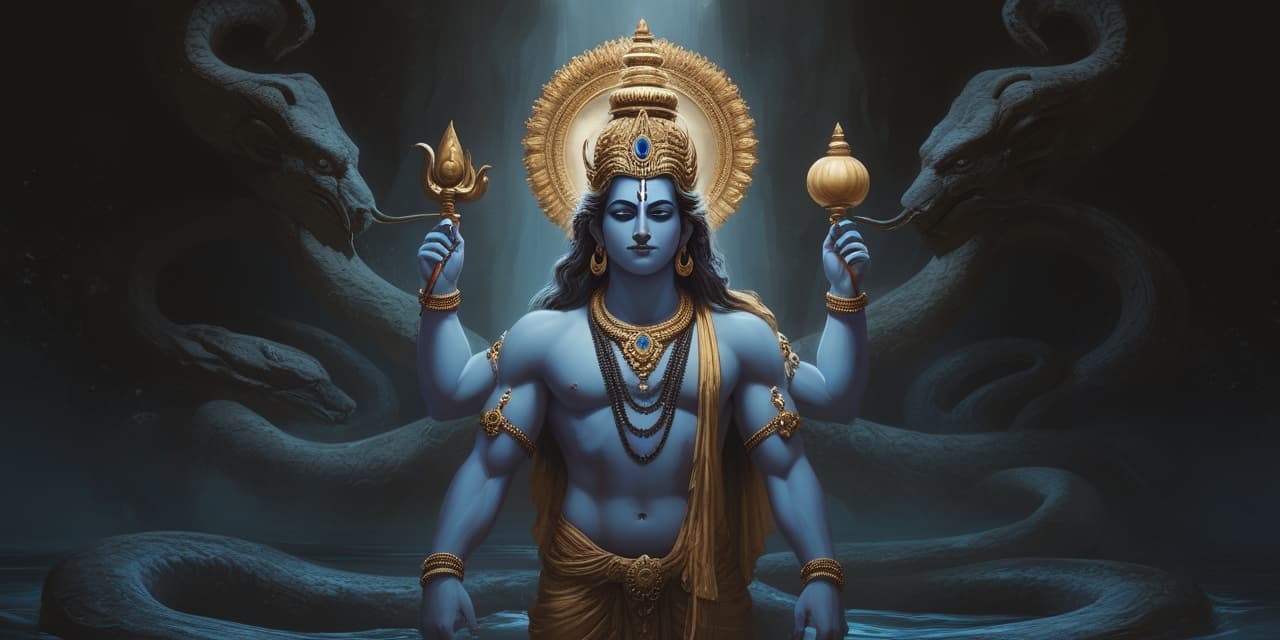
The Preserver of the Universe
Vishnu is the preserver and protector within the Trimurti, the deity who sustains cosmic order, or dharma. Depicted with blue skin and four arms holding a conch, discus, mace, and lotus, he reclines on the serpent Shesha upon the cosmic ocean between cycles of creation. His consort is Lakshmi, goddess of fortune.
The name "Vishnu" likely derives from the Sanskrit root vish, meaning "to pervade" or "to enter," marking him as the all-pervading presence that fills and supports the universe. He is also called Narayana, "he who dwells on the waters."
Whenever cosmic balance is threatened, Vishnu descends to earth as an avatar. His ten principal avatars, the Dashavatara, include Rama and Krishna, heroes of the great epics who restore righteousness and defeat demonic forces. This doctrine of divine descent makes Vishnu the most actively present of the three great gods, intervening directly in the affairs of the world.
The Dashavatara unfolds across cosmic ages, moving from animal to human forms as the world matures: Matsya the fish and Kurma the tortoise rescue creation from a great flood, Varaha the boar raises the earth from the cosmic ocean, and Narasimha the man-lion tears apart the demon Hiranyakashipu to protect his devotee Prahlada — a myth recounted in detail in the Bhagavata Purana and summarized on the Wikipedia entry on Vishnu. Later avatars grow fully human: Parashurama the warrior-sage, Rama of the Ramayana, and Krishna, whose teachings to the warrior Arjuna form the Bhagavad Gita. Most traditions count the Buddha as a ninth avatar, absorbing Buddhism into the Vaishnava fold, while a tenth, Kalki, is prophesied to arrive on a white horse at the end of the current age to end corruption and restore dharma.
Alongside Lakshmi, his eternal consort, and as preserver within the Trimurti beside Brahma and Shiva, Vishnu is honored with over a thousand names recited in the Vishnu Sahasranama, a devotional hymn from the Mahabharata still chanted across Hindu households today. His major temples include Tirupati in Andhra Pradesh, one of the wealthiest and most visited pilgrimage sites in the world, and the Jagannath Temple at Puri, famed for its annual Rath Yatra chariot procession.
Titles & Epithets
- Narayana — "he who dwells on the waters," his most common alternate name
- Hari — "the remover [of sins]," widely used in devotional chanting
- Govinda — "protector of cows," associated with his Krishna avatar
- Chaturbhuja — "four-armed," describing his iconography
- Jagannath — "lord of the universe," honored at the Puri temple
The righteous prince of the Ramayana.
The divine cowherd and charioteer of the Mahabharata.
The man-lion who slays the demon Hiranyakashipu.
Common Questions
What are Vishnu's avatars?
They are his earthly incarnations, the Dashavatara, including Rama and Krishna, who appear to restore dharma when evil rises.
Who is Vishnu's final, prophesied avatar?
Kalki, a warrior riding a white horse, is foretold to appear at the end of the current age, the Kali Yuga, to defeat evil and restore righteousness before the cycle of creation begins anew.
Is the Buddha considered an avatar of Vishnu?
Many Vaishnava traditions count the Buddha as Vishnu's ninth avatar, a way of incorporating Buddhism's teachings into the broader Hindu framework.

