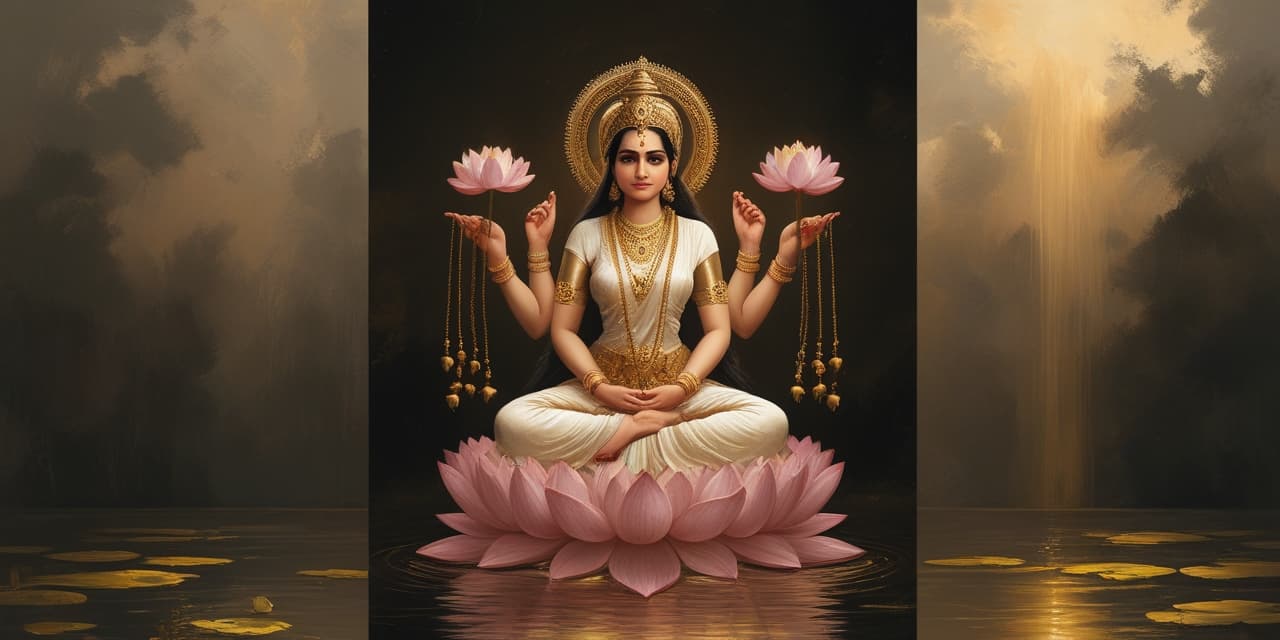
Goddess of Fortune
Lakshmi is the goddess of wealth, fortune, prosperity, and beauty, and the beloved consort of Vishnu. Radiant and golden, she is shown seated or standing on a lotus, holding lotus blossoms, with coins streaming from her hands and flanking elephants pouring water over her.
Her name comes from the Sanskrit lakṣ, meaning "to perceive" or "to aim," tied to lakshya, a goal — fitting for a goddess who embodies the good fortune people strive toward. She is also called Shri, an honorific meaning "radiance" and "auspiciousness."
Lakshmi emerged during the Samudra Manthana, the churning of the cosmic ocean of milk, rising fully formed upon a lotus as the gods and demons stirred the waters. She chose Vishnu as her eternal partner and accompanies him in each of his avatars. She is honored above all during Diwali, the festival of lights, when households welcome her to bring a year of abundance.
Because she accompanies Vishnu through each of his descents to earth, Lakshmi is said to take a matching avatar of her own in every age: as Sita, wife of Rama, in the Ramayana, and as Rukmini and Radha alongside Krishna in the Mahabharata's era, embodying loyalty and devotion in each incarnation (see the Wikipedia entry on Lakshmi for these paired-avatar traditions). Hindu devotional literature also honors her through the Sri Sukta, an ancient hymn appended to the Rigveda that is still recited in her worship today, and through the Ashtalakshmi, a set of eight forms representing wealth, courage, patience, victory, grain, and other blessings she bestows. Alongside Parvati and Saraswati, she completes the Tridevi, the female counterpart to the Trimurti, whose combined shakti powers the three great gods' cosmic work.
Titles & Epithets
- Shri — "radiance" or "auspiciousness," her most common honorific
- Padma — "lotus-born," referencing her emergence from the cosmic waters
- Kamala — another lotus-derived name, "she of the lotus"
- Vaishnavi — "belonging to Vishnu," marking her as his eternal consort
- Lokamata — "mother of the world," honoring her nurturing aspect
Purity and spiritual power rising above worldly mire.
Royal authority and life-giving rains.
Material and spiritual wealth she bestows.
Common Questions
How was Lakshmi born?
She arose from the churning of the ocean of milk, the Samudra Manthana, emerging on a lotus to choose Vishnu as her consort.
Why is Lakshmi worshipped during Diwali?
Devotees invite her into their homes on Diwali to secure prosperity and good fortune for the coming year.
Does Lakshmi appear as other goddesses?
Yes — tradition holds she takes a matching avatar whenever Vishnu does, appearing as Sita in the Ramayana and as Rukmini alongside Krishna, always embodying devotion to her consort.

