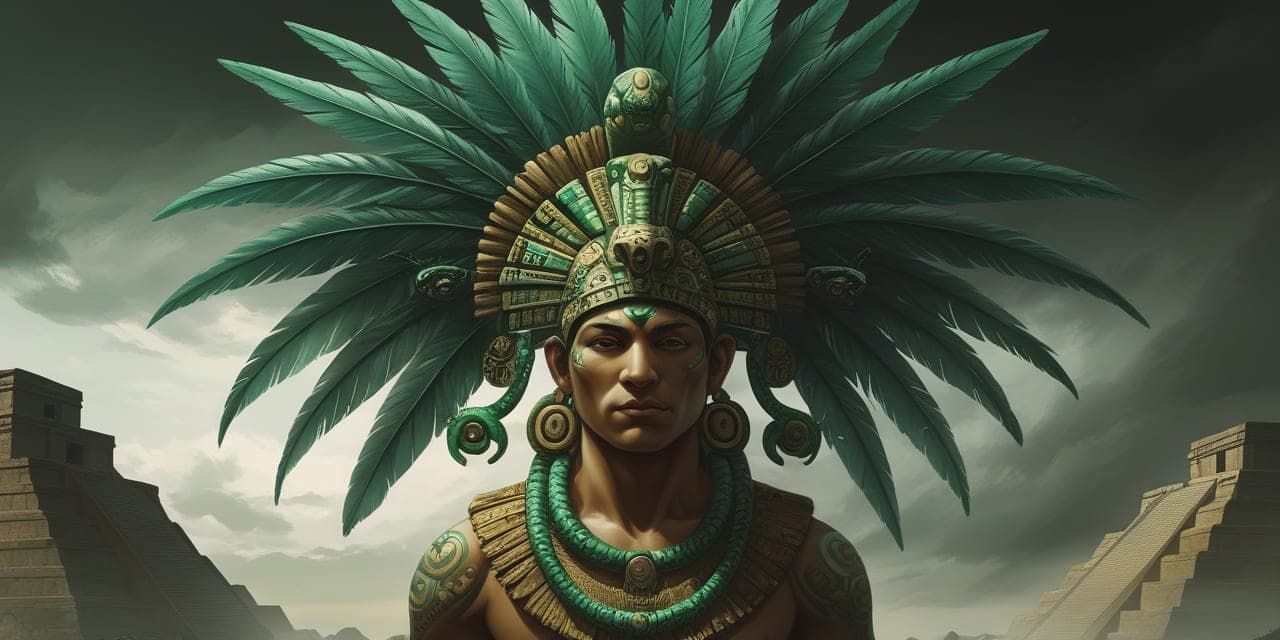
The Feathered Serpent
Quetzalcoatl is among the greatest Aztec gods — patron of wind, wisdom, learning, and the priesthood, and a creator of humankind. Depicted as a serpent sheathed in the iridescent green feathers of the quetzal bird, he bridges earth and sky, matter and spirit. As the wind aspect Ehecatl, he sweeps the roads clean before the rain gods come.
His name fuses Nahuatl quetzalli, the prized green plumage of the quetzal, with coatl, "serpent" — "Feathered Serpent" or "Precious-Feather Snake." The Maya knew an equivalent figure as Kukulkan. Both express the same union of soaring bird and earthbound snake.
In the central creation myth, Quetzalcoatl descends to Mictlan, the underworld, to recover the bones of past humanity from Mictlantecuhtli. He grinds the bones and sprinkles them with his own blood, giving rise to the people of the Fifth Sun. His long rivalry with his brother Tezcatlipoca drives the destruction and renewal of each world-age.
Quetzalcoatl is also credited, in the myth of the Four Suns, with creating the current world's humanity: descending into Mictlantecuhtli's underworld, he tricks the death lord into letting him take the bones of the peoples of earlier ages, then grinds them in a jade bowl and bleeds onto them to make the first Fifth Sun humans — an act of self-sacrifice that echoes throughout Aztec ritual life. In a separate, historically influential episode, Quetzalcoatl appears as a legendary priest-king of the Toltec city of Tula who is tricked and humiliated by his rival Tezcatlipoca, then departs east across the sea, promising to return — a story that later Spanish and Nahua chroniclers linked (controversially, and likely inaccurately) to the arrival of Hernán Cortés; modern historians largely regard that "return" narrative as a post-conquest reinterpretation rather than genuine pre-contact prophecy, per the discussion at Wikipedia's Quetzalcoatl article.
Worship of the feathered serpent stretched across Mesoamerica and far predates the Aztecs themselves — the deity's iconography appears at Teotihuacan and among the Maya as Kukulkan and Gukumatz centuries before the Mexica rose to power. At Tenochtitlan, Quetzalcoatl was honored in his wind aspect, Ehecatl, in distinctive circular temples designed to let breezes flow around them, reflecting the belief that his wind swept the road clear ahead of the rain gods.
Feathered serpent of light, wind, and creation; gives life and learning.
Smoking mirror of night, sorcery, and conflict; his eternal rival.
Key Myths
- Creation of the Fifth Sun humanity: retrieves the bones of past ages from Mictlan and bleeds on them to create the current human race.
- The fall of Tula: as a legendary Toltec priest-king, he is disgraced by Tezcatlipoca's trickery and departs into exile across the eastern sea.
- Shaping the earth: with Tezcatlipoca, tears the earth-monster Cipactli apart to form the sky and land.
- Ehecatl the wind god: as his wind aspect, sweeps the roads before the rain gods, honored in round temples at Tenochtitlan.
- Rivalry with Tezcatlipoca: their contest for supremacy repeatedly ends one world-age and begins the next.
Common Questions
What does Quetzalcoatl's name mean?
It combines quetzalli (the green quetzal feather) and coatl (serpent), meaning "Feathered Serpent."
Is Quetzalcoatl the same as Kukulkan?
They are closely related. Kukulkan is the Maya feathered-serpent deity equivalent to the Aztec Quetzalcoatl, and Gukumatz fills a similar role among the K'iche' Maya.
Did Quetzalcoatl really prophesy the arrival of the Spanish?
Most historians now treat that idea as a post-conquest reinterpretation of the Toltec exile myth rather than an authentic pre-contact prophecy, though it was widely repeated by early colonial chroniclers.

