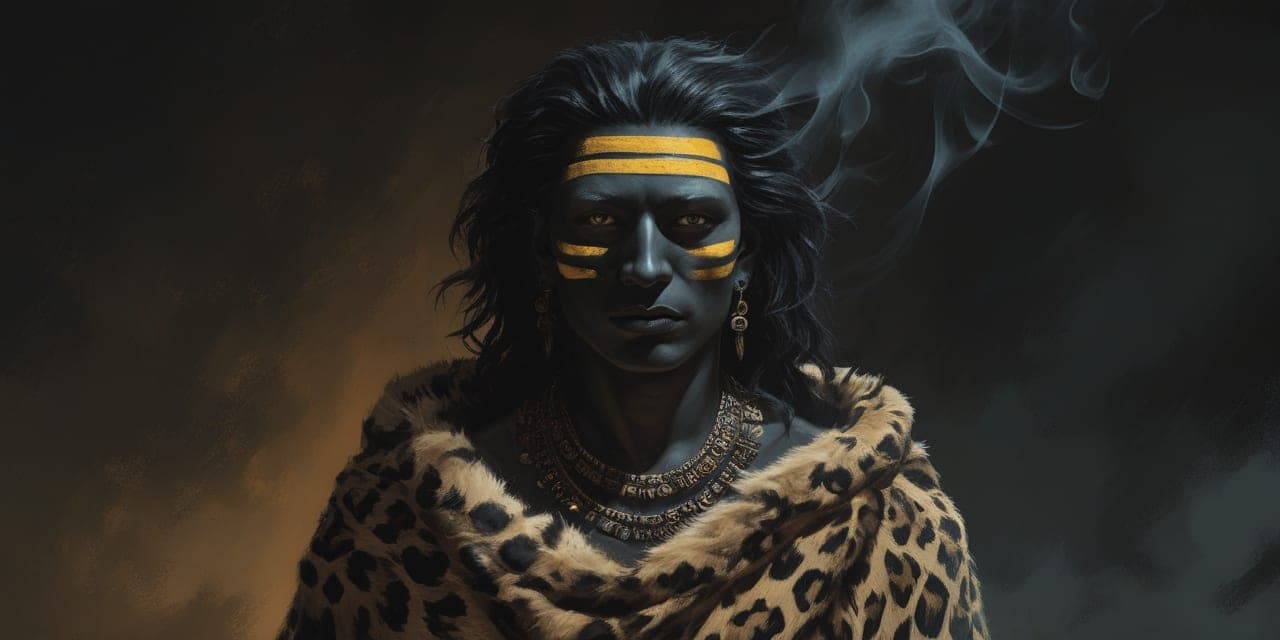
The Smoking Mirror
Tezcatlipoca is the dark, all-seeing god of night, sorcery, destiny, and rulership — one of the most powerful and feared figures in the Aztec pantheon. Ever-changing and capricious, he tests human hearts, grants and revokes fortune, and prowls the world as a jaguar. An obsidian mirror replaces one of his feet, in which he watches all of human action.
His name comes from Nahuatl tezcatl, "mirror," and poctli, "smoke" — "Smoking Mirror," after the polished obsidian discs Aztec seers used for divination. The smoke-clouded glass marks him as the god of hidden knowledge and shifting fate.
Tezcatlipoca and his brother Quetzalcoatl were the engineers of creation, tearing the earth-monster apart to form sky and land. Yet their rivalry repeatedly shatters the world: Tezcatlipoca ruled the first sun until Quetzalcoatl struck him from the sky, beginning the cycle of destruction that leads, eventually, to the age of Huitzilopochtli.
Tezcatlipoca's most famous story is his humiliation of Quetzalcoatl at Tula: disguised as an old man, he tricks the ascetic priest-king into drinking pulque (fermented agave liquor), leading Quetzalcoatl to break his vows and flee the city in shame — the episode that ends the Toltec golden age and sends Quetzalcoatl into exile. He was worshipped through one of the most striking rites in Mexica religion: each year a young man was chosen to live as Tezcatlipoca's living image, dressed richly, taught music and eloquence, and treated as a god for a full year before being sacrificed at its close, a ritual described in detail by Bernardino de Sahagún in his ethnographic accounts of Mexica religion.
As Tezcatlipoca Yohualli Ehecatl, "Night Wind," he could move invisibly through the darkness, and Nahua tradition credited him with the power to appear in countless forms, test the virtue of rulers, and overturn any fortune he had granted. Because he governed both kingship and sorcery, Tezcatlipoca was invoked in coronation rites for new Mexica rulers as well as feared as a bringer of disease, temptation, and misfortune — a genuinely two-sided figure whose favor could never be taken for granted.
Titles & Epithets
- Yohualli Ehecatl, "Night Wind": stresses his power to move unseen and strike without warning.
- Necoc Yaotl, "Enemy of Both Sides": a title reflecting his role as instigator of conflict and rivalry.
- Telpochtli, "the Young Man": emphasizes his restless, ever-changing vigor.
- Ipalnemoani, "He by Whom We Live": a more exalted title shared with other high gods, acknowledging his cosmic power.
- Tepeyollotl, "Heart of the Mountain": a jaguar-form aspect associated with echoes and caves.
Common Questions
Why is Tezcatlipoca called the Smoking Mirror?
His name joins tezcatl ("mirror") and poctli ("smoke"), referring to the smoky obsidian mirrors used for divination — fitting for a god of fate and hidden sight.
How did Tezcatlipoca defeat Quetzalcoatl at Tula?
Disguised as an old man, he tricked the priest-king Quetzalcoatl into breaking his vows of abstinence by drinking pulque, leading to his disgrace and exile from the city.
What was the Toxcatl festival?
An annual Mexica ritual in which a young man lived for a year as Tezcatlipoca's living representative before being sacrificed — one of the most elaborate impersonation rites in Aztec religion.

