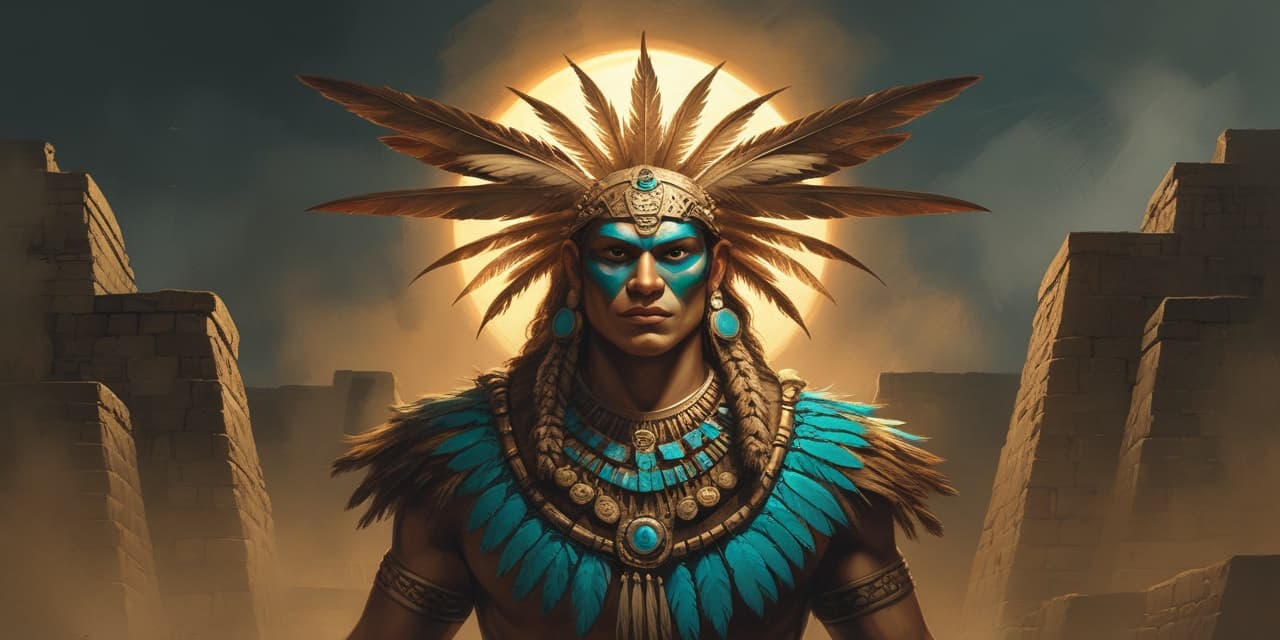
The Sun and War God of Tenochtitlan
Huitzilopochtli is the patron deity of the Mexica (Aztec) people and god of the sun and war. It was he who, in legend, led the wandering Mexica to the swampy island where an eagle perched on a cactus — the sign to found Tenochtitlan. Each day he fights across the sky, and the Aztecs believed his strength had to be renewed with sacrificial blood so the sun would rise again.
His name joins Nahuatl huitzilin, "hummingbird," and opochtli, "left" — "Hummingbird of the Left" (the south), or "Left-handed Hummingbird." Aztecs believed slain warriors returned as hummingbirds to accompany the sun.
At his birth on Coatepec, the "Serpent Mountain," Huitzilopochtli sprang fully armed from his mother Coatlicue to slay his sister Coyolxauhqui and his four hundred brothers — a myth read as the daily triumph of the sun over the moon and stars. Among the brothers of creation he stands beside Quetzalcoatl and Tezcatlipoca as a son of the dual creator.
Huitzilopochtli's cult sat at the physical center of the Aztec empire: he shared the great Templo Mayor pyramid in Tenochtitlan with the rain god Tlaloc, his shrine occupying the southern half in a pairing of war and water, the twin necessities of an expanding empire. Chroniclers such as Bernardino de Sahagún describe elaborate festivals in his honor, including the month of Panquetzaliztli ("Raising of Banners"), when warriors reenacted his birth-battle at Coatepec and captives were sacrificed to renew his strength for the coming year.
Beyond his role as national war-god, Huitzilopochtli was closely tied to the Mexica migration myth: he is said to have spoken to the wandering tribe through a bundle carried by priests, directing them southward for generations until they reached the promised sign — an eagle devouring a serpent atop a cactus — that marked the site of Tenochtitlan, an image still central to the modern Mexican flag. As a solar deity locked in daily combat against darkness, he embodies the broader Aztec conviction, shared with his brothers Quetzalcoatl and Tezcatlipoca, that the cosmos described in the Aztec Pantheon survives only through constant offering and struggle.
Titles & Epithets
- Xiuhcoatl-bearer: he wields the fire serpent Xiuhcoatl as a weapon against his sister Coyolxauhqui and the Centzon Huitznahua.
- Mexitli: an alternate name possibly the root of "Mexico" and "Mexica," the people's own name for themselves.
- Tetzahuitl, "the Omen" or "the Terrible One": a title stressing his fearsome, unpredictable power.
- Ilhuicatl Xoxouhqui, "Blue Sky": a solar epithet linking him to the daytime heavens he crosses each day.
- Patron of Tenochtitlan: official state deity of the Mexica, with his own priesthood and calendar festivals.
Common Questions
What does Huitzilopochtli's name mean?
It means "Hummingbird of the Left" or "Left-handed Hummingbird," from huitzilin ("hummingbird") and opochtli ("left," meaning the south).
Why was Huitzilopochtli so important to the Aztecs?
He was the national patron of the Mexica, guided them to found Tenochtitlan, and as the sun god required sacrifice to keep rising each day.
Who did Huitzilopochtli fight at Coatepec?
At his birth he slew his sister Coyolxauhqui, goddess of the moon, and his four hundred brothers, the Centzon Huitznahua — a battle read as the sun's daily victory over the moon and stars. See the fuller Coatepec myth for the full account.

