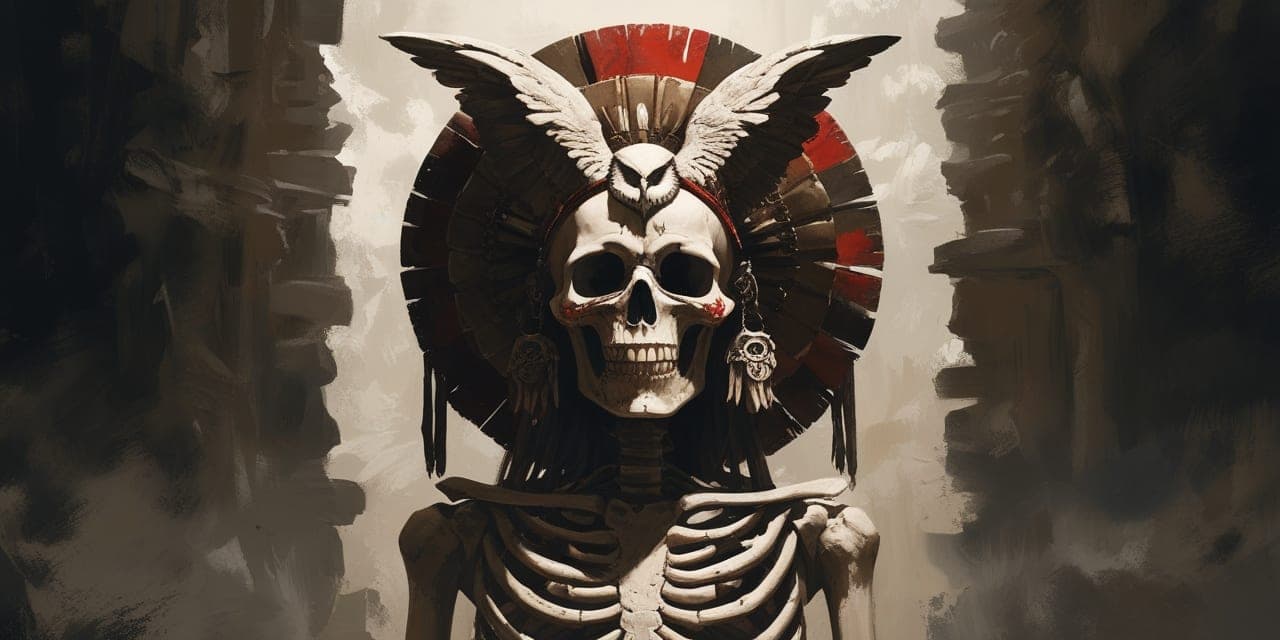
Lord of Mictlan
Mictlantecuhtli is the skeletal god of death who rules Mictlan, the lowest level of the Aztec underworld. With his consort Mictecacihuatl, the "Lady of the Dead," he receives the souls of those who die ordinary deaths — not in battle, sacrifice, or by water. He is portrayed as a blood-spattered skeleton or a figure with a fleshless, toothy skull, often crowned with owl feathers and surrounded by spiders.
His name combines Nahuatl Mictlan, "place of the dead," with tecuhtli, "lord" — "Lord of the Land of the Dead." Mictlan lay at the end of a four-year, nine-level journey the dead had to complete before reaching rest.
In the myth of the Fifth Sun, Quetzalcoatl travels to Mictlan to retrieve the bones of earlier humanity. Mictlantecuhtli grudgingly allows it but lays traps to keep the bones; Quetzalcoatl escapes with them, and from them — mixed with his blood — the present human race is reborn.
Mictlan itself was conceived as the ninth and lowest of the underworld's levels, reached only after the soul survived obstacles including a mountain range that grinds together, a wind that blows knives, and a wide river — a journey said to take four years, aided by a small dog (the origin of the belief that the dead needed a companion animal buried or cremated with them). This picture of a graded, trial-filled underworld is recorded in detail in Bernardino de Sahagún's Florentine Codex, one of the principal colonial-era sources on Mexica religion, and echoed in the codices Vaticanus A and Borgia, which depict Mictlantecuhtli enthroned amid skulls and owls.
Unlike most other members of the Aztec Pantheon, Mictlantecuhtli has no parentage recorded in the surviving sources — he and Mictecacihuatl appear as primordial rulers of the dead in their own right, existing alongside rather than descending from Ometeotl's line. Archaeologists have identified large ceramic statues of Mictlantecuhtli at the Templo Mayor precinct in Tenochtitlan, and his skeletal imagery is widely seen as an ancestor of the skull and bone motifs still associated with Mexico's modern Day of the Dead observances.
Skeletal lord of Mictlan who guards the bones of the dead.
The feathered serpent who steals those bones to recreate humankind.
Symbols & Associations
- Skull and skeleton: depicted as a fleshless or partly fleshed figure, sometimes with a liver hanging from his ribcage.
- Owl (tecolotl): a bird of ill omen and messenger of the underworld in Mexica belief.
- Spider: another creature linked to darkness, death, and the underworld.
- Paper banners and blood: ritual offerings associated with his worship.
- Mictecacihuatl: his consort, the "Lady of the Dead," who co-rules Mictlan and presides over ancient bone-keeping festivals tied to today's Day of the Dead.
Common Questions
What does Mictlantecuhtli's name mean?
It means "Lord of the Land of the Dead," from Mictlan ("place of the dead") and tecuhtli ("lord").
Who goes to Mictlan?
Souls who died of ordinary causes traveled to Mictlan, undergoing a four-year journey through nine levels — unlike warriors and the sacrificed, who joined the sun.
Who is Mictlantecuhtli's consort?
Mictecacihuatl, the "Lady of the Dead," rules Mictlan alongside him and oversees ancient festivals honoring the bones of the dead, a tradition often linked to Mexico's modern Day of the Dead.

