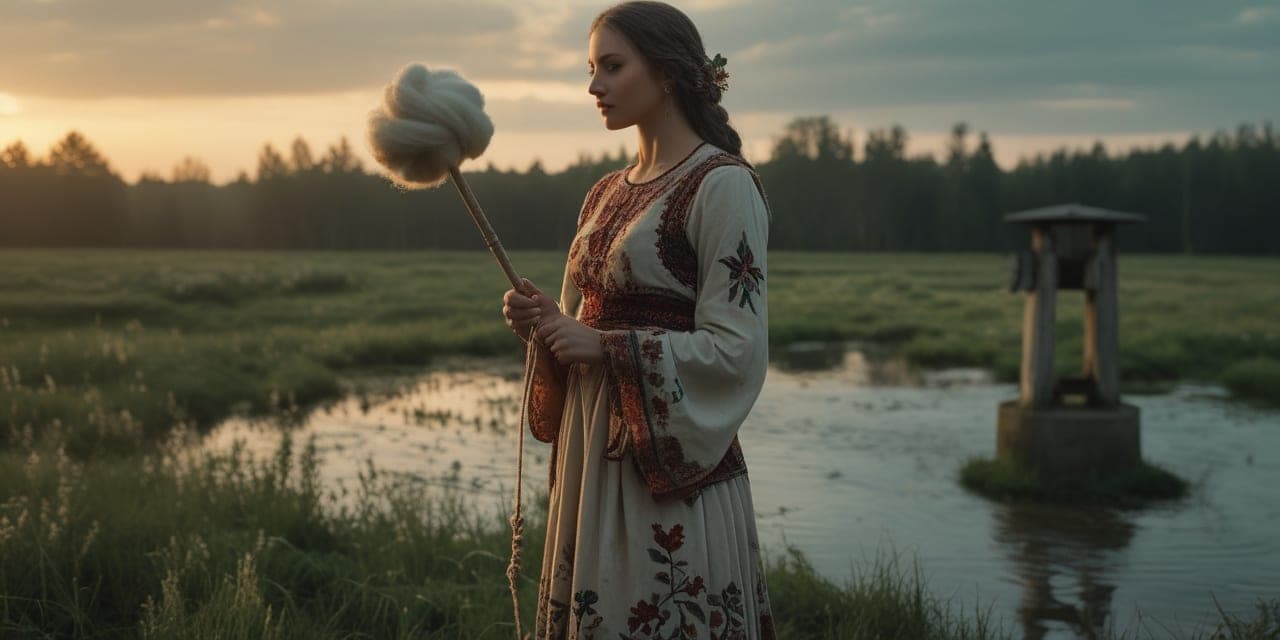
Mother of Damp Earth
Mokosh holds a unique place in the reconstructed Slavic pantheon: she's the only goddess named among the gods Prince Vladimir the Great installed on his hill above Kyiv in 980 CE, standing alongside Perun and Dazhbog in the Primary Chronicle's account — a rare, concrete piece of evidence for how seriously her worship was taken.
Her name most likely derives from a Proto-Slavic root meaning "wet" or "damp," pointing toward her core association with water and moist, fertile earth — sometimes given the epithet "Mat Zemlya," Mother Earth. From that base, her domain widens naturally into fertility, childbirth, and the everyday domestic work of Slavic women, particularly spinning and weaving wool.
Scholars have connected her to a broader Indo-European pattern of fate-and-fertility goddesses associated with thread and spinning — comparisons are sometimes drawn to the Irish goddess Macha and the Baltic goddess of fate, Laima — reflecting a widespread mythological link between women's textile work and the shaping of human destiny.
Surviving folk custom offers more continuity than any myth text does: taboos around spinning on her feast days, offerings left at wells and damp places, and household rituals honoring her as a domestic protector persisted in rural Slavic communities long after formal conversion to Christianity, sometimes folded into the veneration of Christian saints associated with similar domestic and agricultural concerns.
Common Questions
Why was Mokosh the only goddess in Vladimir's official pantheon?
The chronicles don't say directly, but her prominence likely reflects how central earth, fertility, and household protection were to everyday Slavic religious life, even within a pantheon otherwise dominated by gods tied to war and kingship.
What does Mokosh's name mean?
The most widely accepted explanation links it to a Proto-Slavic root for "wet" or "damp," tying her closely to water, moist earth, and fertility — though her exact etymology is still debated among linguists.

