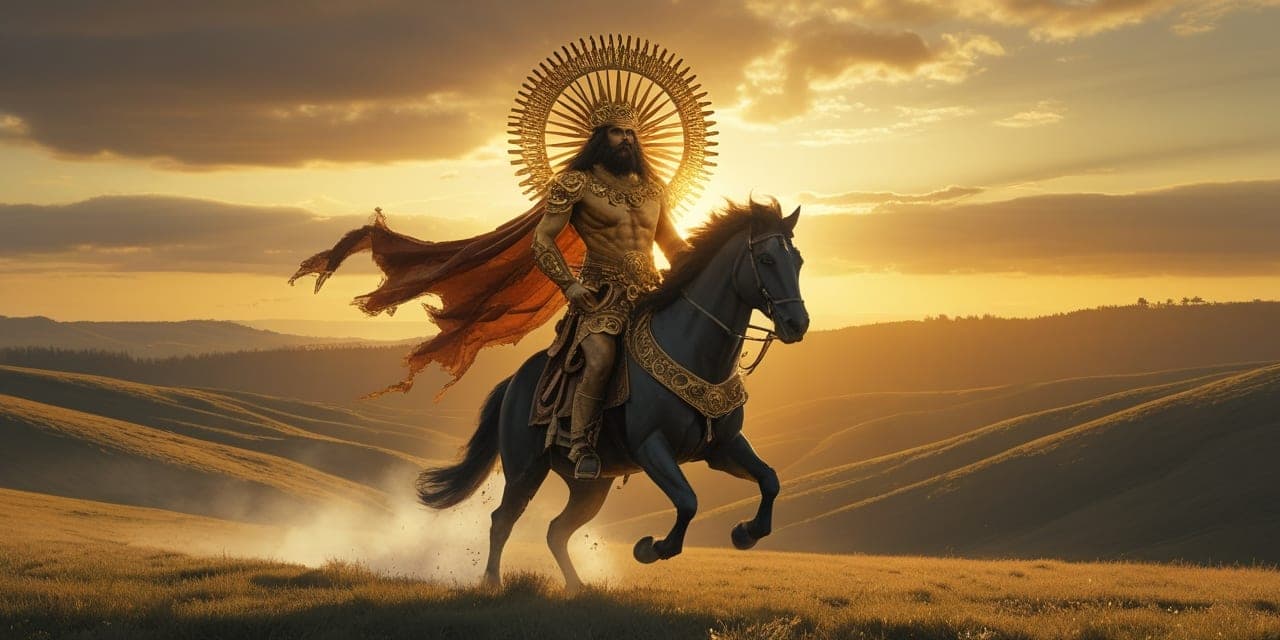
Giver of Sunlight and Fortune
Dazhbog is a solar deity among the gods Prince Vladimir the Great installed above Kyiv in 980 CE, listed in the Primary Chronicle alongside Perun and Mokosh. His name is often glossed as "giving god" — a fitting title for a deity linked as much to fortune and prosperity as to the physical light of the sun.
The clearest surviving textual link to Dazhbog outside the chronicles comes from the Tale of Igor's Campaign, a medieval epic poem, which refers to the Rus' people and their princes as "Dazhbog's grandchildren" — casting him not just as a nature deity but as a divine ancestor of the ruling dynasty and, by extension, the people themselves.
A separate source, the Hypatian Codex, describes Dazhbog as the "Sun tsar, son of Svarog" — tying him genealogically to Svarog, a smith-god associated with celestial fire, in a relationship scholars have compared to the Greek Hephaestus fathering a solar successor. Some researchers read this as evidence of two related fire deities: Dazhbog embodying fire in the sky as sunlight, and a counterpart, Svarozhich, embodying fire on earth as the hearth and forge.
Because so much rests on a handful of textual fragments rather than a connected mythology, Dazhbog's stories haven't survived the way, say, a Greek sun-god's would have — what remains is less a narrative arc and more a cluster of titles and associations: giver, ancestor, sun, and son of fire.
Common Questions
What does "Dazhbog's grandchildren" mean?
It's a phrase from the medieval epic The Tale of Igor's Campaign referring to the Rus' people and their princes, casting Dazhbog as a divine ancestor figure rather than only a nature deity.
Is Dazhbog the son of Svarog?
One source, the Hypatian Codex, calls him "Sun tsar, son of Svarog," and some scholars read this as part of a father-son pair of fire deities — sky fire and hearth fire — though the surviving evidence for the exact relationship is limited.

