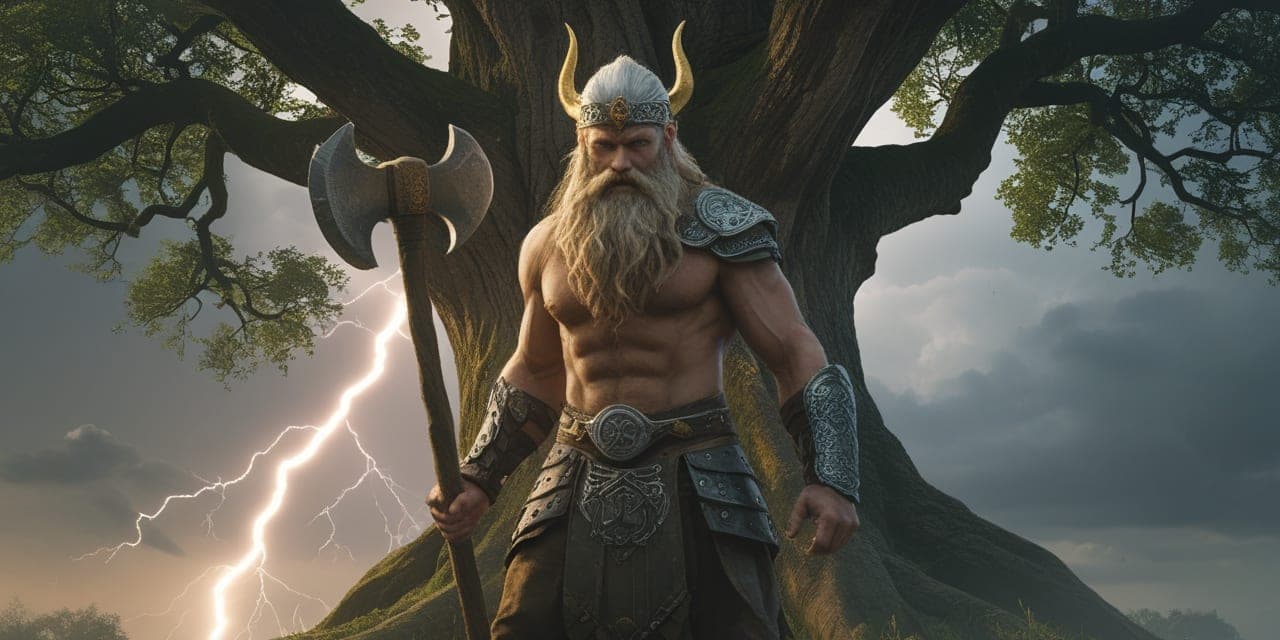
Lord of Thunder
Perun is the highest god of the reconstructed Slavic pantheon — ruler of sky, thunder, lightning, and storms, and patron of war, law, and the warrior class. The Byzantine historian Procopius, in the 6th century CE, recorded that the Slavs worshipped one god, "the maker of lightning," as lord of all - unnamed, but almost universally identified with Perun.
His clearest historical attestation comes centuries later: the Primary Chronicle records that Prince Vladimir the Great raised a wooden idol of Perun, with a silver head and golden mustache, on a hill above Kyiv in 980 CE — the most prominent of several official gods, before Vladimir tore it down himself just eight years later upon adopting Christianity.
Perun is strongly identified with the oak tree, his vegetative counterpart, and with the axe — both his weapon and a common protective amulet shape worn by his worshippers. Thunderclaps were popularly explained as stone arrows or axes he hurled from the sky at his enemies.
A recurring theme across later folklore and 19th–20th-century scholarly reconstruction pairs Perun against Veles, a chthonic rival associated with cattle, magic, and the underworld — a conflict some researchers read as a cosmic battle myth echoing similar sky-god-versus-serpent stories in other Indo-European mythologies, and others regard as a more modern theoretical construction than a directly attested ancient belief.
Common Questions
Was Perun the supreme Slavic god?
Among the gods the Primary Chronicle names, Perun was given the most prominent idol in Vladimir's 980 CE Kyiv pantheon, and most scholars treat him as the chief deity of the tribes that recognized that pantheon, though beliefs likely varied by region.
Did Perun fight Veles?
It's a popular theory built from later folklore and comparative mythology, but not something directly recorded in the surviving medieval sources — modern scholars are divided on how literally to take it.

