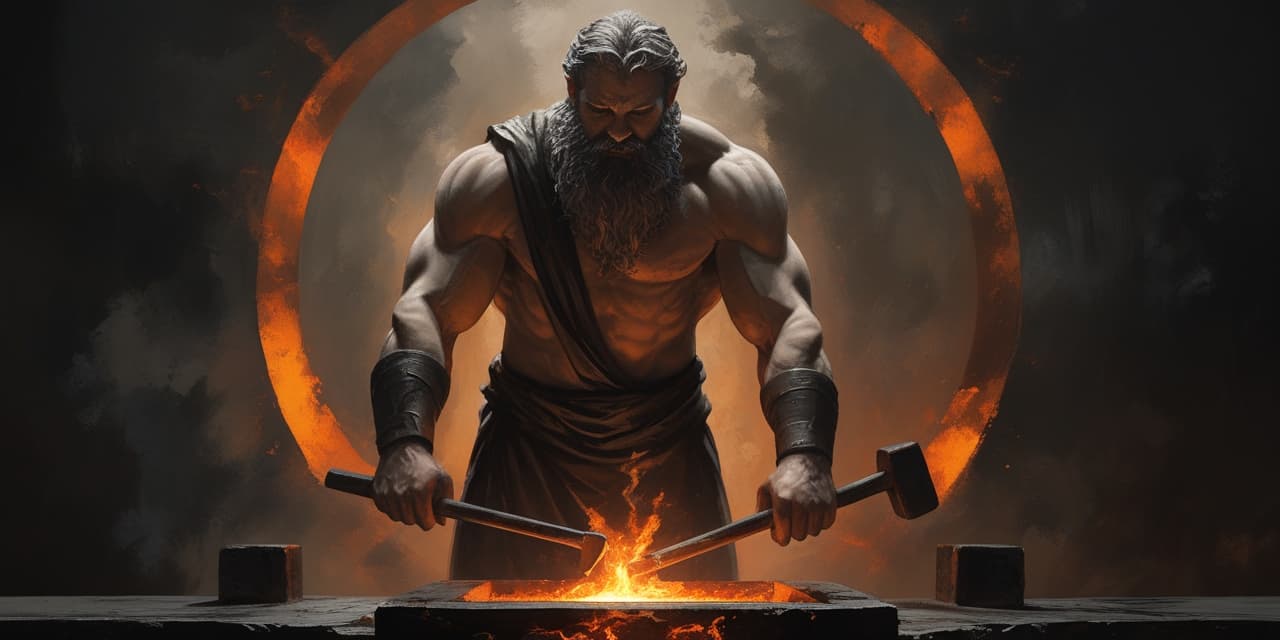
The Smith of the Gods
Hephaestus is the divine craftsman of Olympus — god of fire, metalworking, and the forge. He fashioned the thunderbolts of Zeus, the armor of Achilles, the chains that bound Prometheus, and the gleaming palaces of the gods. Where other Olympians command through beauty or power, Hephaestus rules through skill and labor.
His name is of uncertain, likely pre-Greek origin, and his cult was closely tied to volcanic islands such as Lemnos, where the smoking earth was imagined as his underground forge. To the Romans he was Vulcan, source of the very word "volcano."
Born to Hera — in some tellings without a father — he was cast from Olympus and left lame, the only Olympian marked by imperfection. He won return through cunning: he trapped Hera in a magical throne and freed her only after gaining a place among the gods, and the hand of Aphrodite in marriage.
Power through craft and patience. Lame, mocked, yet indispensable — the maker every god depends on.
Power through beauty and desire. His unfaithful wife, famously caught with Ares in his own golden net.
Famous Creations
- Pandora — the first mortal woman, molded from clay at Zeus's command
- Achilles's armor — forged at the request of the sea-nymph Thetis, including his famed shield
- Zeus's thunderbolts and aegis — the king of the gods's signature weapons
- Talos — a giant bronze automaton built to guard the island of Crete
- Golden handmaidens — living, speaking attendants who assisted him in his forge
- Hermes's winged sandals — crafted for the messenger god's swift travel
Hephaestus's forge was imagined beneath volcanic islands such as Lemnos — where he was said to have landed after his fall from Olympus — and later, Mount Etna in Sicily, where tradition placed him working alongside the Cyclopes. Athens honored him with the Hephaesteion, a well-preserved Doric temple overlooking the ancient marketplace that still stands today, according to records of the temple. As one of the twelve Olympians and half-brother to Ares, Hephaestus proved that Olympus valued skill as much as strength.
Common Questions
Why is Hephaestus lame?
Accounts vary: some say Hera threw him from Olympus in disgust at his deformity, others that Zeus hurled him down for defending Hera, and he was crippled by the fall. The lameness sets him apart as the one flawed Olympian.
Who was the wife of Hephaestus?
In the Iliad he is married to Aphrodite, goddess of love, whose affair with Ares he exposed by trapping the lovers in an unbreakable net. Other traditions name Aglaea, one of the Graces, as his wife.
What are Hephaestus's most famous creations?
He forged Zeus's thunderbolts, Achilles's shield and armor, the bronze giant Talos that guarded Crete, and Pandora, the first mortal woman. He also built living golden handmaidens to assist him in his forge and crafted wonders for many other gods, including Hermes's winged sandals.

