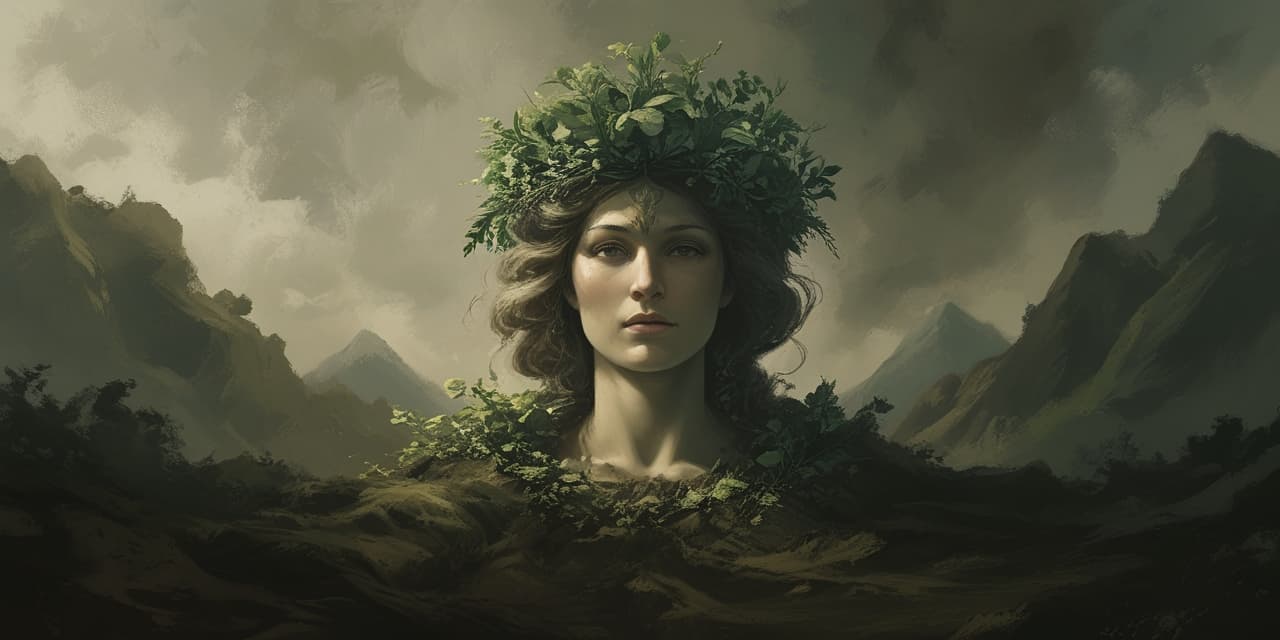
The Mother of Everything
Gaia is the primordial Earth — the great mother from whom nearly the entire Greek cosmos descends. Emerging soon after Chaos, she gave birth to Uranus (the sky), the mountains and the sea, then bore with Uranus the twelve Titans, the Cyclopes and the Hecatoncheires.
Her name, Gaia (or Ge), simply means "earth" — the root that survives in modern words like geography and geology. She is the ground itself made divine, stable and generative beneath every later god.
The Power Behind the Throne
Gaia repeatedly drives the great turnovers of power. Angered when Uranus imprisoned her children, she armed Cronus to overthrow him; later her prophecies helped Zeus understand how to keep his own throne. She is less a ruler than the deep force of nature that outlasts every regime.
Children of the Earth
- Uranus — the Sky, born from her alone, later her consort
- Pontus — the Sea, also born from her without a father
- Ourea — the Mountains, her own offspring
- The twelve Titans — including Cronus, Rhea, Oceanus, and Hyperion, born of her union with Uranus
- The Cyclopes and Hecatoncheires — giant one-eyed and hundred-handed sons, imprisoned by Uranus and later freed to aid Zeus
- Typhon — a monstrous final son, born with Tartarus to challenge Zeus's rule
According to Hesiod's Theogony, Gaia emerged directly after Chaos at the very beginning of the cosmos and bore Uranus, Pontus, and the mountains without a partner, before uniting with Uranus to produce the Titans and the monstrous Cyclopes and Hecatoncheires. When Uranus imprisoned these children in Tartarus out of fear and disgust, Gaia forged a great sickle and persuaded Cronus to use it against his father — the first act of rebellion in Greek myth, and the template for the later overthrow of Cronus by Zeus and the Olympians.
The Earth itself — generative, ancient, and constant across every divine generation.
The sky above her — her son and consort, father of the Titans, overthrown by Cronus.
Common Questions
Is Gaia the same as "Mother Earth"?
Essentially, yes. Gaia is the Greek personification of the Earth as a living, divine mother, and the name is now used in science and ecology (the "Gaia hypothesis") to describe Earth as a self-regulating system.
Did Gaia support Zeus or oppose him?
Both, at different times. Gaia helped end the tyranny of Uranus by arming Cronus, and her counsel later helped Zeus outmaneuver his own father, Cronus. But when she felt Zeus had wronged her imprisoned children, the Giants and the Titans, she is said to have borne the monster Typhon specifically to challenge his rule — a threat Zeus barely defeated.
What is the difference between Gaia and the Titans?
Gaia is the primordial Earth herself, one of the first beings to emerge from Chaos at the dawn of the cosmos. The Titans are the second generation of gods, her children by Uranus, who ruled the universe before being overthrown by Zeus and the Olympians. Gaia is their mother and outlasts them all.

