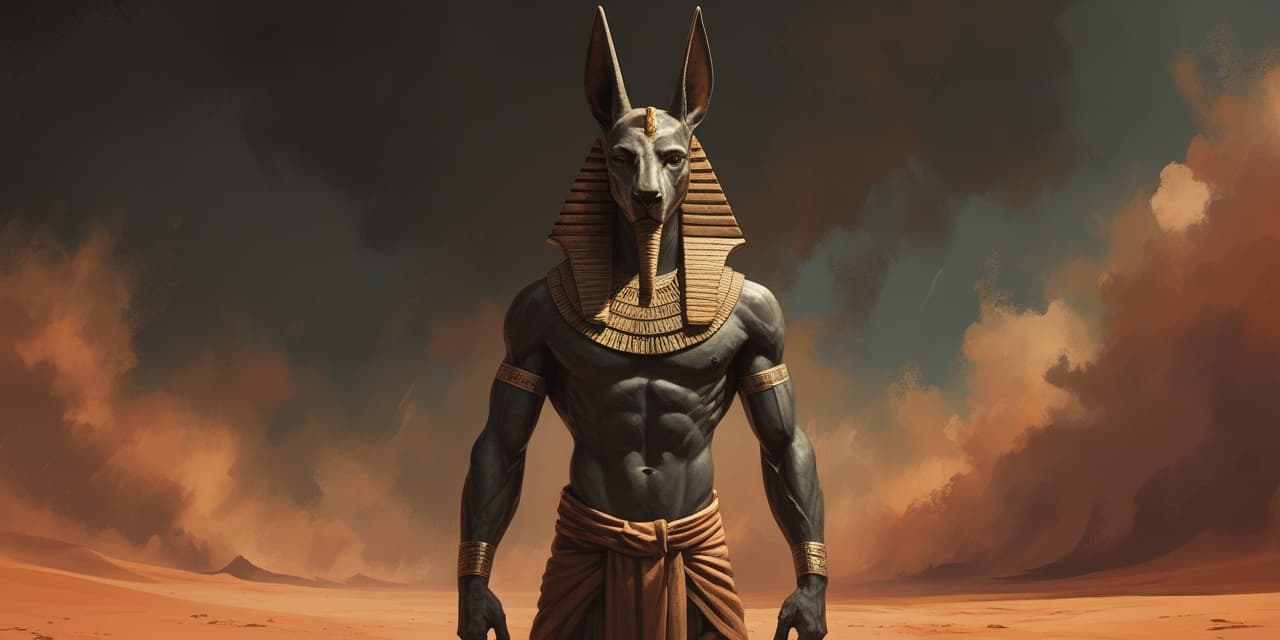
Lord of the Red Land
Set is the Egyptian god of chaos, storms, and the barren desert that the Egyptians called the "red land," opposed to the fertile black soil of the Nile. Son of Geb and Nut, he is depicted with the strange "Set animal" — a creature with a curved snout and square ears that matches no known species.
His name, Sutekh in older forms, is linked to ideas of instigation and disturbance. Set was not purely evil; as a fierce warrior he stood at the prow of Ra's barque each night, spearing the chaos serpent Apophis and defending the sun.
The Murderer of Osiris
Set's defining myth is his betrayal of his brother Osiris, whom he murdered out of jealousy and later dismembered, scattering the pieces across Egypt. This act set in motion the central drama of Egyptian religion, as Isis restored her husband and raised an avenger.
Set then waged a long contest against his nephew Horus for the throne of Egypt. Their struggle symbolized the eternal tension between order and chaos, with Horus ultimately winning kingship while Set was assigned to guard the harsh deserts and foreign lands.
Set was not always Egypt's villain. During the Second Intermediate Period the Hyksos rulers of the Delta adopted him as their patron, and later Ramesside pharaohs took throne names honoring him outright — Seti I ("Man of Set") and Setnakht chief among them — treating Set as a legitimate god of royal power rather than an enemy. His principal cult center was Nubt, or Ombos, in Upper Egypt. Only in the Late Period, as Egypt suffered repeated invasions from the deserts and foreign lands Set represented, did his image fall from favor; priests began erasing his figure from temple walls and equated him with the Greek monster Typhon, details recorded in Wikipedia's overview of Set.
His union with Nephthys, in the account preserved by Plutarch, produced Anubis — conceived when Nephthys disguised herself as Isis, a secret Set discovered and one modern scholars read as an early trigger for his jealousy of Osiris's household.
Cult, Symbols & Legacy
- Was scepter — a staff topped with the Set animal's head, a symbol of power and dominion carried by gods and kings alike
- Nubt (Ombos) — his principal cult center in Upper Egypt
- Two Lords — paired with Horus in royal coronation rites symbolizing the union of Upper and Lower Egypt
- Setnakht & the Ramesside kings — pharaohs who took throne names honoring Set as a legitimate patron
- Later vilification — during the Late Period his cult declined and he was increasingly equated with the Greek monster Typhon
Set's rivalry with Osiris and Horus makes him indispensable to the Ennead's central drama, and to Egyptian mythology's larger idea that order only means something once chaos has been named and contained.
Guards Ra's solar barque, slaying the chaos serpent each night.
Murders Osiris and battles Horus, embodying disorder and the desert's threat.
Common Questions
Was Set considered evil?
Not entirely. Though he murdered Osiris, he also protected Ra from chaos each night, making him an ambivalent force of necessary violence.
What is the Set animal?
It is the unidentified creature used to depict Set, with a curved snout and tall square ears, resembling no real animal scholars can confirm.
Why was Set later seen as evil?
As Egypt suffered invasions from peoples linked to the deserts and foreign lands he represented, his cult fell out of favor in the Late Period, and priests recast him as an enemy god, equating him with the Greek monster Typhon.

