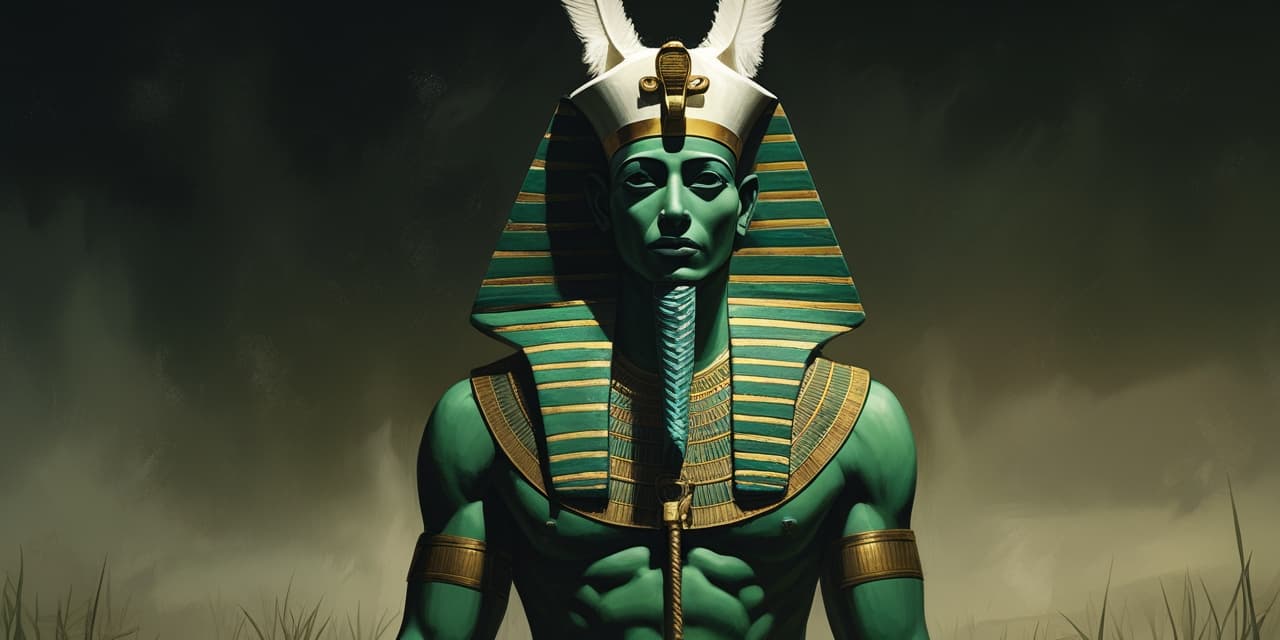
The Murdered King
Osiris was Egypt's first divine king, a wise ruler who taught his people farming and law. Son of the earth god Geb and sky goddess Nut, he married his sister Isis, but his jealous brother Set tricked him into a coffin, sealed it, and cast it into the Nile.
The Greek form Osiris renders the Egyptian Wsir, whose meaning is debated but often linked to ideas of "the mighty one" or "place of the eye." His green skin marked him as a god of vegetation and the renewing flood.
Lord of the Afterlife
Isis recovered and revived him long enough to conceive their son, the falcon god Horus. Though Set later dismembered his body, Osiris was restored through mummification and became ruler of the Duat, the realm of the dead. There he presided over the weighing of each soul's heart against the feather of truth, assisted by Anubis, who performed the embalming that made Osiris's own resurrection — and every Egyptian's hope of one — possible.
Because he died and rose again, Osiris promised every Egyptian the hope of eternal life. His crook and flail became the emblems of pharaonic rule, carried by living kings and clutched in royal tombs.
Egyptians re-enacted Osiris's death and rebirth every year during the Khoiak festival at Abydos, his principal cult center, where priests molded "Osiris beds" — trough-shaped effigies of the god packed with Nile mud and barley seed. Watered in the temple's dark chambers, the grain sprouted into a green figure of Osiris himself, a literal demonstration of the fertility his myth promised, as described in accounts of the Khoiak festival.
Osiris also inherited the older title Khentyamentiu, "Foremost of the Westerners," from Anubis once his own cult eclipsed the earlier necropolis god's, cementing his place as ruler of the dead in the west where the sun set each night.
Titles & Symbols
- Khentyamentiu — "Foremost of the Westerners," lord of the necropolis and the dead
- Wennefer — "the one who continues to be perfect," celebrating his triumph over death
- Djed pillar — his stylized backbone, a symbol of stability ritually "raised" at festivals
- Crook and flail — the shepherd's crook and threshing flail marking royal and divine authority
- Atef crown — the tall white crown flanked by ostrich feathers, unique to Osiris
As the central figure of the Ennead, Osiris's death and resurrection are the hinge on which the rest of Egyptian mythology's afterlife beliefs turn.
The first king of Egypt, teacher of agriculture and civilization.
Judge and ruler of the Duat, granting the dead a chance at eternity.
Common Questions
Why is Osiris shown with green skin?
Green symbolized vegetation, fertility, and rebirth, linking him to the annual flooding of the Nile and the growth it brought.
How did Osiris become king of the dead?
After Set murdered him, Isis restored him through the first mummification, allowing him to rule the underworld and judge the souls of the deceased.
What is the djed pillar?
A stylized image of Osiris's backbone symbolizing stability and endurance; pharaohs ritually "raised" a djed pillar in festivals to celebrate his resurrection and the continuity of their own reign.

