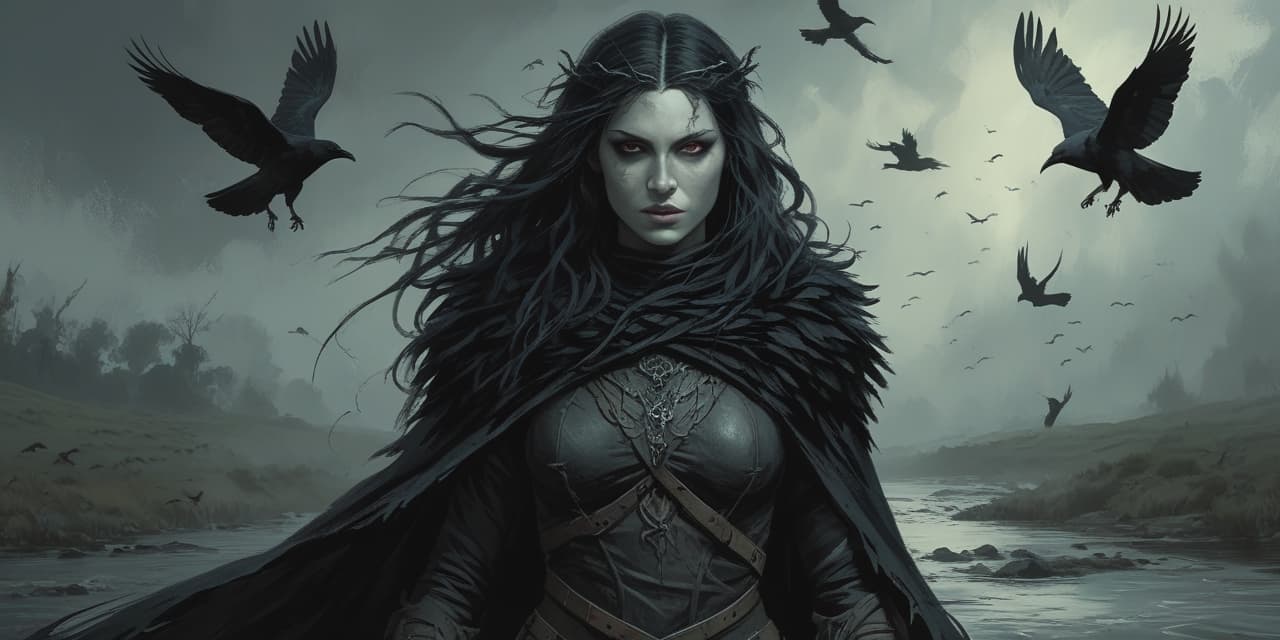
The Phantom Queen
The Morrigan is the dread goddess of war, fate, and death among the Tuatha Dé Danann. Her name is read as "Phantom Queen" or "Great Queen," and she haunts battlefields in the form of a crow or raven, deciding who lives and who falls.
She is often a triple goddess, appearing alongside Badb and Macha, and her power lies in shaping destiny rather than fighting directly. To see her washing bloodied armor at a river ford was an omen of approaching death — an image preserved in the later Irish washerwoman of folklore.
On Samhain she famously couples with the Dagda, pledging her aid against the Fomorians and promising to break their champion in battle. In the great epic the Táin, she torments the hero Cú Chulainn after he spurns her, proving that her favor is as fatal to lose as it is to gain.
The Táin Bó Cúailnge gives that rivalry its fullest form: the Morrigan appears to Cú Chulainn as a beautiful young woman and offers her love and aid in his battles; when he fails to recognize her and refuses, she vows revenge and attacks him during his single combats in the forms of an eel, a wolf, and a red heifer, each of which he wounds in turn. She later returns disguised as an old woman milking a cow, and when the unknowing hero blesses her in thanks for a drink of milk, her wounds close at once — a scene that shows her power resting as much on ritual, word, and disguise as on open warfare.
After the Tuatha Dé Danann's victory at the second battle of Mag Tuired, Cath Maige Tuired has the Morrigan proclaim the battle's outcome to the mountains, rivers, and assemblies of Ireland, and the text preserves a darker coda in which she also foretells a future age of moral collapse and cosmic ruin — casting her less as a simple war-goddess than as a voice of fate itself, fitting her place beside Lugh and Nuada among the decisive figures of the Tuatha Dé Danann's wars.
A goddess of war who shapes fate rather than wielding a blade.
She circles battlefields as a raven, marking the doomed.
Often joined by Badb and Macha as a trio of war.
Key Myths & Forms
- The Washer at the Ford — appears washing bloodied armor or clothing, an omen of death to come
- The Triple Goddess — often grouped with Badb and Macha as a trio presiding over war
- Battle with Cú Chulainn — attacks him in animal forms after he spurns her, then is healed by his unknowing blessing
- The Union with the Dagda — pledges her aid against the Fomorians after meeting him at the River Unshin on Samhain
- The Prophecy of Mag Tuired — her poem after the second battle proclaims victory and foretells a future age of ruin
- The Crow Form — takes the shape of a raven or crow to hover over battlefields and mark the doomed
Common Questions
What does the name "Morrigan" mean?
It is usually translated as "Phantom Queen" or "Great Queen," reflecting her role over fate and death.
Why is the Morrigan associated with crows?
She takes the shape of a crow or raven to hover over battlefields and foretell or claim the deaths of warriors.
How does the Morrigan appear in the Táin Bó Cúailnge?
She offers herself to the hero Cú Chulainn, and when he refuses her, she attacks him in the shape of an eel, a wolf, and a red heifer during his battles — before he unknowingly heals her wounds by blessing her in an old woman's disguise.

