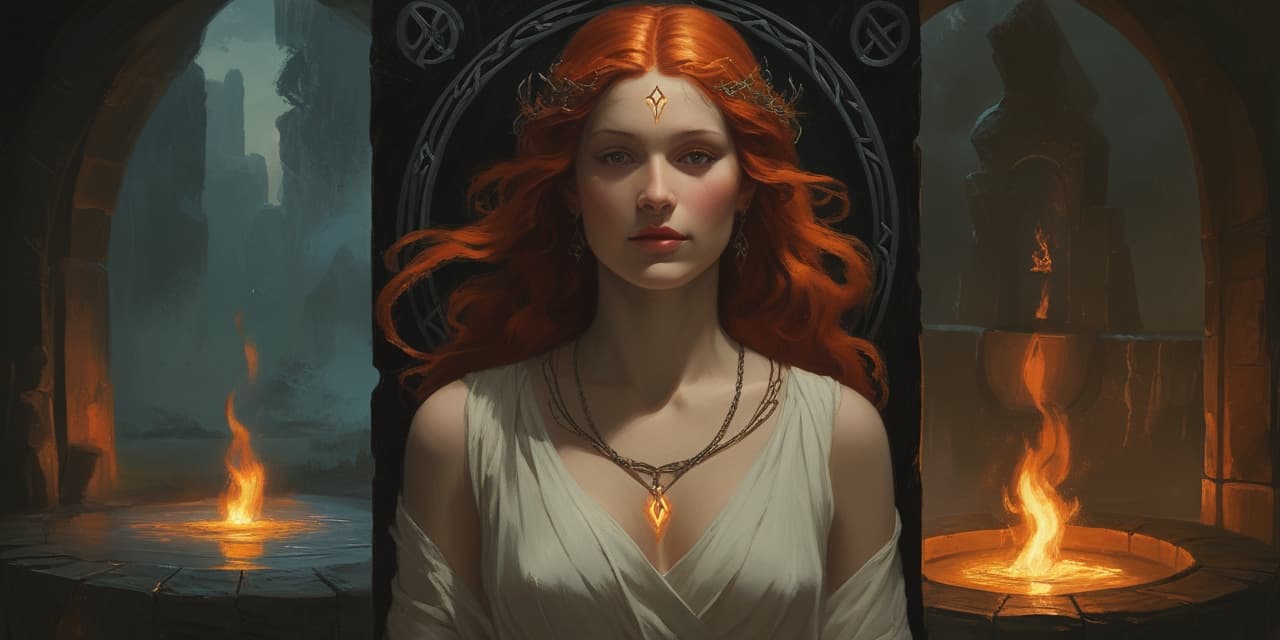
Goddess of the Threefold Fire
Brigid is a luminous goddess of the Tuatha Dé Danann and a daughter of the Dagda. She presides over three great fires: the fire of inspiration in poetry, the fire of the hearth and healing, and the fire of the forge in smithcraft.
Her name derives from a Proto-Celtic word meaning "the exalted one" or "the high one," fitting a goddess who watches over poets, healers, and smiths alike. Some texts describe her as three sisters all named Brigid, a triple goddess overseeing these intertwined arts.
Brigid is also credited with inventing keening, the mournful lament, after the death of her son Ruadán in battle. So beloved was she that her worship flowed seamlessly into Christianity as Saint Brigid of Kildare, whose feast on February 1 echoes the old fire festival of Imbolc.
According to medieval tradition, nineteen priestesses tended Brigid's sacred flame at Kildare in perpetual rotation, and the fire was said never to have been allowed to go out — a taboo so strict that, per some accounts, no man was permitted near it. The flame passed into Christian keeping as the sanctuary fire of Saint Brigid's monastery, was extinguished during the Reformation, and was controversially relit in 1993 by the Brigidine Sisters, where it still burns in Kildare today.
As one of the daughters of the Dagda within the Tuatha Dé Danann, Brigid also appears in the Cath Maige Tuired as the wife of Bres, the half-Fomorian king whose tyrannical rule provoked her own people's revolt — a marriage that briefly bridged the war between the Tuatha Dé Danann and the Fomorians before it collapsed into open conflict.
Symbols & Associations
- Perpetual flame — tended by priestesses at Kildare and said never to have been allowed to go out
- Brigid's cross — a cross woven from rushes each February 1 and hung over doorways for protection
- Sacred wells — holy wells across Ireland, especially at Kildare, long credited with healing powers
- Imbolc — her festival on February 1, marking the start of spring and the lambing season
- Rushes and reeds — gathered from the fields to weave crosses and dolls in her honor
- The forge — smiths invoked her patronage over metalwork alongside poets and healers
Common Questions
What is Brigid the goddess of?
She rules over poetry and inspiration, healing, and smithcraft — often described as a goddess of three sacred fires.
Is the goddess Brigid linked to Saint Brigid?
Yes — many of the goddess's attributes and her festival of Imbolc were absorbed into the veneration of Saint Brigid of Kildare.
What is a Brigid's cross?
A cross woven from rushes or reeds on Imbolc and hung in homes and barns for protection — a folk custom that blends the goddess's ancient fire symbolism with the later saint's feast day.

