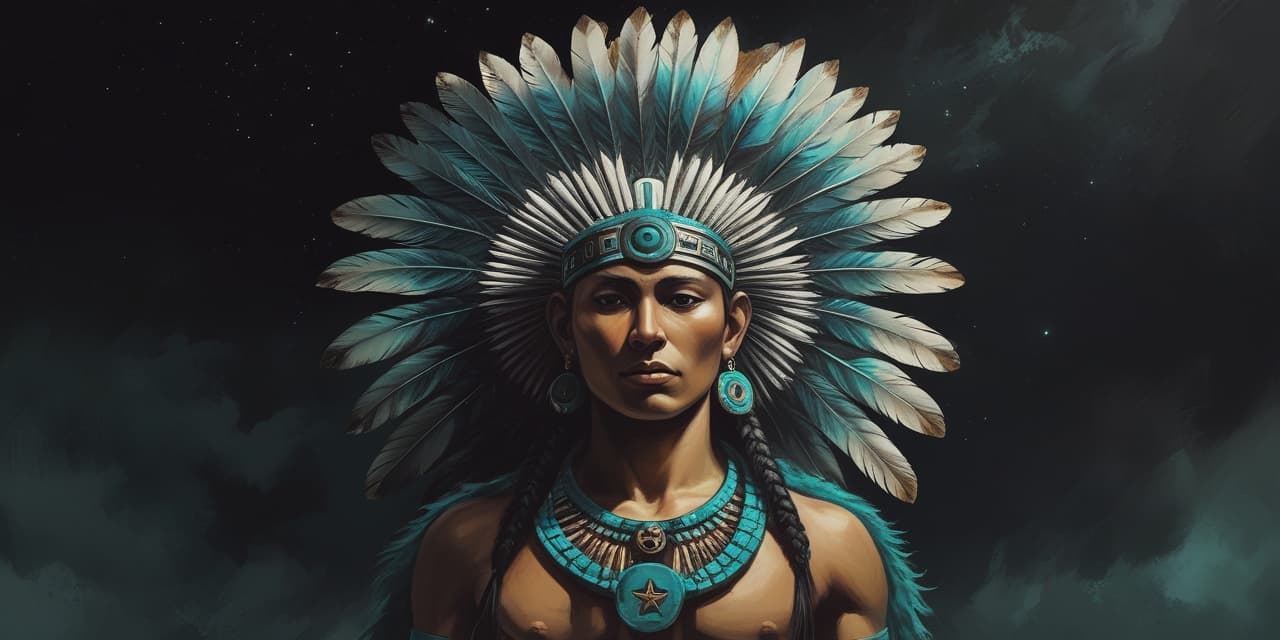
The Lord and Lady of Duality
Ometeotl is the primordial creative principle of Aztec cosmology, a single divinity embodying both male and female aspects. Often split into the pair Ometecuhtli ("Lord of Duality") and Omecihuatl ("Lady of Duality"), this god dwells in Omeyocan, the highest, thirteenth heaven. From this self-generated source all other gods and the structure of the cosmos flow.
The name comes from Nahuatl ome, "two," and teotl, "god" or "sacred energy" — literally "Two-God." The doubling expresses the Aztec idea that all things hold complementary opposites: order and chaos, day and night, fire and water. Ometeotl is less a worshipped, story-telling deity than a remote first cause.
From Ometeotl came four sons who divide creation among the cardinal directions, including the rivals Quetzalcoatl and Tezcatlipoca. These children set in motion the cycle of suns and the building of the world.
Scholars debate how central Ometeotl actually was to everyday Mexica religion. The concept is documented mainly in the work of Bernardino de Sahagún and in the writings of later scholars such as Miguel León-Portilla, who argued that Ometeotl represented a sophisticated, almost philosophical monism underlying the more visible, ritual-heavy worship of gods like Huitzilopochtli and Tlaloc. Other researchers read the sources more cautiously, noting that Ometeotl rarely appears as an object of direct cult or temple worship the way the more active gods of the Aztec Pantheon do — see the overview of Ometeotl for a summary of this debate.
In codex imagery, the dual aspects Ometecuhtli and Omecihuatl are sometimes shown as an elderly couple, reflecting their role as the ultimate ancestral pair from whom all life and all other gods descend. Their home, Omeyocan, sits above the layered heavens of sun, moon, and stars — a realm reserved in some accounts for the souls of infants who died before they could sin, who were thought to return there to await rebirth.
Aspects & Names
- Ometecuhtli, "Lord of Duality": the male aspect of the dual creator.
- Omecihuatl, "Lady of Duality": the female aspect, sometimes called Tonacacihuatl.
- Tonacatecuhtli / Tonacacihuatl: alternate names meaning "Lord/Lady of Our Sustenance," tying the pair to fertility and food.
- Omeyocan, "Place of Duality": the thirteenth and highest heaven where the pair resides.
- Source of the four Tezcatlipocas: in some accounts, Ometeotl's four sons — including Quetzalcoatl and Tezcatlipoca — are each associated with a cardinal direction and a color.
Common Questions
Is Ometeotl one god or two?
Both. Ometeotl is a single dual deity often described as the pairing of Ometecuhtli and Omecihuatl, expressing the union of male and female principles.
What does the name Ometeotl mean?
It joins Nahuatl ome ("two") and teotl ("god" or "sacred force"), meaning "Two-God" or "Dual God."
Was Ometeotl actively worshipped like other Aztec gods?
Not in the same way. Unlike temple-cult gods such as Huitzilopochtli, Ometeotl appears mainly as a philosophical first cause in priestly and scholarly sources, with little evidence of dedicated shrines or festivals in its honor.

