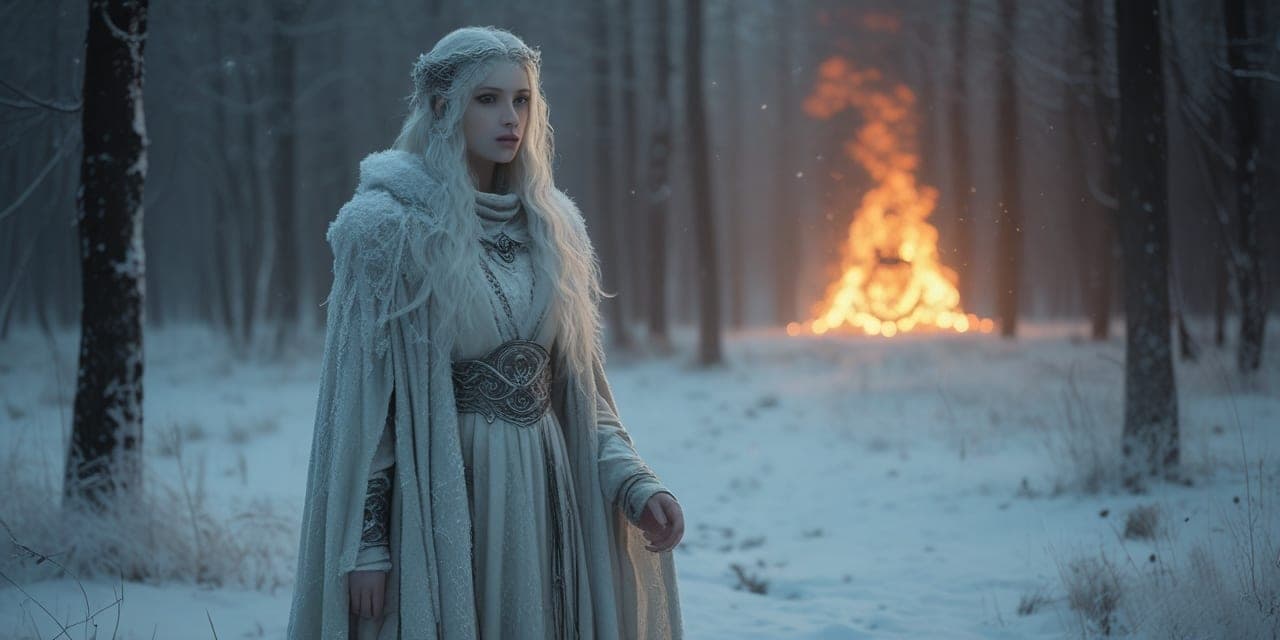
Winter's End
Morana — known as Marzanna in Polish — is a goddess of winter, death, and frost whose name shares a Proto-Indo-European root meaning "death," the same root behind words like "nightmare" (mora) across several European languages. Medieval Christian writers reaching for a familiar comparison likened her to the Greek Hecate for her associations with sorcery, while the 15th-century Polish chronicler Jan Długosz compared her instead to the Roman harvest goddess Ceres.
Unlike most figures in this section, Morana is known less through mythological narrative than through a ritual that is still actively performed today. In the custom known in Polish as topienie Marzanny — "the drowning of Marzanna" — communities build an effigy of the goddess from straw and cloth, carry it in procession through the village, and then burn it, drown it in a river, or both, formally enacting winter's defeat.
Historically tied to the fourth Sunday of Lent, the ritual is now commonly performed around the spring equinox on March 21st, and remains especially strong in the Czech Republic, Poland, Lithuania, and Slovakia — particularly in the Silesia region — where schools still regularly stage it as an educational folk activity rather than a half-remembered curiosity.
In the wider seasonal cycle this ritual expresses, Morana's symbolic "death" clears the way for spring, sometimes personified by a rival goddess of renewal, Vesna or Kostroma, arriving to take her place — a rebirth narrative echoed structurally by the springtime festivals associated with Jarilo, even though ancient sources don't spell out a direct relationship between the two figures.
Common Questions
Is the Marzanna-drowning ritual still practiced today?
Yes — it remains an active folk tradition in the Czech Republic, Poland, Lithuania, and Slovakia, especially strong in Silesia, and is regularly performed as an educational activity in schools.
Why is Morana's effigy destroyed every spring?
The ritual burning or drowning symbolically enacts the end of winter and death, clearing the way for spring's rebirth — a seasonal renewal theme that shows up across many European folk traditions.

