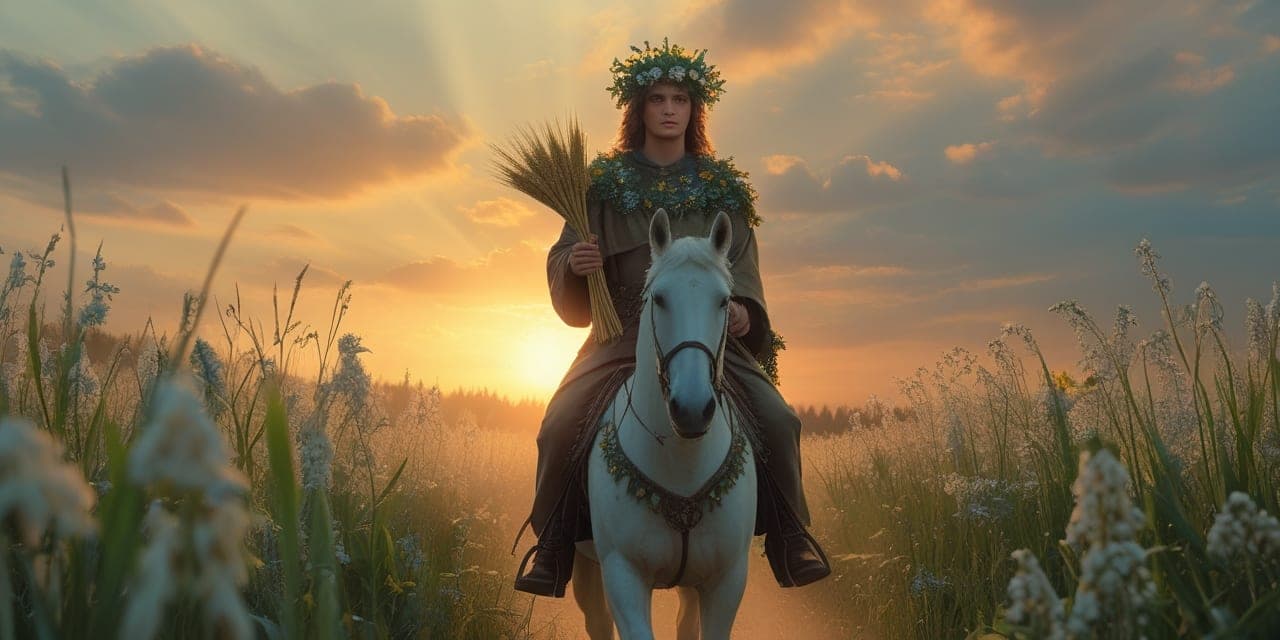
Spring's Vigor
Jarilo is a god of vegetation, fertility, and the surge of new life that arrives with spring, his name rooted in the Proto-Slavic word jarъ — carrying the sense of "spring," "vigor," and "furious youthful energy" all at once. Unlike the gods named in the Kyiv chronicles, Jarilo is known almost entirely through folk custom and comparative reconstruction rather than any medieval historical record naming him directly.
The strongest direct historical evidence comes from a 12th-century biography of the Christian missionary Bishop Otto of Bamberg, which records festivals honoring a war-god named Gerovit — likely a regional relative of Jarilo — among the Wendish and Polabian Slavs of the southern Baltic coast, suggesting the figure once carried martial associations alongside his fertility role.
Far more of what's known about Jarilo comes from folk festivals that persisted into the 19th century across Ukraine, Russia, Belarus, and Serbia, celebrated in late spring or early summer with processions, songs, and rituals marking the peak of the growing season. Parallel spring celebrations survive in Croatia and Slovenia as Jurjevo or "Green George," later folded into the feast day of Saint George after Christianization.
Some modern scholars have proposed that Jarilo forms a symbolic pair with the winter goddess Morana in the seasonal cycle their respective festivals mark — his springtime arrival balanced against her ritual destruction — though this specific relationship is a scholarly reconstruction rather than something stated outright in any surviving ancient source, and the two are more safely described as parallel calendar figures than as a confirmed mythological pair.
Common Questions
Is Jarilo a well-documented god?
Less than most figures on this site — he isn't named in the Kyiv chronicles and is known mainly through a single medieval reference to a related war-god, Gerovit, plus centuries of folk festival tradition rather than direct mythological narrative.
Is Jarilo related to Morana?
Some scholars have proposed a symbolic seasonal pairing between them, but this is a modern reconstruction rather than a relationship directly attested in surviving ancient sources.

