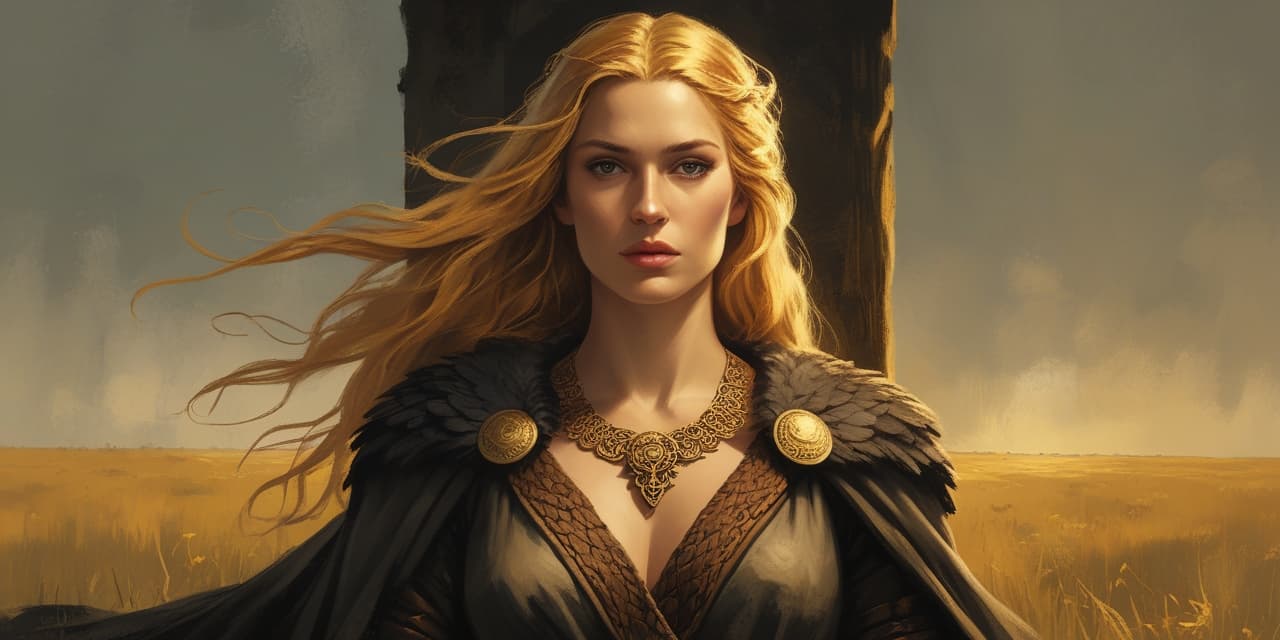
Lady of the Vanir
Freya is the most celebrated of the Norse goddesses, a member of the Vanir who came to dwell among the Aesir after the war between the two divine families. She presides over love, beauty, fertility, and gold, but also over war and death — for half of those who die in battle go to her hall Fólkvangr, while the rest go to Odin's Valhalla.
Her name means simply "the Lady," from Proto-Germanic frawjǭ, the feminine of "lord." It is a title as much as a name, and its echoes are sometimes tangled with those of Frigg, the Aesir queen.
Freya is the foremost practitioner of seidr, a form of Norse magic concerned with fate and prophecy, which she is said to have taught to the gods themselves. She rides a chariot drawn by two great cats and owns the falcon-feather cloak that lets its wearer fly. Her most prized treasure is the radiant necklace Brísingamen, won from four dwarves.
When her husband Óðr wanders far away, Freya weeps tears of red gold in her search for him — a grief that made her a goddess of longing as well as desire.
Freya's most famous treasure, the necklace Brísingamen, was forged by four dwarves; to win it she is said to have spent a night with each of them. When Loki later steals it while she sleeps, the watchman Heimdall wrestles him — both transformed into seals — to win it back, an episode preserved in a short tale sometimes appended to the Prose Edda.
In the poem Þrymskvida, the giant Thrym steals Thor's hammer Mjolnir and demands Freya as his bride in exchange for its return. Freya furiously refuses, so the gods disguise Thor himself as the bride, veiled and wearing Brísingamen, to infiltrate the giant's hall and reclaim the hammer — one of Norse myth's most comic episodes.
Names & Epithets
- Vanadís — "Dís of the Vanir," marking her as the foremost goddess of that divine family.
- Gefn — "the giver," an epithet tied to fertility and generosity.
- Mardöll — "sea-brightener," possibly linking her to light on the ocean.
- Hörn — a byname of uncertain meaning listed among her many names in the Prose Edda.
- Sýr — "sow," an animal epithet connected to fertility symbolism.
- Menglöð — "necklace-glad," a name evoking her treasured Brísingamen.
Common Questions
Why is Freya among the Aesir if she is Vanir?
After the Aesir–Vanir war ended in truce, several Vanir including Freya and her brother Freyr came to live in Asgard as hostages and honored members of the gods.
What is seidr?
Seidr is a form of Norse sorcery dealing with fate, prophecy, and shaping the future. Freya is its great mistress and is credited with teaching it to the Aesir.
How did Freya get her necklace Brísingamen?
According to later sources, four dwarves forged the necklace, and Freya paid for it by spending a night with each of them — making it both her most treasured possession and a symbol of the moral complexity in her myths.

