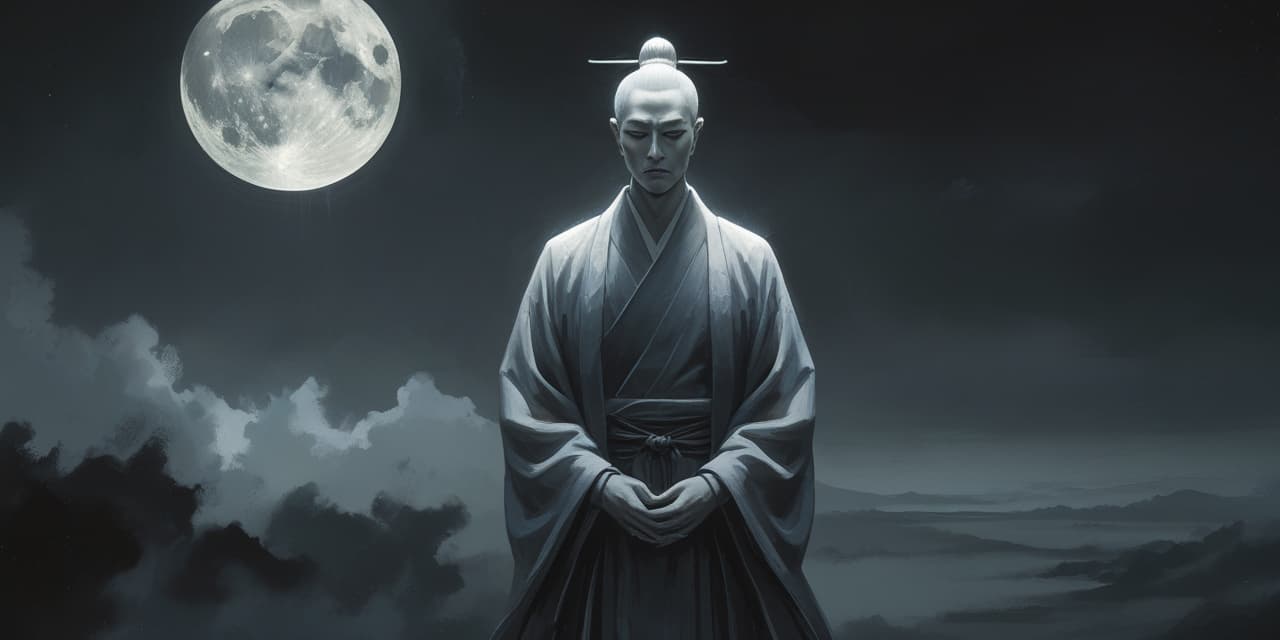
The God of the Moon
Tsukuyomi is the Shinto deity of the moon, second of the three "noble children" born from Izanagi — emerging from his right eye as he purified himself after fleeing the underworld. Izanagi set him to rule the realms of night.
His name combines tsuku (an old form of tsuki, "moon") with yomi, often read as "to read" or "counting" — hence "moon-counter," a fitting title for a kami who marks the passage of nights and months.
Tsukuyomi appears rarely in the myths, but one episode is decisive. Sent by his sister Amaterasu to meet the food goddess Uke Mochi, he was so disgusted to see her produce food from her mouth and body that he killed her. Enraged by this violence, Amaterasu refused ever to look upon him again.
This rupture is the mythic explanation for why the sun and moon occupy the sky at separate times — day and night forever divided between the estranged siblings.
According to the Nihon Shoki, Uke Mochi produced her feast by facing different directions and disgorging food from her body: rice from her mouth when she faced the land, fish when she faced the sea, and game when she faced the mountains. After Tsukuyomi killed her in outrage, crops sprouted from her corpse — rice from her eyes, millet from her ears, beans from her nose, wheat from her genitals, and silkworms from her brow — which the gods gathered and gave to humanity, tying this myth to the origins of agriculture. Notably, the Kojiki tells a near-identical story but assigns the killing to Susanoo and the goddess Ōgetsu-hime instead, one of several places where Japan's two oldest chronicles diverge.
Tsukuyomi is worshipped in his own right at Tsukiyomi-no-miya, a subsidiary shrine within the Ise Grand Shrine complex that also enshrines Amaterasu. Compared to his brighter sister and stormier brother, though, he remains the quietest of the three noble children, appearing in only a handful of episodes across the surviving texts.
Sprang from Izanagi's right eye, mirroring Amaterasu's left.
Rules the night and the cycles of the moon.
Names & Worship
- Tsukuyomi-no-Mikoto — his full honorific name, written with kanji meaning "moon" and "reading" or "counting"
- Tsukiyomi — a common alternate reading of the same name
- Tsukiyomi-no-miya — his subsidiary shrine within the Ise Grand Shrine complex
- Moon-counter — a literal gloss on his name, reflecting his link to the lunar calendar
- Parallel myth — the Kojiki retells his food-goddess story with Susanoo and Ōgetsu-hime instead
Tsukuyomi completes the trio of noble children born from Izanagi, forming, with Amaterasu and Susanoo, the celestial core of the Kami pantheon in Japanese mythology.
Common Questions
Why are the sun and moon separated?
After Tsukuyomi killed the food goddess, Amaterasu turned away from him forever, so the two never share the sky.
What did Uke Mochi produce before she died?
She conjured a banquet by facing the land, sea, and mountains and disgorging rice, fish, and game from her body — an offering Tsukuyomi found so repulsive he killed her.
Does Tsukuyomi have his own shrine?
Yes. Tsukiyomi-no-miya, a subsidiary shrine within the Ise Grand Shrine complex, is dedicated to him alongside Amaterasu's main shrine.

