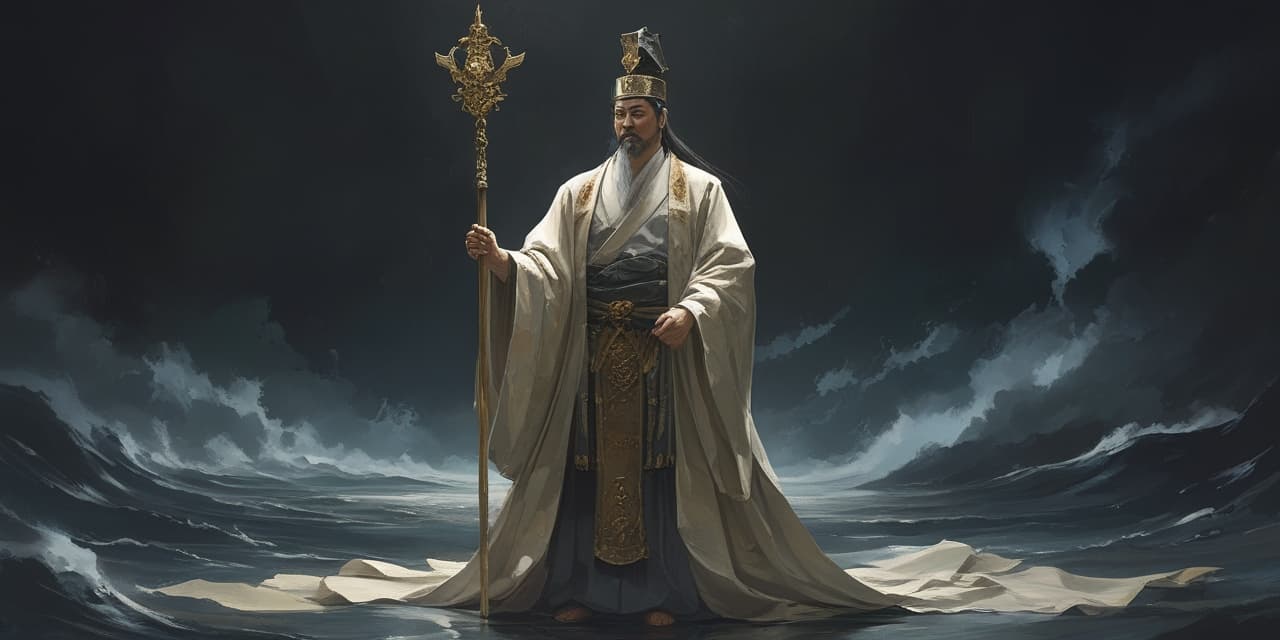
The Father of Creation
Izanagi is the primordial male deity of Japanese myth, who together with his sister and wife Izanami gave shape to the islands of Japan. Standing on the floating bridge of heaven, the pair stirred the chaotic ocean with the jeweled spear Ame-no-nuboko; brine dripping from its tip formed the first island.
His name is usually parsed as "he who invites," paired with Izanami, "she who invites" — the iza- element evoking an inviting or beckoning call. The honorific -no-Mikoto marks his sacred rank among the kami.
After Izanami died birthing the fire kami, Izanagi pursued her into Yomi, the land of the dead, but fled in horror from her rotting form. To cleanse the pollution of death, he bathed in a river — a foundational act of misogi purification still central to Shinto.
From this washing the three "noble children" were born: Amaterasu from his left eye, Tsukuyomi from his right, and Susanoo from his nose. Izanagi then divided the cosmos among them, giving Amaterasu the heavens, Tsukuyomi the night, and Susanoo the seas.
The flight from Yomi is one of the most vivid episodes in the Kojiki: pursued by Izanami and a horde of underworld furies, Izanagi flung down a comb and grapes that transformed into pursuit-slowing fruit, then threw peaches at his attackers before finally blocking the pass Yomotsu Hirasaka with a massive boulder. Speaking across that stone barrier, the couple exchanged their bitter divorce vow — Izanami swearing to kill a thousand of his people each day, Izanagi vowing to cause fifteen hundred births in return — a myth that Shinto tradition reads as the origin of human mortality and birth in balance.
Izanagi's cleansing itself produced far more than the three noble children: as he discarded his staff, belt, robe, and jewelry and washed each part of his body, a whole succession of kami sprang from the pollution being cast off, before the purest deities emerged last from his eyes and nose. This act cemented misogi, ritual purification by water, as one of the foundational rites of Shinto, still practiced by devotees today.
Key Episodes
- Churning the sea — with Izanami, stirs the ocean with Ame-no-nuboko to form the first island, Onogoro
- Death of Izanami — she dies birthing the fire kami Kagutsuchi, whom Izanagi slays in grief and rage
- Flight from Yomi — pursued after seeing Izanami's decaying form, he escapes and seals the underworld pass with a boulder
- The divorce vow — Izanami and Izanagi trade oaths of death and birth across the sealed pass of Yomotsu Hirasaka
- Misogi purification — washing in a river, he generates the three noble children: Amaterasu, Tsukuyomi, and Susanoo
Izanagi stands as the founding patriarch of the Kami pantheon at the center of Japanese mythology.
Common Questions
Are Izanagi and Izanami related?
Yes. In the chronicles they are siblings born of earlier kami, and they become husband and wife to create the world.
How was Amaterasu born?
She emerged from Izanagi's left eye as he purified himself after escaping the underworld.
Why did Izanagi and Izanami separate forever?
After Izanagi fled Yomi and sealed its entrance with a boulder, the two exchanged a mutual vow of death and birth across the stone, ending their marriage and dividing the realms of the living and the dead.

