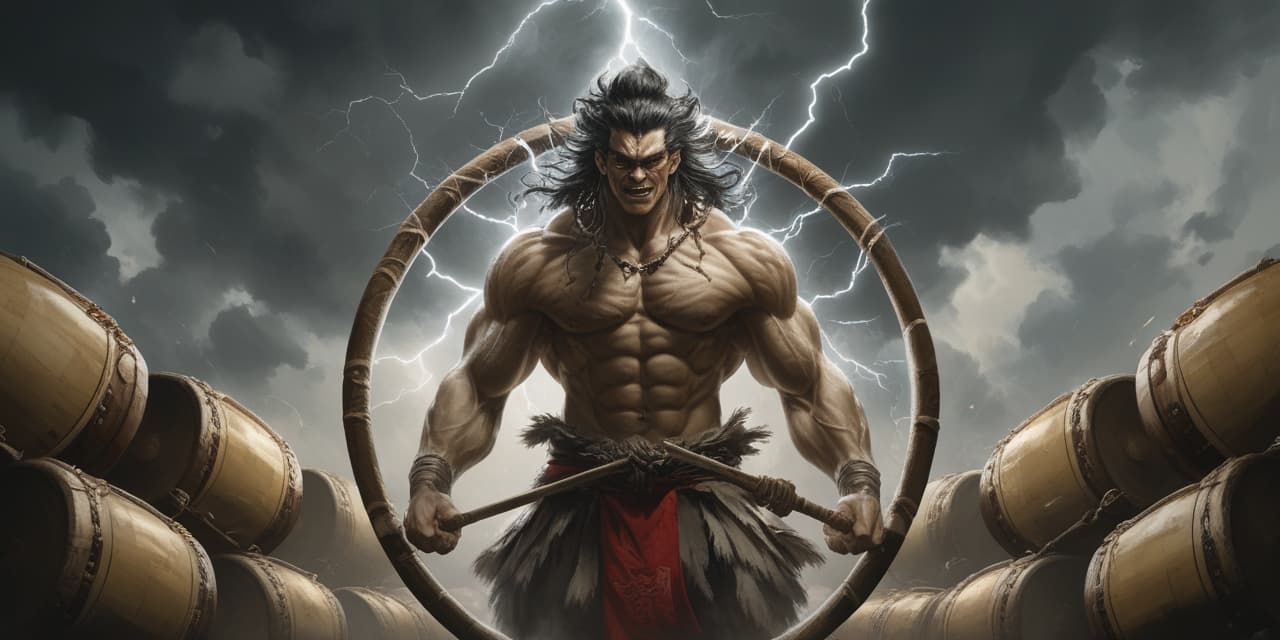
The Drummer of the Storm
Raijin is the fearsome Shinto kami of thunder, lightning, and storms — a wild, demon-like figure often depicted with a circle of taiko drums that he beats to summon crashing thunder across the sky. He belongs to the same tempestuous storm-domain ruled by Susanoo.
His name is plain and elemental: rai means "thunder" and jin means "god" or "deity," giving simply "thunder god." He is also called Kaminari-sama, from kaminari, "thunder," a word literally meaning "the sound of the kami."
In folklore Raijin is paired with the wind god Fujin, the two often shown together as guardians flanking temple gates. Some traditions tie him to the line of creators descended from Izanagi and Izanami, born among the many kami of Yomi.
Though dangerous, Raijin was also revered: his lightning was believed to fertilize rice paddies, so farmers prayed to him for the storms that brought a good harvest.
The Kojiki preserves an older, darker layer of thunder mythology: when Izanami died and decayed in Yomi, eight separate thunder deities, the Yakusa-no-Ikazuchi, are described sprouting from different parts of her corpse — one from her head, others from her chest, belly, and limbs. Many scholars and later folk traditions treat Raijin as an aggregate or descendant of these underworld thunder gods, linking the sky's most feared storm-bringer back to the primordial goddess of death.
Raijin's most famous artistic portrait is the Fūjin Raijin Zu, a pair of folding screens painted by Tawaraya Sotatsu in the early 17th century and now a Japanese National Treasure, showing Raijin and Fujin leaping across a field of gold leaf. He also appears carved among the guardian statues of Kyoto's Sanjusangen-do temple, typically rendered as a green, muscular, oni-like figure with horns and a tiger-skin loincloth — iconography he shares with demons in Japanese folklore.
His thunder and lightning strike down the unwary.
Farmers credit his storms with nourishing the rice harvest.
Names & Depictions
- Raiden(-sama) — "thunder and lightning," a common honorific variant of his name
- Kaminari-sama / Kaminari — "lord thunder," from a word literally meaning "sound of the kami"
- Narukami — "rumbling god," also the title of a classic kabuki play featuring a thunder deity
- Yakusa-no-Ikazuchi — the eight underworld thunder gods born from Izanami's corpse, sometimes linked to Raijin's origin
- Fūjin Raijin Zu — Tawaraya Sotatsu's National Treasure screen painting, his best-known depiction
- Ring of taiko drums — his signature attribute, struck to summon thunderclaps
Raijin's storm domain sits alongside his fellow weather and sky kami of the Kami pantheon within Japanese mythology, overlapping most closely with Susanoo.
Common Questions
How does Raijin make thunder?
He is shown beating a ring of taiko drums, each strike producing a peal of thunder across the heavens.
Who is Raijin usually paired with?
The wind god Fujin; the two storm deities frequently appear together as temple guardians.
What does Raijin look like in art?
He is typically shown as a muscular, horned, oni-like figure in a tiger-skin loincloth, encircled by a ring of drums, most famously in Tawaraya Sotatsu's Fūjin Raijin Zu screen paintings.

