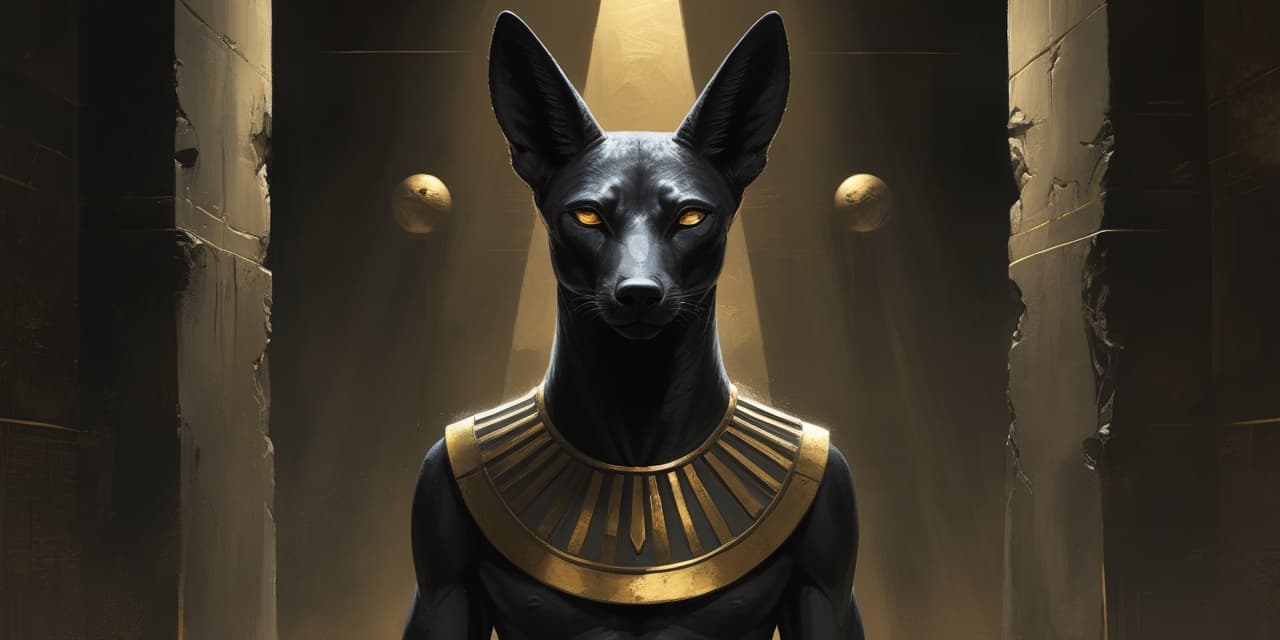
Guardian of the Tomb
Anubis is the jackal-headed god who watches over the dead, presiding over embalming and guiding souls into the afterlife. The Greek name renders the Egyptian Anpu, often connected to a root meaning "royal child" or to the verb for decay that mummification was meant to defeat. His black coloring evoked both the rot of death and the fertile soil of rebirth.
Egyptians chose the jackal because these animals prowled cemeteries; making their image a protector god turned a threat to graves into their guardian.
Weigher of Hearts
Anubis invented mummification when he embalmed the body of the murdered king Osiris, becoming the patron of every embalmer who followed. In the hall of judgment he led the dead before the scales and weighed each heart against the feather of Maat, truth and order.
A heart lighter than the feather earned the soul eternal life with Osiris; a heavy heart was devoured. As "Lord of the Sacred Land," Anubis stood at the threshold between this world and the next, the steady guide whose care made the journey to Horus's ordered realm possible.
Foremost of the Westerners
Before Osiris's cult eclipsed his own in the Middle Kingdom, Anubis held the older title Khentyamentiu, "Foremost of the Westerners," ruling the necropolis in the direction of the setting sun where Egyptians believed the dead resided. His principal cult center was Cynopolis, the "city of the dog," in Upper Egypt, and priests performing mummification wore jackal masks to embody him directly during the embalming rites, according to Britannica's overview of the god.
The Greek writer Plutarch later recorded a variant of Anubis's parentage in which Set's wife Nephthys disguised herself as Isis to conceive him, then hid the child in the marshes out of fear of her husband; Isis found and raised him herself, which is why the god of death remained loyal to Osiris's family despite his father's crime. This account survives in Plutarch's De Iside et Osiride, one of the fullest ancient retellings of the Osiris myth cycle.
Titles & Epithets
- Khentyamentiu — "Foremost of the Westerners," ruler of the necropolis, a title later shared with Osiris
- Imy-ut — "He who is in the place of embalming"
- Neb-ta-djeser — "Lord of the Sacred Land," the desert necropolis
- Tepy-djuef — "He who is upon his mountain," watching cemeteries from the desert cliffs
- Khenty-seh-netjer — "Foremost of the god's booth," overseer of the embalmer's tent
As part of the Ennead's extended family, Anubis occupies a distinct place in Egyptian mythology: the god who makes the passage from death to judgment possible for everyone else.
Common Questions
Why does Anubis have a jackal head?
Jackals scavenged Egyptian cemeteries, so depicting the guardian of the dead as a jackal transformed a graveyard threat into a divine protector.
What was Anubis's role in judgment?
He weighed the deceased's heart against the feather of truth; a balanced heart granted eternal life, while a heavy one was destroyed.
Who were Anubis's parents?
Most myths name him son of Nephthys and Set, secretly raised by Isis after Nephthys concealed the affair from her husband — though earlier Old Kingdom tradition instead made him a son of Ra.

