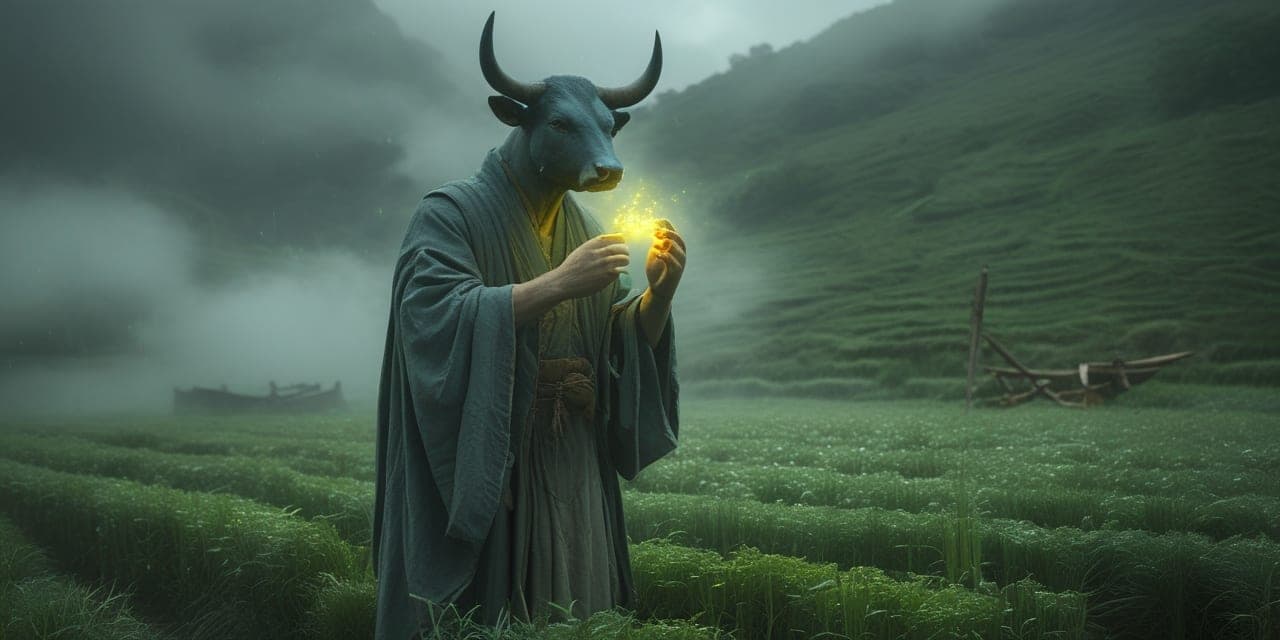
The Divine Farmer
Shennong — "the Divine Farmer" — is one of the legendary figures counted among the Three Sovereigns in most tellings, credited with teaching early humanity how to farm. He's often depicted with a bull's head on a human body, said to have grown to an unusual height shortly after birth, marking him from the start as more than an ordinary ruler.
His central myths concern invention and self-sacrifice in the name of knowledge. Shennong is credited with inventing the plow and the hoe, teaching people to cultivate grain instead of relying on hunting and gathering, and — in the story that made him a patron figure of Chinese medicine — personally tasting hundreds of plants to catalogue their medicinal or poisonous effects, reportedly ingesting dozens of poisons in a single day to learn their antidotes.
One popular legend traces the discovery of tea to Shennong: while boiling water outdoors, leaves from a nearby bush blew into his pot, and he found the resulting brew both refreshing and useful against the toxic effects of the plants he sampled — the mythic origin story most often cited for tea drinking in China.
Shennong is often identified with the Yan Emperor (Yandi), placed just before the Yellow Emperor in China's legendary chronology, and later folk medicine attributes an entire compendium of herbal knowledge to him — the Shennong Ben Cao Jing, a foundational (if much later compiled) text of traditional Chinese pharmacology.
Common Questions
Was Shennong a real historical person?
No — he's a legendary culture hero, not a documented historical ruler. His myths function as origin stories explaining how agriculture and herbal medicine came to exist.
Why is Shennong associated with tea?
Folk legend credits him with discovering tea by accident, when leaves blew into water he was boiling — a myth still commonly cited as tea's origin story in Chinese culture.

