
A Name Generator Before It Was an AI Site
Perchance.org started in 2017 as a place to build random text generators from simple, list-based templates — no coding background needed, just a few text boxes and a "publish" button. Character names, fantasy loot tables, and story prompts were the original use cases. That's easy to forget now, since most people who've heard of Perchance in the last couple of years know it for its free AI image generators, which didn't arrive until years later.
GenName comes at the same problem from the other direction: an AI model that reads context — genre, tone, backstory — instead of a fill-in-the-blank list shuffled at random. Both will hand you a fantasy name in seconds. The gap shows up once your setting gets specific.
Scale Is the Whole Pitch
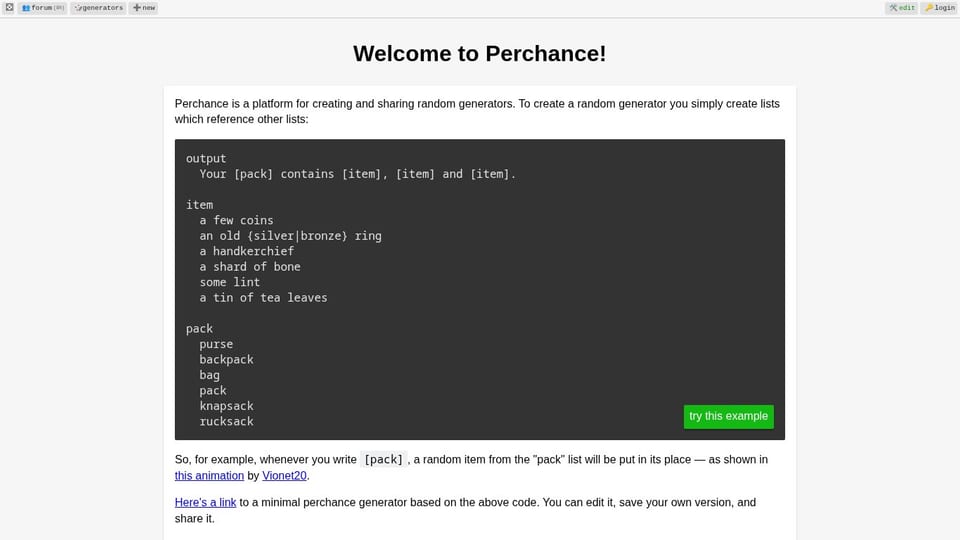
Community authorship is the engine behind Perchance. Anyone can build a generator with its list-based syntax and publish it at a shareable URL, no review process required. That openness is why the platform now hosts thousands of user-made generators, covering D&D names, elvish naming conventions, faction and loot tables, and plenty that have nothing to do with naming at all — text adventures, chatbots, image tools.
It's also free and immediate. No account. No credit card. Revenue comes from ads, not subscriptions. Search for your exact subrace or campaign setting, and there's a real chance somebody already built a generator for it.
What a Borrowed Template Can't Read
Every generator on Perchance is built and maintained by whoever made it, working from their own word list and their own idea of what "elvish" or "orcish" should sound like. Pull the wrong one and you're stuck with a fixed pool that has no idea your character is a disgraced paladin raised by smugglers. There's no field for that. There's only the category the author decided to support.
Upkeep is uneven, too. A generator's quality — and whether it still works at all — depends on whether its author is still around. Abandoned pages don't get flagged. They just sit there next to newer ones, quietly out of date.
- Fast bulk lists: tavern names, loot, NPC titles
- A niche someone already built well
- Names with no backstory attached
- Read a backstory or setting you describe
- Guarantee the author still maintains it
- Check if a name is free as a handle or domain
Give It a Backstory, Get a Different Name
GenName's character name generator takes genre, gender, and era as real inputs, and its fantasy and RPG generators go further, taking an actual backstory rather than a category tag. A dwarven cleric exiled from her clan and a street thief who talks his way out of everything don't just draw from different word pools — they get named differently because the model read what you told it about who they are.
That's the honest trade. Typing a sentence takes longer than clicking a category link somebody else already built. For a name that has to survive an entire campaign, the extra ten seconds is usually worth it.
Side by Side
Community-built, template-based, no signup
- Thousands of user-made generators, most topics covered
- Free, ad-supported, no account needed
- Fixed word pools per generator, no context field
- Quality and upkeep vary by author
Context-first, AI-generated, one maintained tool
- Setting, tone, and backstory as real inputs
- 600+ fantasy and RPG-specific generators
- Handle-availability checks for streamer or gamertag names
- Free to generate, no account required
The Case for Not Switching
None of this makes Perchance worth abandoning. If you already know exactly what your setting's names should sound like, and someone else already built a generator tuned to it, adding a context field is friction you don't need. The sheer range of what the platform hosts — loot tables, invented dialects, entire text-adventure engines — is still broader than anything a single naming tool, GenName included, has reason to replicate.
The list-based model also ages well for names that were never meant to carry weight. A random inn sign doesn't need a backstory. Building one for it would be effort spent on the wrong thing.
A Workflow That Uses Both
Reach for a community generator when you need volume and don't care which specific list it comes from. Reach for context when you're naming someone the table will remember past session one. In practice, that usually means running the disposable NPCs and tavern names through whichever Perchance generator fits, then saving the slower, contextual pass for your party's rival or your own D&D and tabletop RPG names — the names that need to survive more than one story.
Perchance's own history makes the split obvious in hindsight: it was a name generator first, years before "AI" became the pitch on its homepage. GenName picked up that same job with a different set of tools. Neither one retired the other. They just split the work.