
A Good RPG Name Generator Answers a Narrow Question
A D&D or RPG name generator earns its bookmark by doing one thing well: producing a name that sounds right for a specific race, culture, or class without making you scroll through forty options that sound like they belong in a different game entirely. That's a narrower job than it looks. "Fantasy name" covers everything from Tolkien elves to Forgotten Realms tieflings to a homebrew world with its own phonetic rules, and most tools pick one lane and stay in it.
There are dozens of these tools floating around. Five of them show up constantly in GM subreddits and Discord servers, and they solve the problem in genuinely different ways — some lean on decades-old template libraries, some lean on a community of hobbyists building generators for fun, and at least one leans on AI reading your actual campaign context. Here's how each one holds up.
Quick verdict, if you're mid-session and don't have time to read five sections:
- Fantasy Name Generators — fastest path to a race-correct batch, but the name never learns anything about the character wearing it.
- Perchance — widest niche coverage of the five, because thousands of hobbyists built it instead of one team, so quality swings generator to generator.
- Donjon — the pick if you're naming a boss inside a dungeon you're also building, not just naming in isolation.
- Kassoon — narrowest scope of the five, and that's the appeal for a table running straight 5E with no homebrew races.
- GenName — slowest first result, but the only one of the five where backstory actually changes the output.
1. Fantasy Name Generators: The Old Reliable
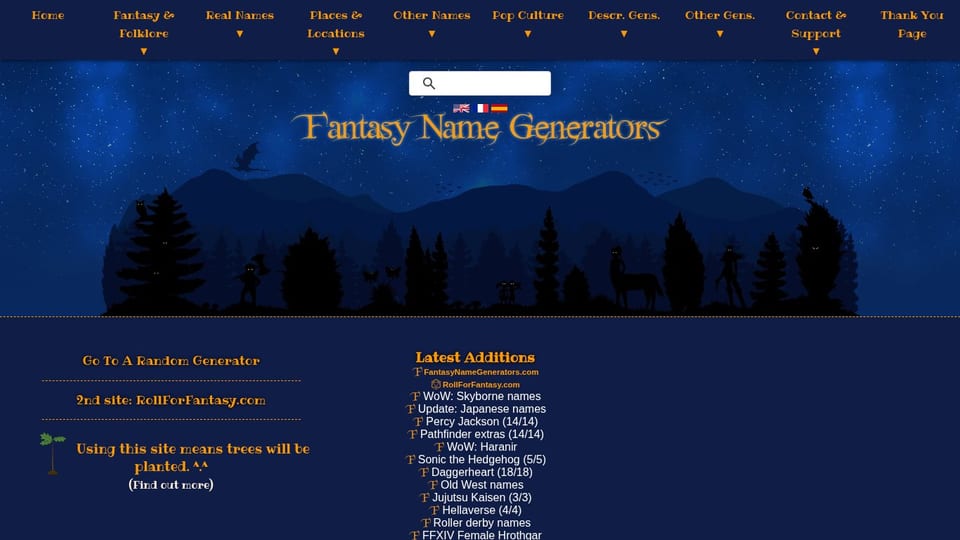
Fantasy Name Generators has been the default bookmark for D&D names for well over a decade, and it shows in the sheer breadth of what's on the site. It runs a dedicated generator for nearly every playable D&D race — dwarves, elves, tieflings, dragonborn, halflings, and the rest — plus generators for dungeons, taverns, and the kind of world-flavor names a splatbook wouldn't cover. Each one sticks closely to that race's established naming conventions, so the output rarely feels out of place at the table.
What it can't do is take a character beyond the category label. Pick "Tiefling names" and you'll get options like Zariel Mordrenn or Isavel Kaal — solid, on-brand, entirely disconnected from whether your tiefling grew up in a noble house or ran from a cult. There's no field for that. The generator gives you a name; the backstory is still on you.
2. Perchance: Whatever the Community Already Built
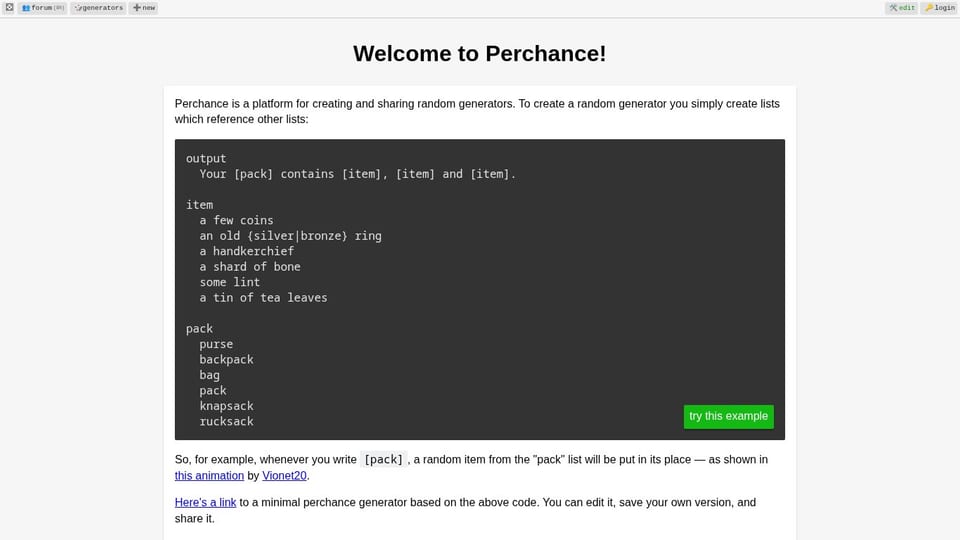
Perchance isn't one generator — it's a platform hosting a huge library of community-made ones, built with a simple templating syntax anyone can learn. For D&D and RPG names specifically, that means there's rarely just one "dwarf name generator." There are a dozen, made by different hobbyists, each with its own quirks and coverage, alongside full random character generators that spit out race, class, and background in one click.
The tradeoff is consistency. Quality varies wildly generator to generator since anyone can publish one, and there's no editorial layer curating which "elf name generator" is actually good versus which one is a first draft someone abandoned in 2022. No signup is required to use any of it, which keeps the friction near zero — you're trading a little quality-control roulette for that convenience.
- Disposable NPCs you'll never see again
- Bulk tavern, shop, and settlement names
- Quick brainstorming before a session
- Weigh a character's class or backstory
- Stay consistent in quality across generators
- Explain why a name fits the culture it claims
3. Donjon: The GM's Toolbox, Not Just a Name Machine
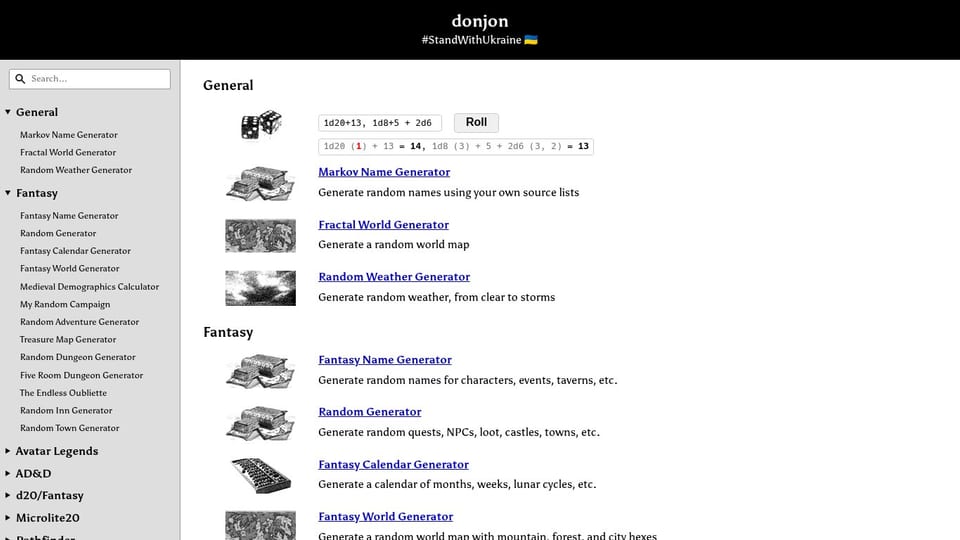
Donjon reads like it was built by someone running a game, not marketing a product — because it was. The site's own copyright notice traces back to 2009, and the interface hasn't chased any redesign trend since; it's dense, text-forward, and fast. Name generators are one small piece of a much bigger toolbox that also builds dungeons, generates NPCs, rolls up encounters, and calculates settlement demographics.
That breadth is the appeal for GMs specifically. You're not bouncing between five tabs to build a dungeon, populate it, and name the boss — Donjon does all three from the same hub. The names themselves lean generic-fantasy rather than D&D-specific; there's a Markov-chain generator that produces phonetically plausible names from a seed list rather than race-tuned output, which is powerful for a homebrew world but less precise if you specifically need "high elf" versus "wood elf."
4. Kassoon: Narrow, D&D-Specific, No Frills
Kassoon keeps its scope tight: it's a D&D-focused toolbox with a name generator that lets you pick race and gender and get a list back, alongside a broader set of character and campaign tools built around 5th Edition specifically. It doesn't try to be a general fantasy-writing site the way Fantasy Name Generators does — everything on it assumes you're sitting down to build or run a D&D game.
That focus is also its ceiling. Because it's scoped to D&D's official races and rules, it won't help much with a homebrew setting that departs from the Player's Handbook, and it doesn't extend to other systems the way a multi-system toolbox does. If you're playing straight 5E and want something built specifically for that table, it's a reasonable, no-nonsense pick.
5. GenName: Names That Know the Character's Story
GenName takes a different starting point than the other four. Instead of picking a race off a list and getting a static pool of pre-written names, you describe the character — race, class, tone, backstory, whatever detail actually matters — and an AI-driven generator produces names shaped by that context rather than pulled from a fixed template. A grizzled dwarf mercenary who deserted his clan and a dwarf paladin still serving one don't just get names from the same word bank; they get names that reflect who they actually are.
The site's D&D & RPG name generators cover the ground you'd expect — races, classes, and several tabletop systems beyond D&D itself, from Pathfinder to Blades in the Dark — grouped so you're not hunting through a flat alphabetical list to find the one built for your table. If you're naming something closer to general fiction than a specific race or class, the character name generator covers that wider net instead.
The honest tradeoff: typing out context takes longer than clicking a category button, and if you just need forty disposable tavern-goer names by Saturday, that extra step is friction you don't need. Where it earns its keep is the character who's going to survive more than one session — the one whose name should sound like it belongs to the backstory you already wrote, not like it got pulled from the same bucket as everyone else's.
Huge race-by-race template library
- Dedicated generator per D&D race
- No signup, instant results
- No context or backstory input
Community and GM-toolbox generators
- Free, fast, no account needed
- Broader RPG tools bundled in (dungeons, NPCs)
- Quality and D&D-specificity vary by tool
Context-aware AI generation
- Backstory, tone, and class as real inputs
- Names differ by character, not just by race label
- Slower first result than a one-click randomizer
How to Choose Between Them
Match the tool to the name's job. A name that exists to fill a tavern for thirty seconds doesn't need context — Fantasy Name Generators, Perchance, or Donjon will hand you a stack of them faster than you can type a sentence. A name attached to a character your players will remember for the whole campaign is a different problem, and that's where feeding in the backstory actually pays off.
Most tables end up using a mix rather than picking one tool forever. Randomize the crowd; write context for the leads. If you're building out an entire party rather than one hero, browsing GenName's RPG name generators by race and class in one pass tends to save more rerolls than starting from five separate random-list tabs.
One more thing worth saying plainly: none of these tools know your table's history. A generator can't tell you that "Astrid" is already the name of somebody's dead sister-character from three campaigns ago. That part's still on you.
Common Questions
Are AI-generated D&D names considered official or canon-safe to publish?
No generator's output is official D&D lore — that only comes from Wizards of the Coast sourcebooks. Names from any of these tools, AI-driven or template-based, are safe to use in home games and original homebrew content you publish yourself, since you're not reproducing copyrighted characters or text.
Why do template-based generators sometimes produce the same name twice?
Template tools recombine a fixed pool of syllables or pre-written names, so running the same category dozens of times will eventually repeat or produce near-duplicates. It's a side effect of a finite word bank, not a bug — the fix is usually just rerolling or switching generators for variety.
Should I use the same generator for every character in my party?
Not necessarily. If your party spans multiple cultures or regions in your setting, a single generator tuned to one naming convention will flatten that variety. Mixing tools — or using one that takes each character's background as input — keeps the party from sounding like they all grew up in the same village.