
A character name generator has one job: hand you a name that fits the genre and hints at who the character is, before you lose the thread of the scene you're writing. That's harder than it sounds, because "character name" means different things depending on the story. A fantasy hero needs invented syllables that feel earned. A sci-fi crew member needs something closer to a call sign. An anime lead needs Japanese-name conventions a reader will recognize on sight. A literary-fiction protagonist just needs to sound like someone you'd pass on the street this year.
Most tools are built around one of those jobs, not all of them. That pattern is worth tracking across the four we're comparing here — Fantasy Name Generators, Perchance, Behind the Name, and GenName's own AI-driven approach — because it explains why the right answer changes depending on what you're actually naming.
Quick verdict, matched to genre:
- Fantasy Name Generators — fastest for a big batch of on-genre fantasy or anime names, with no field for backstory.
- Perchance — widest genre spread of the four, because it's thousands of independent authors instead of one curated tool.
- Behind the Name — the only one built for realistic and historical fiction, since it pulls attested names, not invented ones.
- GenName — the only one that changes the name based on the character's role, not just their genre.
1. Fantasy Name Generators Runs on Sheer Volume
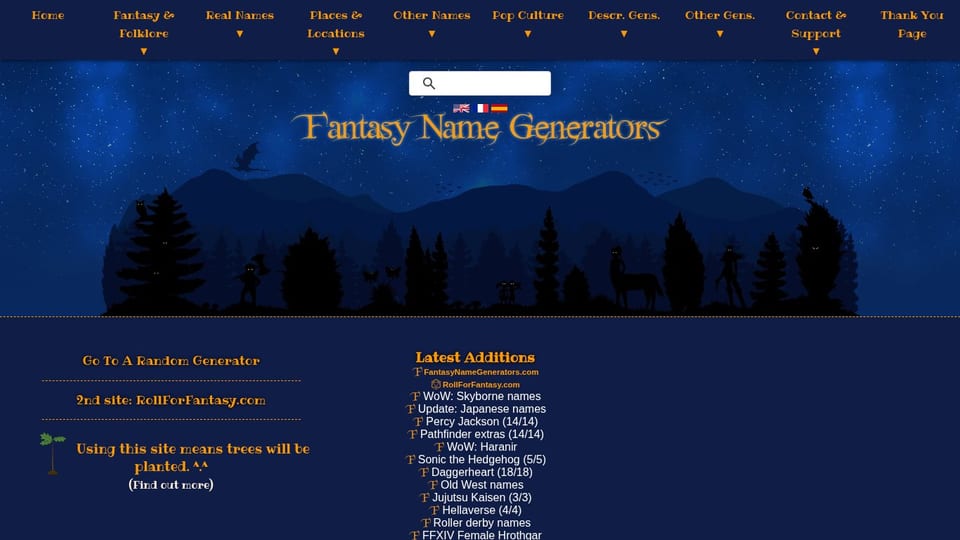
Fantasy Name Generators aggregates more than 1,100 individual generators, organized by race, species, and franchise — human, goblin, elf, orc, plus dedicated pages for Lord of the Rings, Harry Potter, Star Wars, Game of Thrones, and Dragon Age. It also runs generators for anime and manga characters, which puts it closer to genre-breadth than its "fantasy" name suggests.
Click a button and you get ten names. Click again and you get ten more. There's no field for backstory, no way to specify a starting letter, and no way to tell it your character just betrayed their kingdom. It's a lookup table with a refresh button, and it's honest about being exactly that.
That's not a knock. If you need forty tavern-goers named before Saturday's session, a lookup table with a refresh button is precisely the tool you want.
2. Perchance Is a Platform, Not a Single Tool
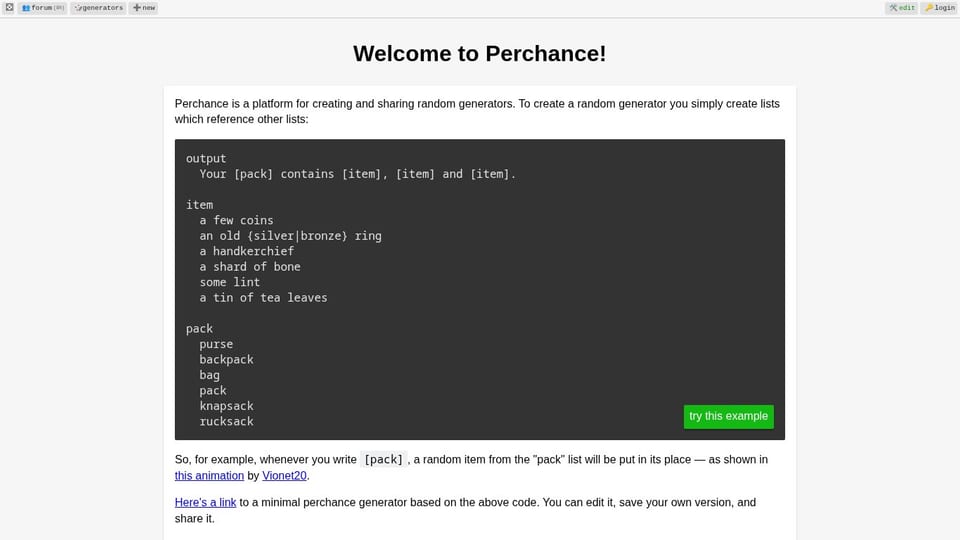
Perchance doesn't operate like the other three. It's a build-your-own-generator platform, and anyone with a free account can publish one. The character name generators that come up when you search "Perchance character names" are community projects, not one curated tool — so quality and scope swing wildly from page to page.
Some are genuinely good: broad genre coverage, audible pronunciation, separate dials for common versus uncommon names. Others are one author's word list from a few years back that never got touched again. You won't know which you landed on until you've already generated a page of names.
The upside is real, though. No sign-up, no cap on regenerating, and a genre spread — fantasy, anime, sci-fi, real-world — that no single curated tool matches, simply because thousands of independent authors are covering thousands of different niches at once.
3. Behind the Name Trades Invention for Attested Names
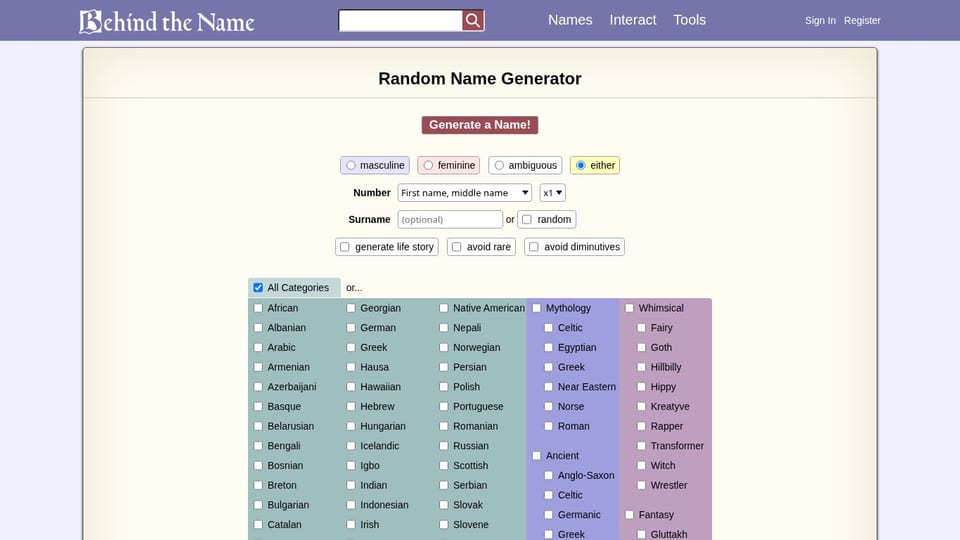
Behind the Name doesn't invent names. It looks them up. Its random name generator pulls from a real database of attested given names and surnames, filtered across roughly 80 categories spanning regions (English, Spanish, Japanese, Arabic, Hindi), mythologies (Celtic, Egyptian, Greek, Norse, Roman), and historical periods (Anglo-Saxon, Germanic, Ancient Greek).
You can set gender to masculine, feminine, ambiguous, or either; pick a format from first-name-only up to a first name plus three middles; toggle surnames; and generate a one-line "life story" for whoever comes out the other end. "Avoid rare" and "avoid diminutives" filters exist too, for when you want a name a reader will recognize as ordinary rather than invented.
That makes it the right choice for exactly one job: realistic or historical fiction, where the name needs to have actually existed somewhere. It's the wrong choice for fantasy or sci-fi. There's no invented-elvish mode here, and there was never meant to be one.
4. Six Genres, One Shared Form (GenName)
That's the whole premise behind GenName's character name generator: a name should follow from who the character is, not just what genre the story happens to be. One form covers fantasy, sci-fi, anime/manga, realistic/modern, video game, and horror/gothic — the same range Fantasy Name Generators and Perchance split across dozens of separate pages — with gender and era layered on as additional dials.
Feed it a grizzled dwarven mercenary and a noble elven scholar, and you don't get two names from the same "fantasy" bucket. You get names shaped by what you told it about each one. That's the trade: a slower first result than a one-click randomizer, in exchange for a name that fits the character instead of just the genre.
It also enforces shape, not just vibe. The generator treats a character name as one of three concrete forms — a single iconic name, a given name plus surname, or a name with an epithet or title — and its default five-name batch is built to mix all three rather than defaulting to one pattern five times over:
Three Approaches, Not Four Products
Zoom out and the four tools collapse into three actual methods. Fantasy Name Generators and Perchance both draw from fixed word lists — one curated by a single team, one crowdsourced across thousands of independent authors. Behind the Name draws from a real-world name database. GenName generates from context. Four tools, three underlying approaches.
Fantasy Name Generators, Perchance
- Instant, unlimited regeneration
- No context or backstory field
- Quality depends on who built the list
Behind the Name
- Attested, historically real names
- ~80 culture and region filters
- No invented fantasy or sci-fi mode
GenName
- Genre, gender, and era as real inputs
- Names shaped by the character described
- Slower first result, closer fit
When Randomization Is Fine — and When It Isn't
Neither approach is wrong. They solve for different moments in the same project.
- You need dozens of disposable NPCs fast
- The name carries no backstory or arc
- You already know the exact sound you want
- You're populating a world, not a cast
- The name has to survive the whole book
- Class, role, or backstory should show in the sound
- You're mixing genres in one cast
- A reader will meet this character more than once
How to Choose, by What You're Actually Naming
Writing high fantasy with invented races? Fantasy Name Generators' race-specific pages are still the fastest way to pull a big batch of on-genre names, provided none of them need to reflect a backstory.
Deep in a homebrew setting that doesn't fit any single template? Perchance's breadth is the advantage — somewhere among its thousands of generators is probably a niche match for whatever you're running. Just check the last-updated date before trusting one for more than a session.
Writing realistic or historical fiction? Behind the Name is the only one of the four with names that actually existed, which matters the moment a reader who knows the culture starts checking.
And if the character needs to hold up across three hundred pages — a protagonist, a rival, the villain who shows up in act three having earned their name — that's the case for feeding context into GenName's character name generator instead of pulling from a list built for someone else's story.
Common Questions
Which character name generator is best for Dungeons & Dragons?
It depends on the character's weight in the campaign. Fantasy Name Generators or Perchance are faster for one-off NPCs and shopkeepers. For a player character or a recurring villain, a tool that factors in class and backstory tends to save more rerolls than a flat random list.
Can Behind the Name generate fantasy or sci-fi names?
Not in the invented sense. Its random generator pulls from real historical and cultural name databases, so it's built for realistic or historical fiction, not for elvish or futuristic names that were never attested anywhere.
Is Perchance safe to use without an account?
Yes — most Perchance generators run without sign-up or login. An account is only needed to build and publish your own generator, not to use one someone else made.
Do AI character name generators replace random generators entirely?
No. A random generator is faster when you don't care about backstory. A context-driven generator only earns its slower pace when the name needs to reflect something specific about the character.