
What Makes a Baby Name Tool Worth Your Time
A baby name tool is worth opening if it does one of two things: hands you real information about a name you already have in mind, or generates fresh candidates you wouldn't have thought of on your own. Most sites try to do both and end up middling at each.
The four tools here split cleanly along that line. Two are reference databases you search. One is a full parenting hub with names as a side feature. One skips the list entirely and generates names from whatever you tell it. Knowing which category you're standing in front of saves you an evening of clicking around.
None of the four is wrong to use. They're just answering different questions. A database answers "what does this name mean and how popular is it." A generator answers "what haven't I thought of yet, given everything I know about this specific kid." Most naming searches actually need both, just not at the same time.
Quick verdict, ranked by how narrow a job each one does:
- Nameberry — deepest database plus a community forum, but the predictive tools sit behind a subscription.
- BabyCenter — names as one feature inside a full pregnancy hub, convenient if you're already there for the due-date tracker.
- Behind the Name — the only one of the four that sources its etymology instead of paraphrasing it.
- GenName — the only one that generates from your criteria instead of filtering a fixed list down to them.
1. Nameberry: The Database Every Parent Ends Up At
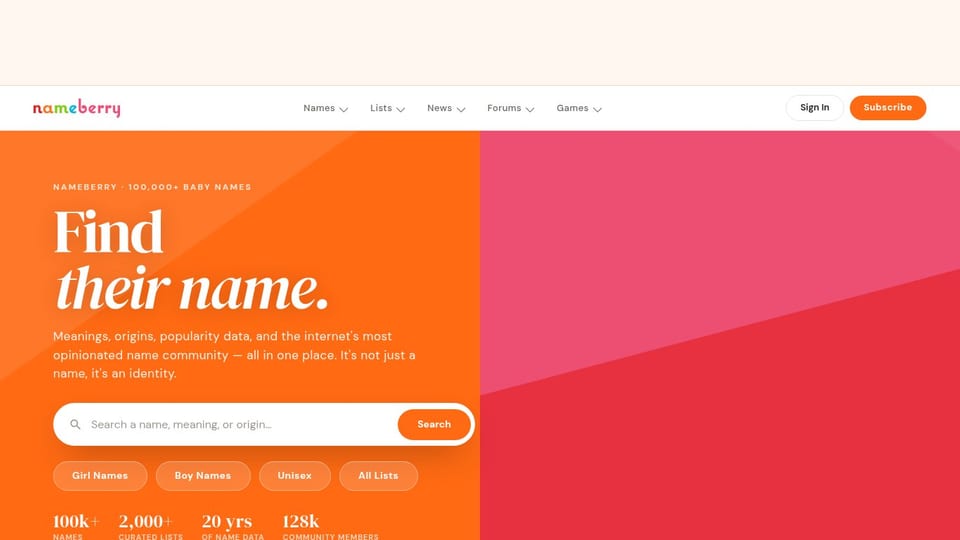
Nameberry's database runs past 70,000 names, and that number is before you touch the forums, the trend columns, or the "name of the day" emails. Search by origin, syllable count, meaning, or popularity trend, and it narrows that pile down fast. The site grew out of Pamela Redmond and Linda Rosenkrantz's 1988 naming book "Beyond Jennifer & Jason," and the editorial voice still shows — opinionated, well-researched, occasionally blunt about a name's staying power.
Where it gets tight is depth versus access. The 70,000-name core reference is free to browse. The predictive popularity tool and quiz-style generators like Namehunter and Baby Name DNA sit behind a $5-a-month subscription. Worth it if you want a popularity forecast out to 2040 — not worth it if you just want to check what "Aria" means.
The forums are worth a separate mention. Thousands of expecting parents post real feedback on shortlists, and that social-proof layer is something a solo database entry can't replicate. It's slow, though. Reading a hundred replies to find the three that address your actual question is its own kind of work.
2. BabyCenter: Names as One Piece of a Bigger Toolkit
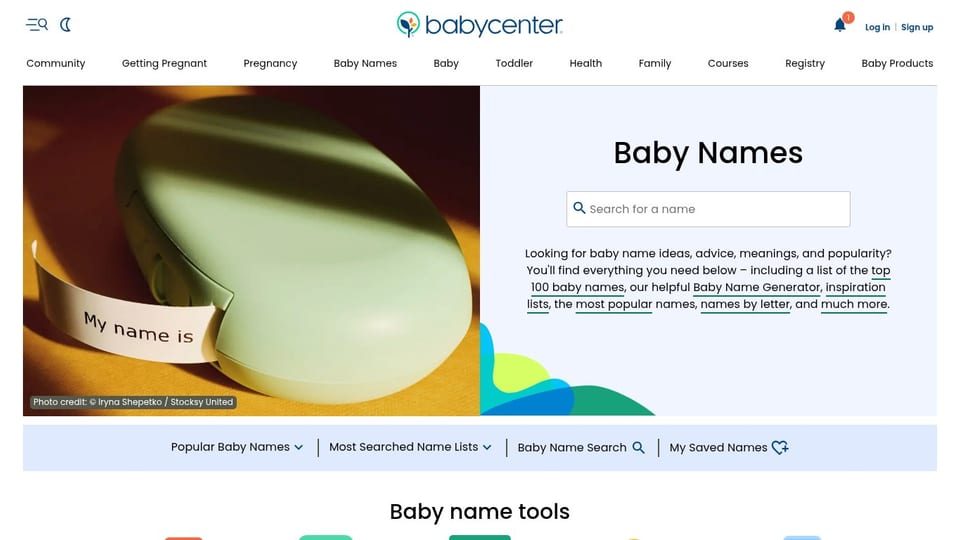
Need a due-date calculator, a week-by-week pregnancy tracker, and a name search in the same browser tab? BabyCenter is built for exactly that. Its name finder lets you search by meaning, origin, and theme, sitting inside a site that pulled roughly 7.5 million visits in August 2026 — a scale that comes from being a full pregnancy and parenting hub, not a names-only destination.
That's also the tradeoff. Names are a feature here, not the product. The entry pages are solid for a quick meaning check, but they don't carry the trend analysis or editorial depth that Nameberry built its reputation on. If you're already tracking your pregnancy on BabyCenter, the name finder is a convenient stop. If names are the whole reason you're there, you'll likely end up somewhere more specialized anyway.
There's a real upside to the bundling, though. You're not juggling five browser tabs and five accounts across your pregnancy. One login covers the due-date math, the symptom tracker, and the shortlist you're building for the nursery door.
3. Behind the Name: Etymology With the Receipts
Ask Nameberry what a name means and you'll get a friendly paragraph. Ask Behind the Name and you'll get a sourced etymology — the actual linguistic root, the language it passed through, and the historical figures who carried it. This is the site to use when you want to know a name is genuinely Old Norse and not just Old-Norse-flavored.
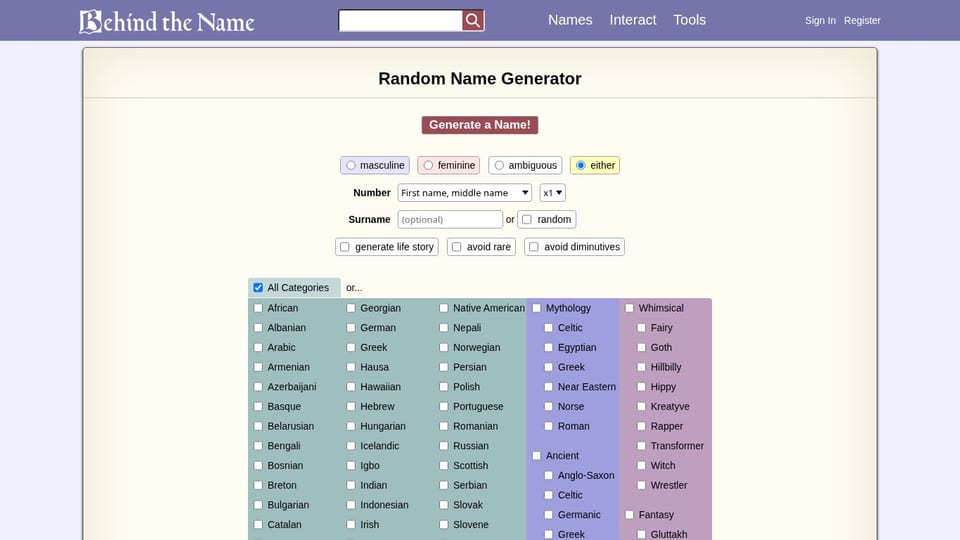
It also has a random name generator, called the Random Renamer, that's more configurable than it looks. You pick a gender option (masculine, feminine, ambiguous, or either), narrow by usage category — dozens of them, from specific cultures to mythology to fictional settings — and toggle things like "avoid rare" or "avoid diminutives." It's a genuinely useful tool for brainstorming within a defined origin. It's less useful if your criteria don't map neatly onto "usage category," which is most of what real parents are actually filtering by: a sibling name to match, a surname to sound good against, a family tradition to nod to without copying outright.
4. GenName: Names Built From What You Actually Tell It
Tell GenName's baby name generator the origin, the style, and the gender you want, and it generates names matched to that context — rather than filtering a fixed list down to what already happens to exist in a database. Origins run from English and Spanish through Japanese, Arabic, Korean, Hawaiian, and a dozen others, each with its own naming conventions built in rather than treated as one generic bucket. Style ranges from classic to modern to deliberately unique, and every name comes back with its meaning and origin attached.
This is the flip side of Behind the Name's approach. Instead of narrowing a fixed list to match your filters, it builds candidates around them directly — useful when what you're picturing doesn't already have a clean entry in someone else's database. It won't hand you the same depth of sourced history a dedicated etymology site will. That's not the job it's doing.
One naming detail worth knowing before you start: some countries regulate this more than Americans expect. Iceland runs an official naming committee that has to approve any given name not already on an existing list, and parents there can genuinely be turned down on their first choice. It's a reminder that "is this name allowed" isn't a rhetorical question everywhere.
How the Four Stack Up
Put the actual numbers next to each other and the differences get concrete fast.
Numbers aside, the four tools split into two different jobs. Three are reference sites you search. One generates fresh candidates from your own criteria.
Editorial reference with trend data and community
- 70,000+ names with meaning and origin
- Popularity trend charts and forums
- Predictive tools behind a $5/mo tier
Etymology-first with sourced citations
- Cited linguistic roots, not paraphrased guesses
- Configurable random name generator
- Filters by usage category, not personal context
Generation-first, matched to your own filters
- Fresh names built from origin, style, and gender
- Meaning and origin attached to every result
- Free, no account or subscription required
How to Choose Based on What You Actually Need
So which one do you actually open first? It depends on whether you're researching a name or hunting for one.
If you already have a name in mind and want its real history, start with Behind the Name or Nameberry. If you have a rough shape — an origin, a style, a sibling name it needs to sit next to — and want fifteen fresh options built around that shape, that's what a baby name generator is actually for. Running it the other direction works too: generate a batch, then verify the meaning of whichever one sticks on a reference site before you commit.
- Verify a meaning claim on a sourced site before repeating it
- Use a generator when your criteria don't fit a search filter
- Cross-check a "rare" pick against real popularity data
- Expect a database to invent a name that isn't already in it
- Treat a generated meaning as sourced without checking it
- Skip saying the name with your surname just because it's trending
Common Questions
Is GenName's baby name generator free to use?
Yes. Generating names doesn't require an account or a subscription — set your filters and get results immediately.
Does Behind the Name have a way to just generate random names?
Yes, it's called the Random Renamer. You can filter by gender and dozens of usage categories, and toggle options like avoiding rare or diminutive forms.
Is BabyCenter's name database as deep as Nameberry's?
BabyCenter doesn't publish a name count, but names are one feature inside a much broader pregnancy and parenting hub. Nameberry is built specifically around its name database, so the entries and trend data run deeper.